Comment
doi: 10.1083/jcb.201603037.
On the move, lysosomal CAX drives Ca2+ transport and motility
Affiliations
- PMID: 27022089
- PMCID: PMC4810312
- DOI: 10.1083/jcb.201603037
Item in Clipboard
Comment
On the move, lysosomal CAX drives Ca2+ transport and motility
J Cell Biol.
.
Abstract
Acidic Ca(2+)stores are important sources of Ca(2+)during cell signaling but little is known about how Ca(2+)enters these stores. In this issue, Melchionda et al. (2016. J. Cell Biol. http://dx.doi.org/10.1083/jcb.201510019) identify a Ca(2+)/H(+)exchanger (CAX) that is required for Ca(2+)uptake and cell migration in vertebrates.
© 2016 Lloyd-Evans.
Figures
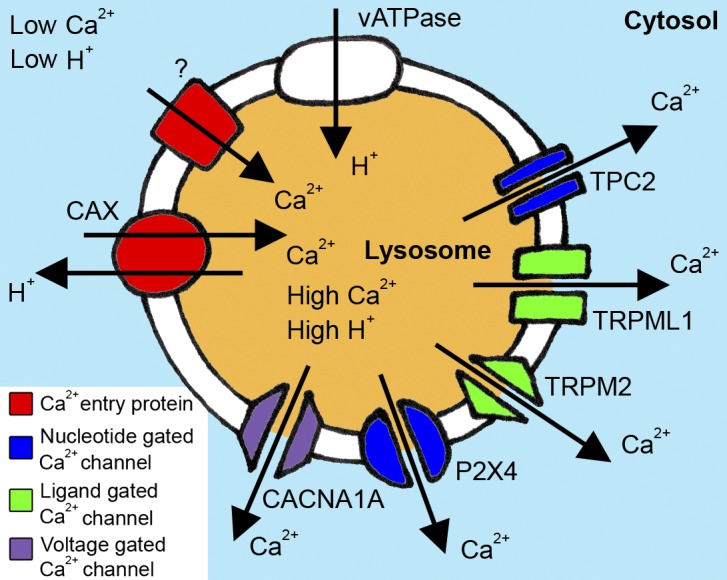
Lysosomal Ca2+ transporters and channels. Our current understanding of lysosomal Ca2+ transport and the proteins that regulate the transport of Ca2+ into and out of the lysosome is heavily stacked in favor of Ca2+ release channels. To date, voltage-gated (CaV2.1/CACNA1A), ligand-gated (TRPML1 and TRPM2), and nucleotide-gated (TPC1, TPC2, and P2X4) channels have all been identified or implicated in lysosomal Ca2+ release (Patel and Cai, 2015). Much less is known about the mechanisms of Ca2+ entry into lysosomes. In lower order organisms, CAX mediates lysosomal Ca2+ entry against the proton gradient. In this issue, Melchionda et al. (2016) provide the first evidence for a mammalian lysosomal Ca2+ uptake mechanism in nonplacental mammals. These findings provide further support for the key role of the lysosome as an intracellular Ca2+ store.
Comment on
-
Ca2+/H+ exchange by acidic organelles regulates cell migration in vivo.J Cell Biol. 2016 Mar 28;212(7):803-13. doi: 10.1083/jcb.201510019. Epub 2016 Mar 21. J Cell Biol. 2016. PMID: 27002171 Free PMC article.
References
-
- Christensen K.A., Myers J.T., and Swanson J.A.. 2002. pH-dependent regulation of lysosomal calcium in macrophages. J. Cell Sci. 115:599–607. - PubMed
Publication types
MeSH terms
Substances
LinkOut - more resources
Full Text Sources
Other Literature Sources
Miscellaneous