


Individualized Household Allergen Intervention Lowers Allergen Level But Not Asthma Medication Use: A Randomized Controlled Trial
- PMID: 27025297
- PMCID: PMC5295498
- DOI: 10.1016/j.jaip.2016.01.016
Individualized Household Allergen Intervention Lowers Allergen Level But Not Asthma Medication Use: A Randomized Controlled Trial
Abstract
Background: Environmental exposures to indoor allergens are major contributors to asthma symptoms, particularly in inner cities. The effectiveness of household allergen reduction as an adjunct to National Asthma Education Prevention Program guideline-based pharmacologic therapy in asthma has not been prospectively studied.
Objective: To study the effect of individualized allergen reduction on ability to reduce asthma pharmacologic therapy over 40 weeks.
Methods: We performed a randomized controlled trial to determine the effect of multifaceted indoor allergen avoidance measures on the ability to reduce asthma controller therapy in adults and children residing in New York City who were both sensitized and exposed to at least 1 indoor allergen. Asthma treatment and control were optimized in all subjects before randomization.
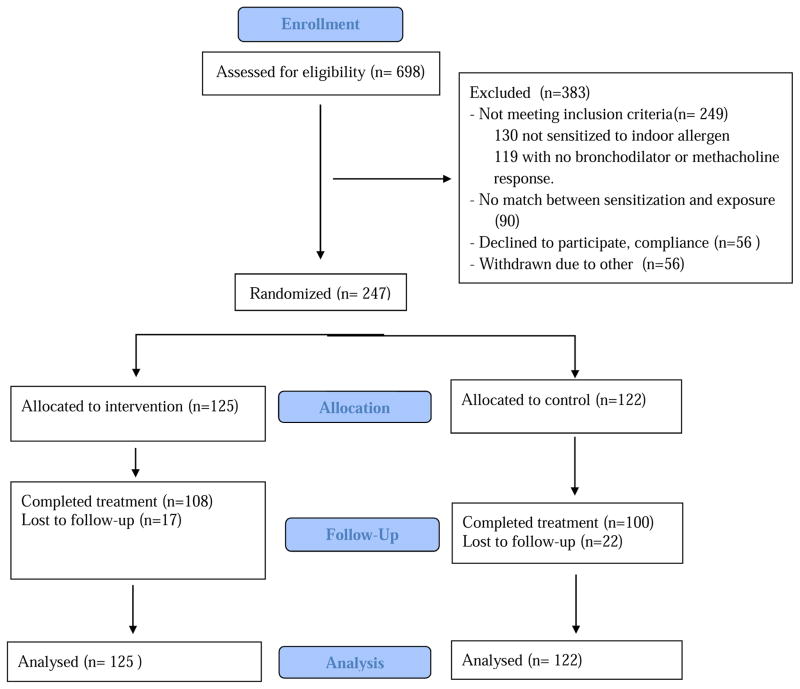
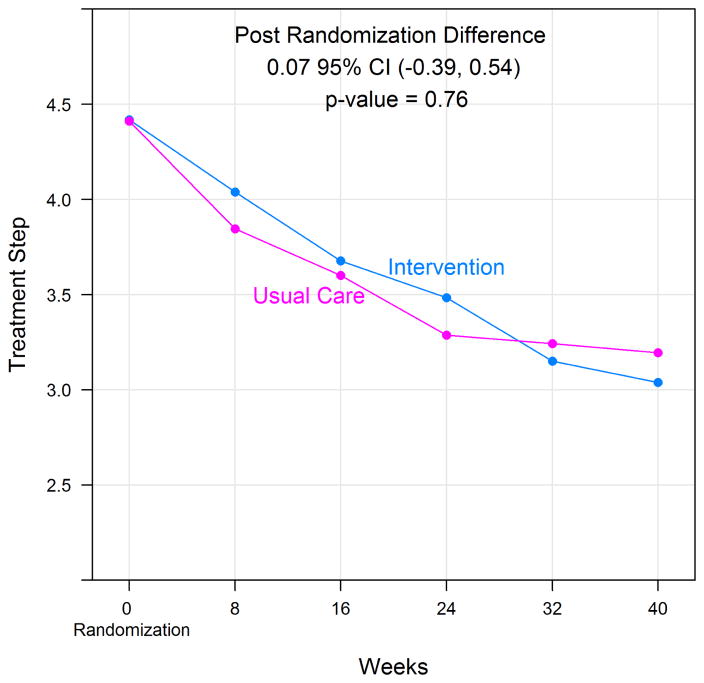
Results: A total of 125 subjects were randomized to receive individualized household allergen reduction and 122 received a sham intervention. Subjects in the intervention group significantly reduced all measured allergen levels (cat, dog, dust mite allergens in the bedroom, cockroach and mouse allergens in the kitchen and bedroom); those in the control group reduced only dust mite and mouse allergens in the bedroom and cockroach allergen in the kitchen. Participants in the intervention arm reduced National Asthma Education Prevention Program-based therapy from step 4.4 at randomization to 3.50 postintervention (range, 0-6); participants in the control arm reduced medication from step 4.4 to 3.4 (P = .76). There were no differences in other measured asthma outcomes.
Conclusions: Targeted allergen avoidance measures do not allow for reduction in asthma pharmacologic therapy compared with usual care in patients already receiving optimal controller therapy.
Keywords: Allergens; Asthma; Asthma controller; Cockroach; Mouse.
Copyright © 2016 American Academy of Allergy, Asthma & Immunology. Published by Elsevier Inc. All rights reserved.
Figures
Comment in
-
Can We Clear the Air?J Allergy Clin Immunol Pract. 2016 Jul-Aug;4(4):680-1. doi: 10.1016/j.jaip.2016.04.017. J Allergy Clin Immunol Pract. 2016. PMID: 27393779 No abstract available.
References
-
- Chew GL, Perzanowski MS, Canfield SM, Goldstein IF, Mellins RB, Hoepner LA, et al. Cockroach allergen levels and associations with cockroach-specific IgE. The Journal of allergy and clinical immunology. 2008 Jan;121(1):240–5. - PubMed
-
- Rosenstreich DL, Eggleston P, Kattan M, Baker D, Slavin RG, Gergen P, et al. The role of cockroach allergy and exposure to cockroach allergen in causing morbidity among inner-city children with asthma. The New England journal of medicine. 1997 May 8;336(19):1356–63. - PubMed
-
- Gruchalla RS, Pongracic J, Plaut M, Evans R, 3rd, Visness CM, Walter M, et al. Inner City Asthma Study: relationships among sensitivity, allergen exposure, and asthma morbidity. The Journal of allergy and clinical immunology. 2005 Mar;115(3):478–85. - PubMed
-
- Morgan WJ, Crain EF, Gruchalla RS, O'Connor GT, Kattan M, Evans R, 3rd, et al. Results of a home-based environmental intervention among urban children with asthma. The New England journal of medicine. 2004 Sep 9;351(11):1068–80. - PubMed
Publication types
MeSH terms
Substances
Grants and funding
LinkOut - more resources
Full Text Sources
Other Literature Sources
Medical
Miscellaneous
