


Safety, efficacy and clinical generalization of the STAR protocol: a retrospective analysis
- PMID: 27025951
- PMCID: PMC4811843
- DOI: 10.1186/s13613-016-0125-9
Safety, efficacy and clinical generalization of the STAR protocol: a retrospective analysis
Abstract
Background: The changes in metabolic pathways and metabolites due to critical illness result in a highly complex and dynamic metabolic state, making safe, effective management of hyperglycemia and hypoglycemia difficult. In addition, clinical practices can vary significantly, thus making GC protocols difficult to generalize across units.The aim of this study was to provide a retrospective analysis of the safety, performance and workload of the stochastic targeted (STAR) glycemic control (GC) protocol to demonstrate that patient-specific, safe, effective GC is possible with the STAR protocol and that it is also generalizable across/over different units and clinical practices.
Methods: Retrospective analysis of STAR GC in the Christchurch Hospital Intensive Care Unit (ICU), New Zealand (267 patients), and the Gyula Hospital, Hungary (47 patients), is analyzed (2011-2015). STAR Christchurch (BG target 4.4-8.0 mmol/L) is also compared to the Specialized Relative Insulin and Nutrition Tables (SPRINT) protocol (BG target 4.4-6.1 mmol/L) implemented in the Christchurch Hospital ICU, New Zealand (292 patients, 2005-2007). Cohort mortality, effectiveness and safety of glycemic control and nutrition delivered are compared using nonparametric statistics.
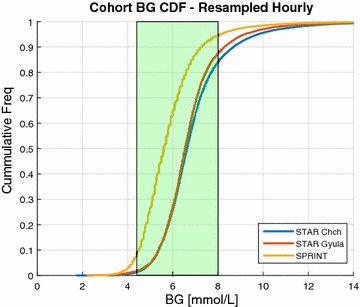
Results: Both STAR implementations and SPRINT resulted in over 86 % of time per episode in the blood glucose (BG) band of 4.4-8.0 mmol/L. Patients treated using STAR in Christchurch ICU spent 36.7 % less time on protocol and were fed significantly more than those treated with SPRINT (73 vs. 86 % of caloric target). The results from STAR in both Christchurch and Gyula were very similar, with the BG distributions being almost identical. STAR provided safe GC with very few patients experiencing severe hypoglycemia (BG < 2.2 mmol/L, <5 patients, 1.5 %).
Conclusions: STAR outperformed its predecessor, SPRINT, by providing higher nutrition and equally safe, effective control for all the days of patient stay, while lowering the number of measurements and interventions required. The STAR protocol has the ability to deliver high performance and high safety across patient types, time, clinical practice culture (Christchurch and Gyula) and clinical resources.
Keywords: Glycemic control; Hyperglycemia; Hypoglycemia; Intensive care unit; Model-based; Patient-specific; Personalized; Stochastic; Targeted.
Figures
References
LinkOut - more resources
Full Text Sources
Other Literature Sources
Miscellaneous
