


Perchlorate in Water Supplies: Sources, Exposures, and Health Effects
- PMID: 27026358
- PMCID: PMC4834222
- DOI: 10.1007/s40572-016-0087-y
Perchlorate in Water Supplies: Sources, Exposures, and Health Effects
Abstract
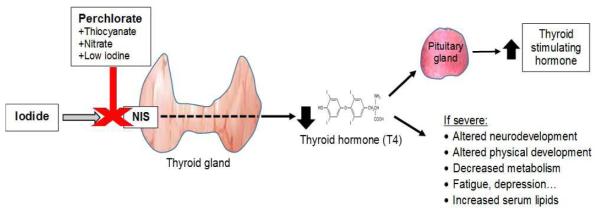
Perchlorate exposure occurs from ingestion of natural or man-made perchlorate in food or water. Perchlorate is used in a variety of industrial products including missile fuel, fireworks, and fertilizers, and industrial contamination of drinking water supplies has occurred in a number of areas. Perchlorate blocks iodide uptake into the thyroid and decreases the production of thyroid hormone, a critical hormone for metabolism, neurodevelopment, and other physiologic functions. Occupational and clinical dosing studies have not identified clear adverse effects, but may be limited by small sample sizes, short study durations, and the inclusion of mostly healthy adults. Expanding evidence suggests that young children, pregnant women, fetuses, and people co-exposed to similarly acting agents may be especially susceptible to perchlorate. Given the ubiquitous nature of perchlorate exposure, and the importance of thyroid hormone for brain development, studying the impact of perchlorate on human health could have far-reaching public health implications.
Keywords: Drinking water; Iodine; Perchlorate; Thyroid.
Figures
References
-
- ATSDR . Toxicological Profile for Perchlorates. Agency for Toxic Substances and Disease Registry. Atlanta, GA: 2008. Available from: http://www.atsdr.cdc.gov/toxprofiles/tp162-c3.pdf. - PubMed
-
- Tellez Tellez R, Michaud Chacon P, Reyes Abarca C, Blount BC, Van Landingham CB, Crump KS, et al. Long-term environmental exposure to perchlorate through drinking water and thyroid function during pregnancy and the neonatal period. Thyroid. 2005;15(9):963–75. - PubMed
-
- Rao B, Anderson TA, Orris GJ, Rainwater KA, Rajagopalan S, Sandvig RM, et al. Widespread natural perchlorate in unsaturated zones of the southwest United States. Environ Sci Technol. 2007;41(13):4522–8. - PubMed
-
- Blount BC, Valentin-Blasini L. Biomonitoring as a method for assessing exposure to perchlorate. Thyroid. 2007;17(9):837–41. - PubMed
-
- Blount BC, Valentin-Blasini L, Osterloh JD, Mauldin JP, Pirkle JL. Perchlorate exposure of the US population, 2001-2002. J Expo Sci Environ Epidemiol. 2007;17(4):400–7. - PubMed
Publication types
MeSH terms
Substances
Grants and funding
LinkOut - more resources
Full Text Sources
Other Literature Sources
Medical
