


Enteric disease episodes and the risk of acquiring a future sexually transmitted infection: a prediction model in Montreal residents
- PMID: 27026613
- PMCID: PMC11960768
- DOI: 10.1093/jamia/ocw026
Enteric disease episodes and the risk of acquiring a future sexually transmitted infection: a prediction model in Montreal residents
Abstract
Objective: The sexual transmission of enteric diseases poses an important public health challenge. We aimed to build a prediction model capable of identifying individuals with a reported enteric disease who could be at risk of acquiring future sexually transmitted infections (STIs).
Materials and methods: Passive surveillance data on Montreal residents with at least 1 enteric disease report was used to construct the prediction model. Cases were defined as all subjects with at least 1 STI report following their initial enteric disease episode. A final logistic regression prediction model was chosen using forward stepwise selection.
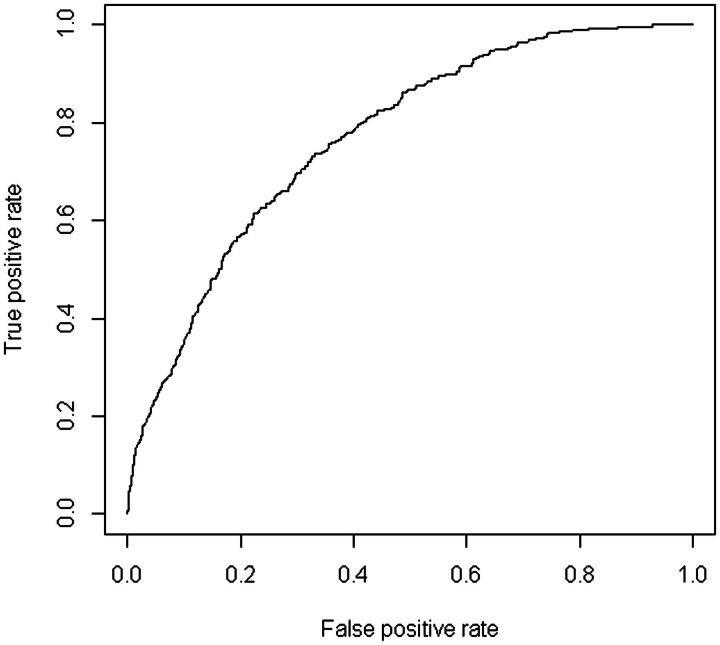
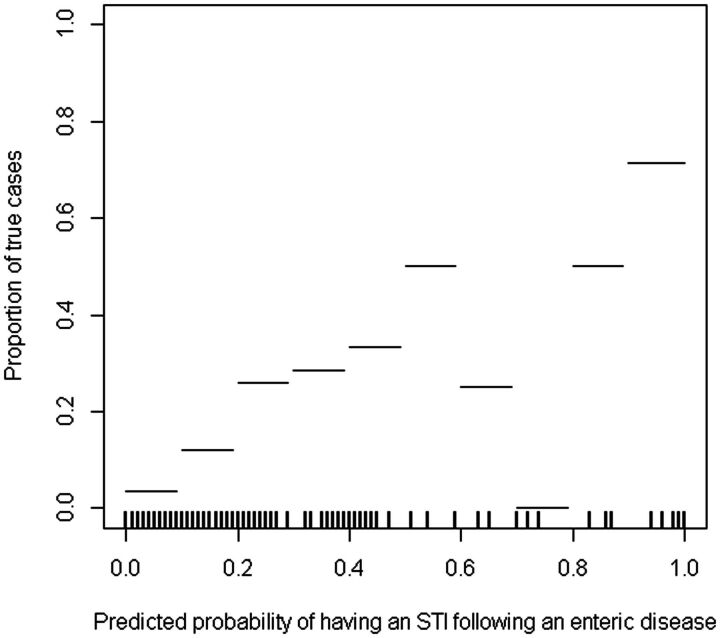
Results: The prediction model with the greatest validity included age, sex, residential location, number of STI episodes experienced prior to the first enteric disease episode, type of enteric disease acquired, and an interaction term between age and male sex. This model had an area under the curve of 0.77 and had acceptable calibration.
Discussion: A coordinated public health response to the sexual transmission of enteric diseases requires that a distinction be made between cases of enteric diseases transmitted through sexual activity from those transmitted through contaminated food or water. A prediction model can aid public health officials in identifying individuals who may have a higher risk of sexually acquiring a reportable disease. Once identified, these individuals could receive specialized intervention to prevent future infection.
Conclusion: The information produced from a prediction model capable of identifying higher risk individuals can be used to guide efforts in investigating and controlling reported cases of enteric diseases and STIs.
Keywords: decision support techniques; food-borne diseases; public health surveillance; sexually transmitted diseases.
© The Author 2016. Published by Oxford University Press on behalf of the American Medical Informatics Association. All rights reserved. For Permissions, please email: journals.permissions@oup.com.
Conflict of interest statement
None.
Figures
References
-
- Most H . Manhattan: “a tropic isle"? Am J Trop Med Hyg. 1968. ; 17 : 333 – 354 . - PubMed
-
- Salit IE Khairnar K Gough K Pillai DR . A possible cluster of sexually transmitted Entamoeba histolytica: genetic analysis of a highly virulent strain . Clin Infect Dis. 2009. ; 49 : 346 – 353 . - PubMed
-
- Hung CC Chang SY Ji DD . Entamoeba histolytica infection in men who have sex with men . Lancet Infect Dis. 2012. ; 12 : 729 – 736 . - PubMed
Publication types
MeSH terms
LinkOut - more resources
Full Text Sources
Other Literature Sources
Medical
