


Patterns of Chinese medicine use in prescriptions for treating Alzheimer's disease in Taiwan
- PMID: 27028311
- PMCID: PMC4810525
- DOI: 10.1186/s13020-016-0086-9
Patterns of Chinese medicine use in prescriptions for treating Alzheimer's disease in Taiwan
Abstract
Background: Certain Chinese medicine (CM) herbs and acupuncture may protect against Alzheimer's disease (AD). However, there is a lack of research regarding the use of CM in patients with AD. The aim of this study was to investigate CM usage patterns in patients with AD, and identify the Chinese herbal formulae most commonly used for AD.
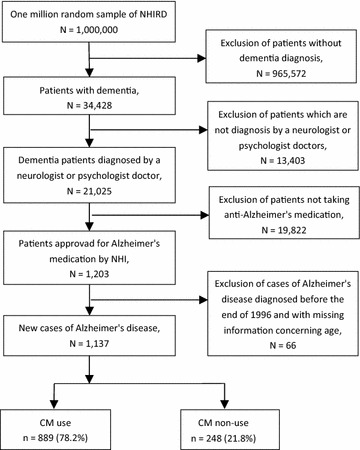
Methods: This retrospective, nationwide, population-based cohort study was conducted using a randomly sampled cohort of one million patients, selected from the National Health Insurance Research Database between 1997 and 2008 in Taiwan. CM use and the top ten most frequently prescribed formulae for treating AD were assessed, including average formulae dose and frequency of prescriptions. Demographic characteristics, including sex, age and insurance level were examined, together with geographic location. Existing medical conditions with the behavioral and psychological symptoms of dementia, and medications associated with CM were also examined. Factors associated with CM use were analyzed by multiple logistic regressions.
Results: The cohort included 1137 newly diagnosed AD patients, who were given conventional treatment for AD between 1997 and 2008. Among them, 78.2 % also used CM treatments, including Chinese herbal remedies, acupuncture and massage manipulation. Female patients (aOR 1.57 with 95 % CI 1.16-2.13) and those living in urban areas (aOR 3.00 with 95 % CI 1.83-4.90 in the middle of Taiwan) were more likely to use CM. After adjusting for demographic factors, AD patients suffering from the behavioral and psychological symptoms of dementia were more likely to seek CM treatment than those with no symptoms (aOR 2.26 with 95 % CI 1.48-3.43 in patients suffering more than three symptoms). Bu-Zhong-Yi-Qi-Tang and Ji-Sheng-Shen-Qi-Wan were the two formulae most frequently prescribed by CM practitioners for treating AD.
Conclusion: Most people with AD who consumed herbal products used supplement qi, nourish the blood, and quiet the heart spirit therapy as complementary medicines to relieve AD-related symptoms, in addition to using standard anti-AD treatments.
Figures
References
-
- McShane R, Areosa Sastre A, Minakaran N. Memantine for dementia. Cochrane Database Syst Rev. 2006;(2):CD003154. - PubMed
LinkOut - more resources
Full Text Sources
Other Literature Sources
Medical
Molecular Biology Databases
