Review
. 2016 Jul;29(3):429-47.
doi: 10.1128/CMR.00090-15.

The Point-of-Care Laboratory in Clinical Microbiology

Affiliations
Review

The Point-of-Care Laboratory in Clinical Microbiology

Michel Drancourt et al. Clin Microbiol Rev. 2016 Jul.

Abstract

Point-of-care (POC) laboratories that deliver rapid diagnoses of infectious diseases were invented to balance the centralization of core laboratories. POC laboratories operate 24 h a day and 7 days a week to provide diagnoses within 2 h, largely based on immunochromatography and real-time PCR tests. In our experience, these tests are conveniently combined into syndrome-based kits that facilitate sampling, including self-sampling and test operations, as POC laboratories can be operated by trained operators who are not necessarily biologists. POC laboratories are a way of easily providing clinical microbiology testing for populations distant from laboratories in developing and developed countries and on ships. Modern Internet connections enable support from core laboratories. The cost-effectiveness of POC laboratories has been established for the rapid diagnosis of tuberculosis and sexually transmitted infections in both developed and developing countries.


Figures

FIG 1
FIG 1
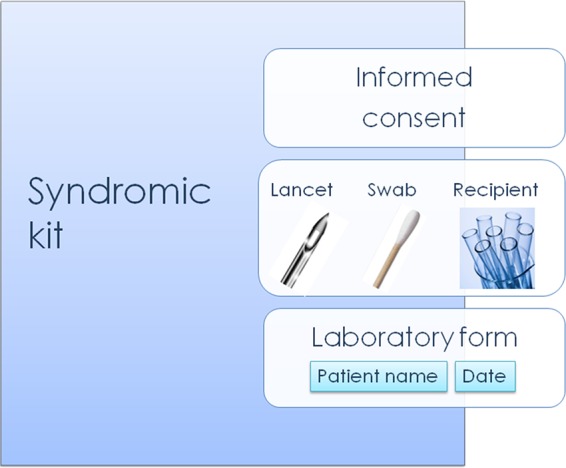
Syndromic kit for POC testing containing materials for clinical specimen collection, self-collection, and paperwork.
FIG 2
FIG 2
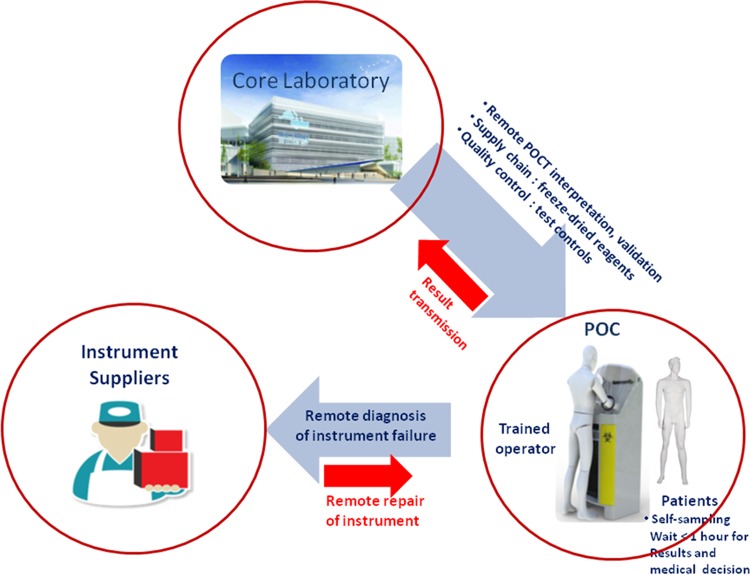
The POC laboratory in its environment: patients, core laboratory and instruments, software, and reagent suppliers.
FIG 3
FIG 3
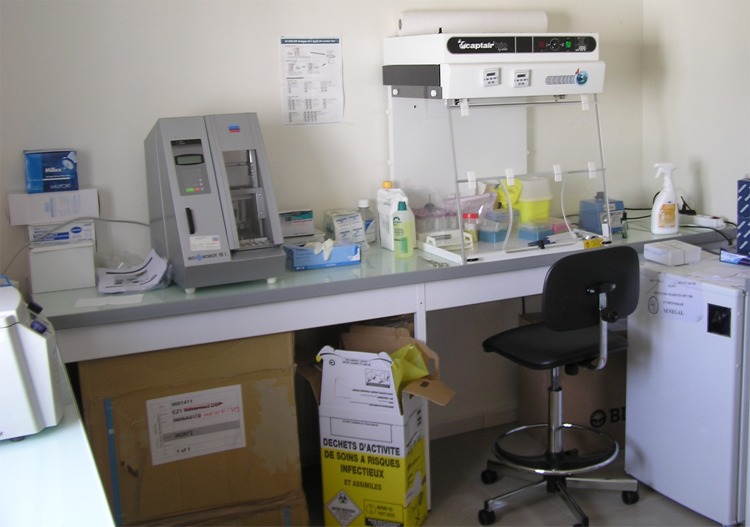
Remote POC testing in a rural village in Senegal. The POC test was run using its own source of electricity. (Reprinted from reference .)
None
None
None
None

References

    1. Fournier PE, Drancourt M, Colson P, Rolain JM, La Scola B, Raoult D. 2013. Modern clinical microbiology: new challenges and solutions. Nat Rev Microbiol 11:574–585. doi:10.1038/nrmicro3068. - DOI - PMC - PubMed
    1. Bossuyt X, Verweire K, Blanckaert N. 2007. Laboratory medicine: challenges and opportunities. Clin Chem 53:1730–1733. doi:10.1373/clinchem.2007.093989. - DOI - PubMed
    1. Nugent RP, Krohn MA, Hillier SL. 1991. Reliability of diagnosing bacterial vaginosis is improved by a standardized method of gram stain interpretation. J Clin Microbiol 29:297–301. - PMC - PubMed
    1. Sokhna C, Mediannikov O, Fenollar F, Bassene H, Diatta G, Tall A, Trape JF, Drancourt M, Raoult D. 2013. Point-of-care laboratory of pathogen diagnosis in rural Senegal. PLoS Negl Trop Dis 7:e1999. doi:10.1371/journal.pntd.0001999. - DOI - PMC - PubMed
    1. Bouricha M, Samad MA, Levy PY, Raoult D, Drancourt M. 2014. Point-of-care syndrome-based, rapid diagnosis of infections on commercial ships. J Travel Med 21:12–16. doi:10.1111/jtm.12090. - DOI - PubMed

Substances