. 2016 Jun;60(6):1470-81.
doi: 10.1002/mnfr.201600013. Epub 2016 Apr 21.

Prevention of hormonal breast cancer by dietary jamun

Affiliations

Prevention of hormonal breast cancer by dietary jamun

Farrukh Aqil et al. Mol Nutr Food Res. 2016 Jun.

Abstract

Scope: Syzygium cumini (jamun) is perhaps the only berry that has the diversity of anthocyanidins of blueberry and bilberry and the abundance of ellagitannins/ellagic acid of black raspberry. Here, we report the potential of jamun against 17β-estrogen-mediated breast cancer and the role of miRNAs and other targets in disease inhibition.

Methods and results: Female August-Copenhagen Irish rats were given AIN-93M diet or diet supplemented with jamun. Two weeks later, animals received 17β-estradiol and were palpated weekly for the mammary tumors. At the end of 26 weeks, the jamun-diet significantly delayed the first tumor appearance by 21 days, and reduced the tumor incidence (65% versus 96%), tumor burden (313 ± 95 versus 661 ± 123 mm(3) ) and tumor multiplicity (1.8 ± 0.3 versus 4.2 ± 0.4 tumors/rat) compared to control. The experimental diet significantly reduced the estrogen-associated growth of pituitary prolactinomas, circulating prolactin and estradiol levels and offset estrogen-associated increases in mammary cell-proliferation, estrogen receptor-alpha (ER-α), and cyclinD1. miRNAs that were either overexpressed (miR-182 and miR-375) or underexpressed (miR-127 and miR-206) following estrogen-treatment were significantly protected by jamun diet.

Conclusions: Together, our data show that jamun significantly offset estrogen-mediated alterations in mammary cell-proliferation, ER-α, cyclinD1, and candidate miRNAs, and that the modulation of these biomarkers correlated with a reduction in mammary carcinogenicity.

Keywords: ACI rats; Breast cancer; Estradiol; Jamun pulp; miRNAs.


Conflict of interest statement

Conflict of interests

The authors have declared no conflict of interest.

Figures

Figure 1
Figure 1
Photographs of blueberry (BB), black raspberry (BRB) and jamun berries shown along with the types and amounts of their anthocyanidins. Anthocyanidin structure is shown on the right side. In addition to ellagic acid (EA), jamun pulp powder contains anthocyanidins similarly as found in BB (delphinidin, cyanidin, peonidin, petunidin, and malvidin), however, their relative ratios are different. BRB almost exclusively contains cyanidin and EA.
Figure 2
Figure 2
Average weekly body weight gain and diet consumption. (A) Body weights of rats receiving either control diet or diet supplemented with 5% jamun pulp powder. Animals were weighed weekly and average body weight is presented. SD (≤7%) is not included for clarity. (B) Diet consumption by the ACI rats fed control diet, and diet supplemented with jamun, with and without estrogen treatment during the course of the study.
Figure 3
Figure 3
Effect of diet supplemented with 5% jamun pulp powder on tumor incidence (A), tumor volume (B), and tumor multiplicity (C). Female ACI rats were challenged with silastic implants of E2 and tumors were palpated after twelve weeks of E2 implantation. Tumor incidence was calculated from the weekly palpation report and analyzed using a nonparametric log-rank test. Asterisk indicates significant difference between animals fed with control diet versus experimental diet. Tumor volume (B) and tumor multiplicity (C) were calculated at the time of euthanasia and analyzed using unpaired two-tailed Student’s t-test. Asterisk indicate the significant differences of jamun diet in reducing both, the tumor volume and tumor multiplicity when compared with the E2-treated control. *p <0.05; **p <0.01; ***p <0.001.
Figure 4
Figure 4
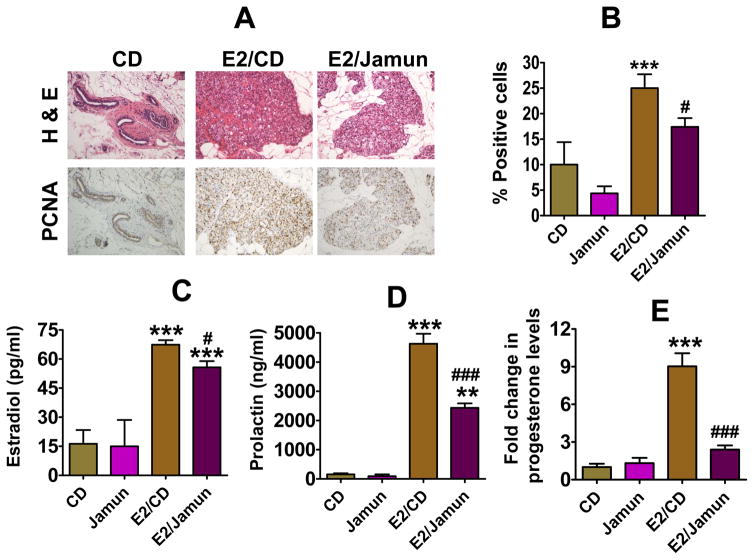
Antiproliferative effects of the control diet (CD) and diet supplemented with jamun pulp powder with and without estrogen (E2) treatment evaluated by immunohistochemical staining for Proliferating Cell Nuclear Antigen (PCNA) at euthanasia. Photomicrographs are 20× magnification of normal and hyperplastic mammary tissues (A); corresponding graph representing the quantitation of deeply stained cells for PCNA (B). Circulating estradiol (A), prolactin (B), and progesterone (C) levels measured at euthanasia in rats fed control diet or diet supplemented with jamun. Values represent average ± SD. Statistical significance was analyzed by generalized linear model (GLM) followed by post hoc Tukey’s multi-comparison test to compare treatment groups using SAS software. Asterisk shows significant difference at *p <0.05; **p <0.01; ***p <0.001 versus the control diet whereas # denotes comparison between E2/Jamun to E2 treated control animals at #p < 0.05; ##p <0.01; ###p <0.001.
Figure 5
Figure 5
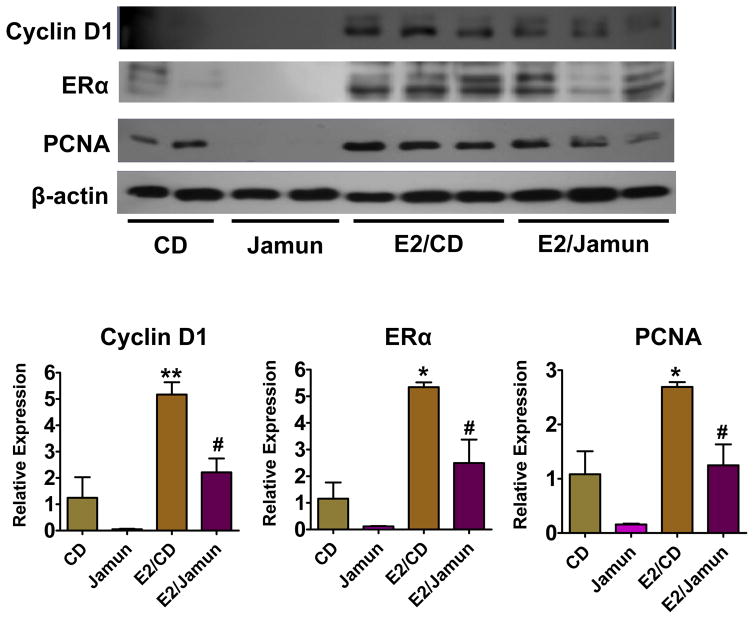
Effect of jamun on protein expression levels of selected markers. Western blot analysis was performed on the mammary protein lysates isolated using RIPA buffer. 30 μg protein was separated by gel electrophoresis and probed for the indicated proteins. Blots were stripped and reprobed with β-actin to confirm the equal loading. Densitometry was performed using ImageJ software and the bar graph is given representing average ± SD of 4–6 samples. Statistical significance was analyzed by generalized linear model (GLM) followed by post hoc Tukey’s multi-comparison test to compare treatment groups using SAS software. Asterisks show significant difference at *p <0.05; **p <0.01 versus the control diet whereas # denotes comparison between E2/Jamun to E2 treated control animals at #p < 0.05.
Figure 6
Figure 6
Effect of diet supplemented with jamun pulp powder (5% w/w) on indicted miRNAs on E2-mediated mammary tumorigenesis. The small RNAs were isolated by mirVana miRNA kit and quantified by Bioanalyzer. qPCR analysis was performed using a TaqMan miRNA kit using manufacturer’s guidelines. Reverse Transcription Kit and TaqMan gene-specific miRNA assays. Select miRNAs were analyzed by qRT-PCR in tissues of E2-alone and jamun-treated ACI rats. Data represent mean ± SD of fold change in mRNA expression relative to the untreated control of five animals. Statistical significance was analyzed by two-way ANOVA after applying the Bonferroni post hoc test for multiple comparisons at *p <0.05; **p <0.01; ***p <0.001 versus the control diet. Student’s t test was done to compare E2/Jamun to E2-treated control animals where #p < 0.05; ##p <0.01; ###p <0.001.

References

    1. Siegel RL, Miller KD, Jemal A. Cancer statistics, 2015. CA: a cancer journal for clinicians. 2015;65:5–29. - PubMed
    1. DeSantis C, Ma J, Bryan L, Jemal A. Breast cancer statistics, 2013. CA: a cancer journal for clinicians. 2014;64:52–62. - PubMed
    1. Ferlay J, Soerjomataram I, Ervik M, Dikshit R, et al. GLOBOCAN 2012. International Agency for Research on Cancer; Lyon, France: 2013.
    1. Weiderpass E, Meo M, Vainio H. Risk factors for breast cancer, including occupational exposures. Saf Health Work. 2011;2:1–8. - PMC - PubMed
    1. Yager JD, Davidson NE. Estrogen carcinogenesis in breast cancer. N Engl J Med. 2006;354:270–282. - PubMed

Publication types

MeSH terms