


Derivation of Novel Risk Prediction Scores for Community-Acquired Sepsis and Severe Sepsis
- PMID: 27031381
- PMCID: PMC4911244
- DOI: 10.1097/CCM.0000000000001666
Derivation of Novel Risk Prediction Scores for Community-Acquired Sepsis and Severe Sepsis
Abstract
Objective: We sought to derive and internally validate a Sepsis Risk Score and a Severe Sepsis Risk Score predicting future sepsis and severe sepsis events among community-dwelling adults.
Design: National population-based cohort.
Setting: United States.
Subjects: A total of 30,239 community-dwelling adults 45 years old or older in the national REasons for Geographic And Racial Differences in Stroke cohort.
Interventions: None.
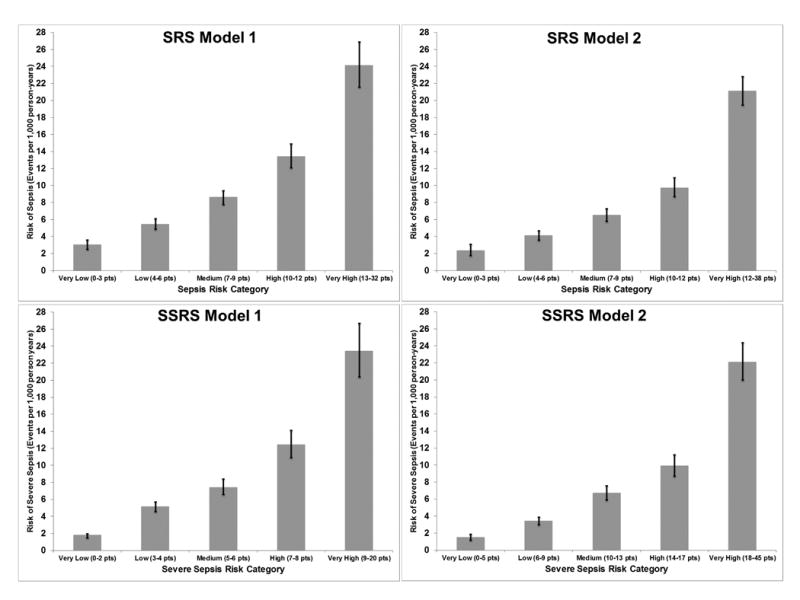
Measurements and main results: Over a median of 6.6 years (interquartile range, 5.1-8.1 yr) of follow-up, there were 1,532 first sepsis (prevalence 8.3 per 1,000 person-years) and 1,151 first severe sepsis (6.2 per 1,000 person-years) events. Risk factors in the best derived Sepsis Risk Score and Severe Sepsis Risk Score included chronic lung disease, age 75 years or older, peripheral artery disease, diabetes, tobacco use, white race, stroke, atrial fibrillation, coronary artery disease, obesity, hypertension, deep vein thrombosis, male sex, high-sensitivity C-reactive protein greater than 3.0 mg/dL, cystatin C ≥1.11 mg/dL, estimated glomerular filtration rate less than 60 mL/min/1.73 m, and albumin-to-creatinine ratio protein greater than 30 μg/mg. Sepsis Risk Score risk categories were very low (0-3 points; 2.3 events per 1,000 person-years), low (4-6; 4.1), medium (7-9; 6.5), high (10-12; 9.7), and very high (13-38; 21.1). Severe Sepsis Risk Score risk categories were very low (0-5 points; 1.5 events per 1,000 person-years), low (6-9; 3.4), medium (10-13; 6.7), high (14-17; 9.9), and very high (18-45; 22.1). The Sepsis Risk Score and Severe Sepsis Risk Score exhibited good discrimination (bootstrapped C index, 0.703 and 0.742) and calibration (p = 0.65 and 0.06).
Conclusions: The Sepsis Risk Score and Severe Sepsis Risk Score predict 10-year sepsis and severe sepsis risk among community-dwelling adults and may aid in sepsis prevention or mitigation efforts.
Conflict of interest statement
Dr. Wang, Donnelly, Griffin and Shapiro do not report any related conflicts of interest.
Figures
Comment in
-
Predicting and Eventually Preventing the Future: Sepsis Risk in Community-Dwelling Adults.Crit Care Med. 2016 Jul;44(7):1425-6. doi: 10.1097/CCM.0000000000001755. Crit Care Med. 2016. PMID: 27309160 Free PMC article. No abstract available.
References
-
- Katz DL, Ali A. Preventive Medicine, Integrative Medicine, and the Health of the Public. Commissioned paper for Institute of Medicine (IOM) of the National Academies. Summit on Integrative Medicine and the Health of the Public. 2009 In.
-
- Corday E, Corday SR. Advances in clinical management of acute myocardial infarction in the past 25 years. Journal of the American College of Cardiology. 1983;1(1):126–132. - PubMed
-
- Centers for Disease C, Prevention. Ten great public health achievements--United States, 2001-2010. MMWR Morb Mortal Wkly Rep. 2011;60(19):619–623. - PubMed
-
- Levy MM, Fink MP, Marshall JC, et al. 2001 SCCM/ESICM/ACCP/ATS/SIS International Sepsis Definitions Conference. Intensive care medicine. 2003;29(4):530–538. - PubMed
Publication types
MeSH terms
Grants and funding
LinkOut - more resources
Full Text Sources
Other Literature Sources
Medical
Research Materials
