


Older Adults with Dementia Are Sedentary for Most of the Day
- PMID: 27031509
- PMCID: PMC4816298
- DOI: 10.1371/journal.pone.0152457
Older Adults with Dementia Are Sedentary for Most of the Day
Abstract
Purpose: Self-reported data suggest that older adults with dementia are inactive. The purpose of the present study was to objectively assess the physical activity (PA) levels of community-dwelling and institutionalized ambulatory patients with dementia, and to compare with the PA levels of cognitive healthy older adults.
Methods: We used actigraphy to assess the PA levels in institutionalized (n = 83, age: 83.0 ± 7.6, Mini-Mental-State Examination (MMSE): 15.5 ± 6.5) and community-dwelling dementia patients (n = 37, age: 77.3 ± 5.6, MMSE-score: 20.8 ± 4.8), and healthy older adults (n = 26, age: 79.5 ± 5.6, MMSE-score: 28.2 ± 1.6). We characterized PA levels based on the raw data and classified <100 counts/min as sedentary behavior.
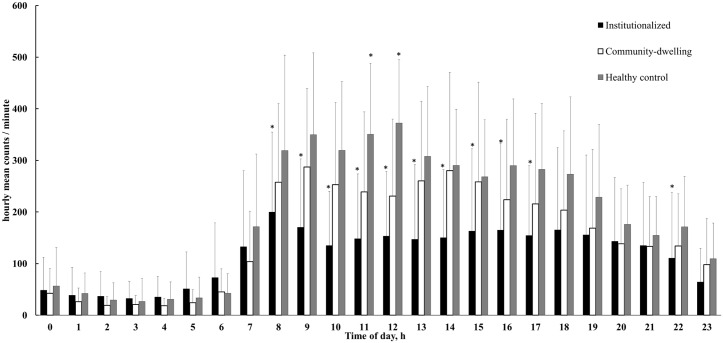
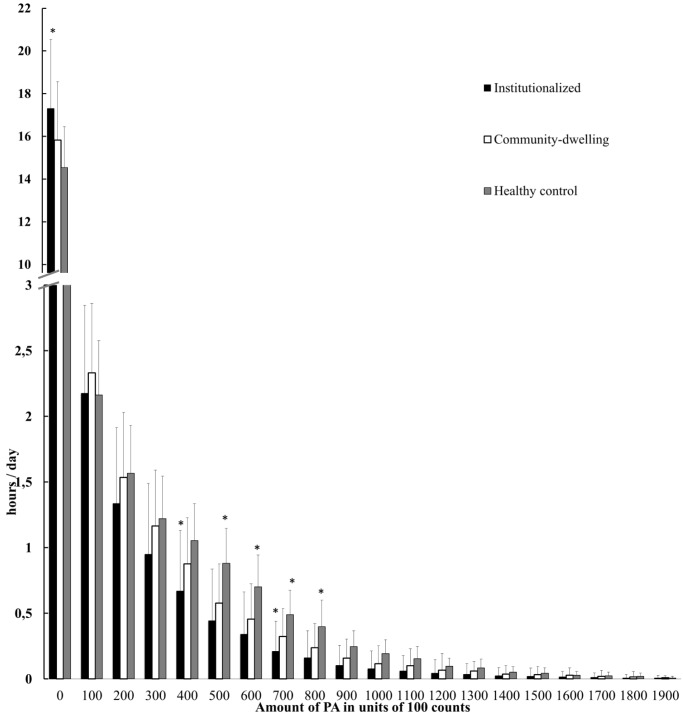
Results: Institutionalized dementia patients had the lowest daily PA levels (1.69 ± 1.33 counts/day), spent 72.1% of the day sedentary, and were most active between 8:00 and 9:00 am. Institutionalized vs. community-dwelling dementia patients had 23.5% lower daily PA levels (difference M = 0.52, p = .004) and spent 9.3% longer in sedentariness (difference M = 1.47, p = .032). Community-dwelling dementia patients spent 66.0% of the day sedentary and were most active between 9:00 to 10:00 am with a second peak between 14:00 to 15:00. Community-dwelling dementia patients vs healthy older adults' daily PA levels and sedentary time were 21.6% lower and 8.9% longer, respectively (difference M = 0.61, p = .007; difference M = 1.29, p = .078).
Conclusions: Institutionalized and community-dwelling dementia patients are sedentary for most of the day and the little PA they perform is of lower intensity compared to their healthy peers. Their highest PA peak is when they get out of bed in the morning. In addition, it seems that institutionalized living is associated with lower PA levels in dementia patients. These are the first results that objectively characterize institutionalized as well as community-dwelling dementia patients' PA levels and confirm that dementia patients are inactive.
Conflict of interest statement
Figures
Similar articles
-
Dementia Patients Are More Sedentary and Less Physically Active than Age- and Sex-Matched Cognitively Healthy Older Adults.Dement Geriatr Cogn Disord. 2018;46(1-2):81-89. doi: 10.1159/000491995. Epub 2018 Aug 24. Dement Geriatr Cogn Disord. 2018. PMID: 30145584 Free PMC article.
-
Quantifying Habitual Physical Activity and Sedentariness in Older Adults-Different Outcomes of Two Simultaneously Body-Worn Motion Sensor Approaches and a Self-Estimation.Sensors (Basel). 2020 Mar 28;20(7):1877. doi: 10.3390/s20071877. Sensors (Basel). 2020. PMID: 32231041 Free PMC article.
-
Tri-Axial Accelerometer-Determined Daily Physical Activity and Sedentary Behavior of Suburban Community-Dwelling Older Japanese Adults.J Sports Sci Med. 2015 Aug 11;14(3):507-14. eCollection 2015 Sep. J Sports Sci Med. 2015. PMID: 26336336 Free PMC article.
-
Instrumented measures of sedentary behaviour and physical activity are associated with mortality in community-dwelling older adults: A systematic review, meta-analysis and meta-regression analysis.Ageing Res Rev. 2020 Aug;61:101061. doi: 10.1016/j.arr.2020.101061. Epub 2020 Apr 30. Ageing Res Rev. 2020. PMID: 32360669
-
A systematic approach to selecting an appropriate measure of self-reported physical activity or sedentary behavior.J Phys Act Health. 2012 Jan;9 Suppl 1:S19-28. doi: 10.1123/jpah.9.s1.s19. J Phys Act Health. 2012. PMID: 22287444 Review.
Cited by
-
Characteristics of Cognitive Function Changes and Related Factors in Individuals With Cognitive Impairment During the Pandemic of COVID-19: A Retrospective Chart Review Study.Psychiatry Investig. 2023 Feb;20(2):109-119. doi: 10.30773/pi.2022.0223. Epub 2023 Feb 23. Psychiatry Investig. 2023. PMID: 36891595 Free PMC article.
-
Corrigendum: Evaluation of Wearable Technology in Dementia: A Systematic Review and Meta-Analysis.Front Med (Lausanne). 2021 Mar 11;8:659639. doi: 10.3389/fmed.2021.659639. eCollection 2021. Front Med (Lausanne). 2021. PMID: 33777985 Free PMC article.
-
Types of leisure time physical activities (LTPA) of community-dwelling persons who have been screened positive for dementia.BMC Geriatr. 2021 Apr 23;21(1):270. doi: 10.1186/s12877-021-02201-1. BMC Geriatr. 2021. PMID: 33892624 Free PMC article.
-
Dementia Patients Are More Sedentary and Less Physically Active than Age- and Sex-Matched Cognitively Healthy Older Adults.Dement Geriatr Cogn Disord. 2018;46(1-2):81-89. doi: 10.1159/000491995. Epub 2018 Aug 24. Dement Geriatr Cogn Disord. 2018. PMID: 30145584 Free PMC article.
-
Engagement in purposeful activities and social interactions amongst persons with dementia in special care units compared to traditional nursing homes: An observational study.Scand J Caring Sci. 2022 Sep;36(3):650-662. doi: 10.1111/scs.13017. Epub 2021 Jul 21. Scand J Caring Sci. 2022. PMID: 34291489 Free PMC article.
References
MeSH terms
LinkOut - more resources
Full Text Sources
Other Literature Sources
Medical
