


Hepatitis B virus nuclear export elements: RNA stem-loop α and β, key parts of the HBV post-transcriptional regulatory element
- PMID: 27031749
- PMCID: PMC5013995
- DOI: 10.1080/15476286.2016.1166330
Hepatitis B virus nuclear export elements: RNA stem-loop α and β, key parts of the HBV post-transcriptional regulatory element
Abstract
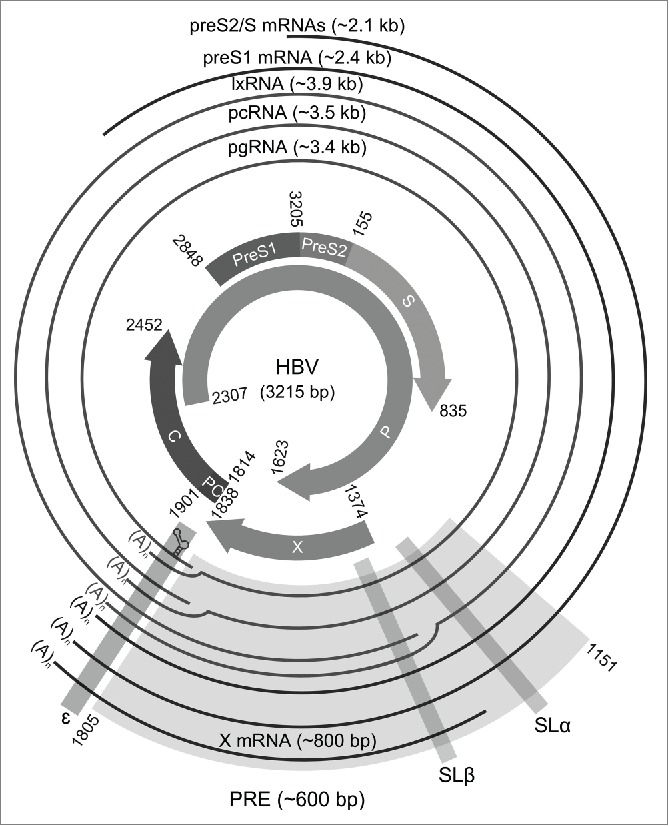
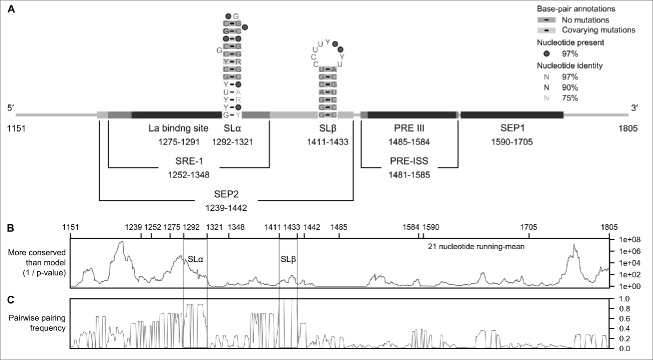
Many viruses contain RNA elements that modulate splicing and/or promote nuclear export of their RNAs. The RNAs of the major human pathogen, hepatitis B virus (HBV) contain a large (~600 bases) composite cis-acting 'post-transcriptional regulatory element' (PRE). This element promotes expression from these naturally intronless transcripts. Indeed, the related woodchuck hepadnavirus PRE (WPRE) is used to enhance expression in gene therapy and other expression vectors. These PRE are likely to act through a combination of mechanisms, including promotion of RNA nuclear export. Functional components of both the HBV PRE and WPRE are 2 conserved RNA cis-acting stem-loop (SL) structures, SLα and SLβ. They are within the coding regions of polymerase (P) gene, and both P and X genes, respectively. Based on previous studies using mutagenesis and/or nuclear magnetic resonance (NMR), here we propose 2 covariance models for SLα and SLβ. The model for the 30-nucleotide SLα contains a G-bulge and a CNGG(U) apical loop of which the first and the fourth loop residues form a CG pair and the fifth loop residue is bulged out, as observed in the NMR structure. The model for the 23-nucleotide SLβ contains a 7-base-pair stem and a 9-nucleotide loop. Comparison of the models with other RNA structural elements, as well as similarity searches of human transcriptome and viral genomes demonstrate that SLα and SLβ are specific to HBV transcripts. However, they are well conserved among the hepadnaviruses of non-human primates, the woodchuck and ground squirrel.
Keywords: Covariance model; RNA secondary structure; hepadnavirus; stem-loop α; stem-loop β.
Figures
References
-
- Chen A, Kao YF, Brown CM. Translation of the first upstream ORF in the hepatitis B virus pregenomic RNA modulates translation at the core and polymerase initiation codons. Nucleic Acids Res 2005; 33:1169-81; PMID:15731337; http://dx.doi.org/10.1093/nar/gki251 - DOI - PMC - PubMed
-
- Chen A, Panjaworayan T-Thienprasert N, Brown CM. Prospects for inhibiting the post-transcriptional regulation of gene expression in hepatitis B virus. World J Gastroenterol WJG 2014; 20:7993-8004; PMID:25009369; http://dx.doi.org/10.3748/wjg.v20.i25.7993 - DOI - PMC - PubMed
-
- Doitsh G, Shaul Y. A long HBV transcript encoding pX is inefficiently exported from the nucleus. Virology 2003; 309:339-49; PMID:12758180; http://dx.doi.org/10.1016/S0042-6822(03)00156-9 - DOI - PubMed
-
- Smith GJ, Donello JE, Hope TJ, Lück R, Steger G. The hepatitis B virus post-transcriptional regulatory element contains two conserved RNA stem-loops which are required for function. Nucleic Acids Res 1998; 26:4818-27; PMID:9776740; http://dx.doi.org/10.1093/nar/26.21.4818 - DOI - PMC - PubMed
-
- Chen A, Brown CM. Distinct families of cis-acting RNA replication elements epsilon from hepatitis B viruses. RNA Biol 2012; 9:130-6; PMID:22418844; http://dx.doi.org/10.4161/rna.18649 - DOI - PMC - PubMed
Publication types
MeSH terms
Substances
LinkOut - more resources
Full Text Sources
Other Literature Sources
