A Meta-Analysis to Determine if Lower Extremity Muscle Strengthening Should Be Included in Military Knee Overuse Injury-Prevention Programs
- PMID: 27031886
- PMCID: PMC5224733
- DOI: 10.4085/1062-6050-51.4.09
A Meta-Analysis to Determine if Lower Extremity Muscle Strengthening Should Be Included in Military Knee Overuse Injury-Prevention Programs
Abstract
Context: Knee overuse injuries are the most common musculoskeletal complaints in military trainees and are common in active-duty warfighters. Muscle strengthening is usually recommended; however, research is conflicting in this area, which makes it difficult to develop effective screening, prevention, and training interventions for warfighters.
Objective: To determine if lower extremity muscular weakness contributes to knee overuse injuries and identify specific muscular involvement.
Data sources: We searched MEDLINE, PubMed, Web of Science, SPORTDiscus, CINAHL, and Military & Government Collection and reference lists of relevant articles published between January 1, 2000, and January 1, 2013.
Study selection: For inclusion, requirements were uninjured and injured groups; provision of the sample size, means, and standard deviations for all groups; identification of the specific muscles assessed; and clearly defined knee injury.
Data extraction: Sample size, sex, and muscle strength means and standard deviations.
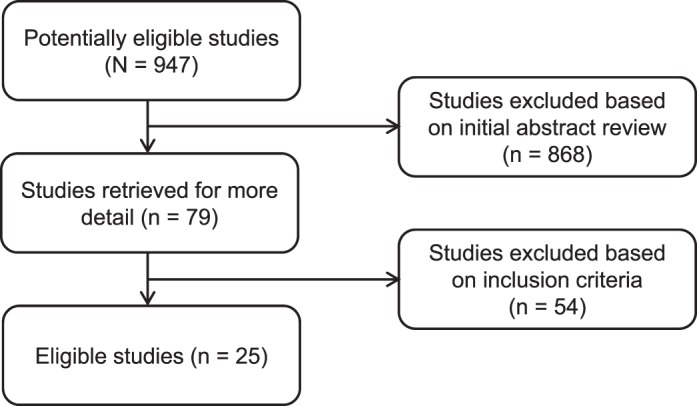
Data synthesis: Twenty-five studies met these criteria. We used the Scottish Intercollegiate Guidelines Network algorithm to determine the appropriate tool for appraising article quality. Unweighted random-effects model meta-analyses were conducted. Separate meta-analyses were performed for the moderators of strength measurement scale (absolute or normalized muscle strength), muscle group, and sex. A weighted random-effects model with a Hedges g effect metric and 95% confidence intervals were used for comparison across studies.
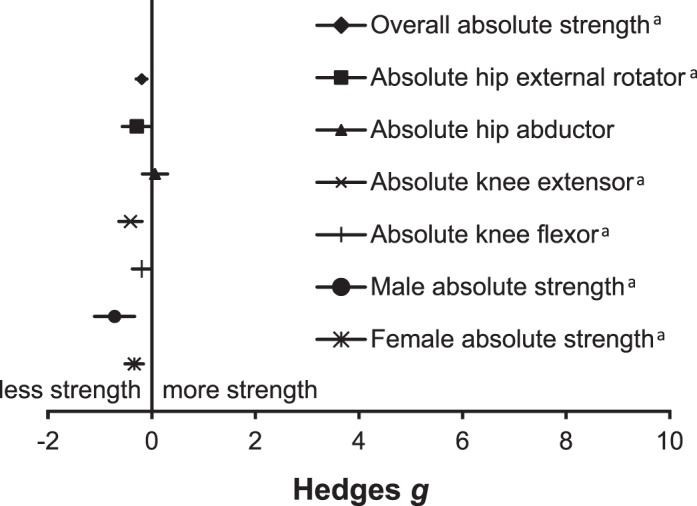
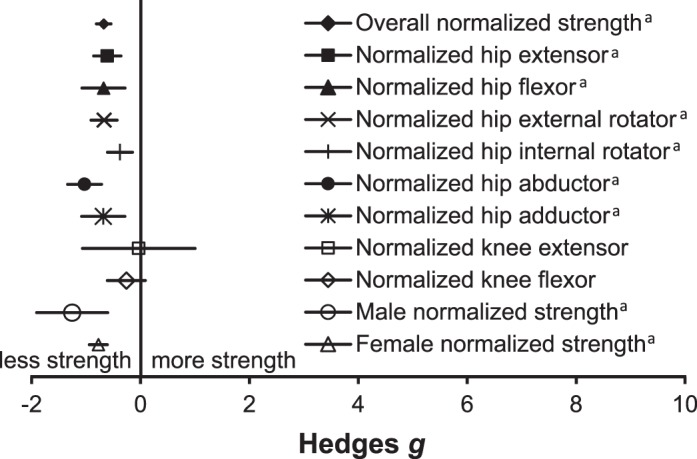
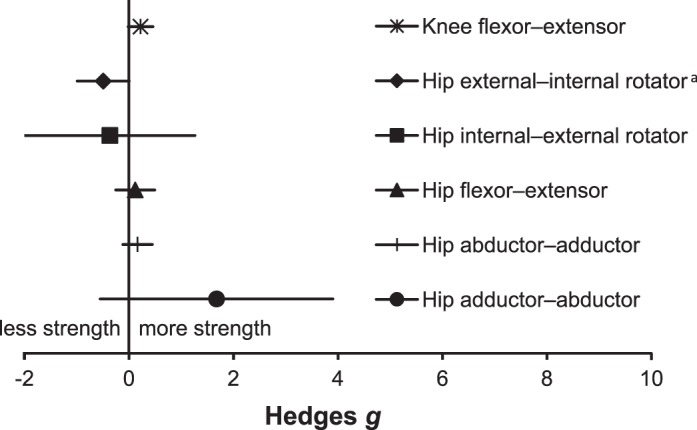
Conclusions: Our meta-analysis suggests that individuals with symptoms of a knee overuse injury have lower absolute and normalized hip muscle strength. Specifically, they had lower absolute hip external-rotator, knee-extensor, and knee-flexor strength, as well as lower normalized hip external-rotator, hip-extensor, and hip-abductor strength, compared with asymptomatic control participants. The findings suggest a possible link between lower hip and thigh strength and knee overuse injuries. Further research is needed to determine if weakness is a cause or a result of knee overuse injuries before screening and intervention can be developed for at-risk warfighters.
Keywords: hip strength; iliotibial band syndrome; patellofemoral pain syndrome; warfighters.
Figures
References
-
- Allison KF, Keenan KA, Sell TC, et al. . Musculoskeletal, biomechanical, and physiological gender differences in the US military. US Army Med Dep J. April−June 2015: 22−32. - PubMed
-
- Hauret KG, Jones BH, Bullock SH, Canham-Chervak M, Canada S. . Musculoskeletal injuries description of an under-recognized injury problem among military personnel. Am J Prev Med. 2010; 38 suppl 1: S61– S70. - PubMed
-
- Heir T. . Musculoskeletal injuries in officer training: one-year follow-up. Mil Med. 1998; 163 4: 229– 233. - PubMed
-
- Kaufman KR, Brodine S, Shaffer R. . Military training-related injuries: surveillance, research, and prevention. Am J Prev Med. 2000; 18 suppl 3: S54– S63. - PubMed
Publication types
MeSH terms
LinkOut - more resources
Full Text Sources
Other Literature Sources
Medical
Miscellaneous