


The Combined Landscape of Denisovan and Neanderthal Ancestry in Present-Day Humans
- PMID: 27032491
- PMCID: PMC4864120
- DOI: 10.1016/j.cub.2016.03.037
The Combined Landscape of Denisovan and Neanderthal Ancestry in Present-Day Humans
Abstract
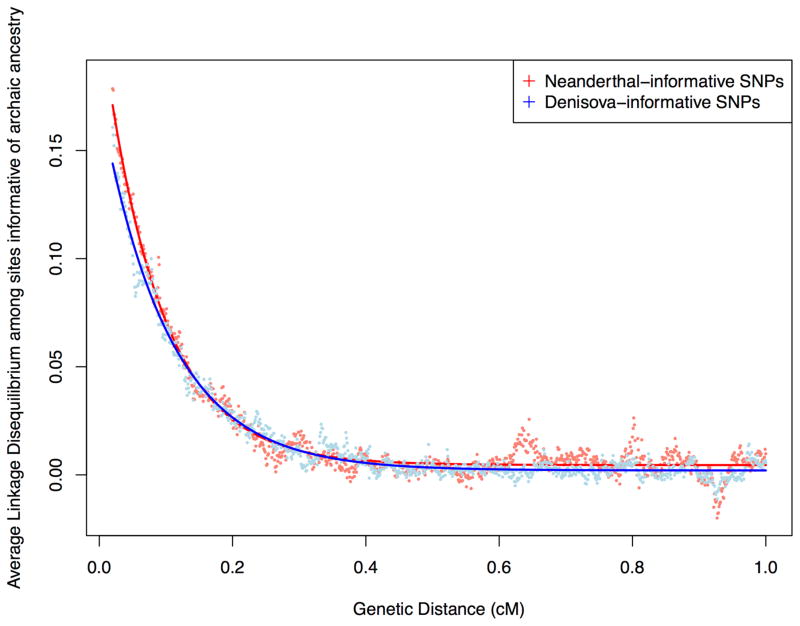
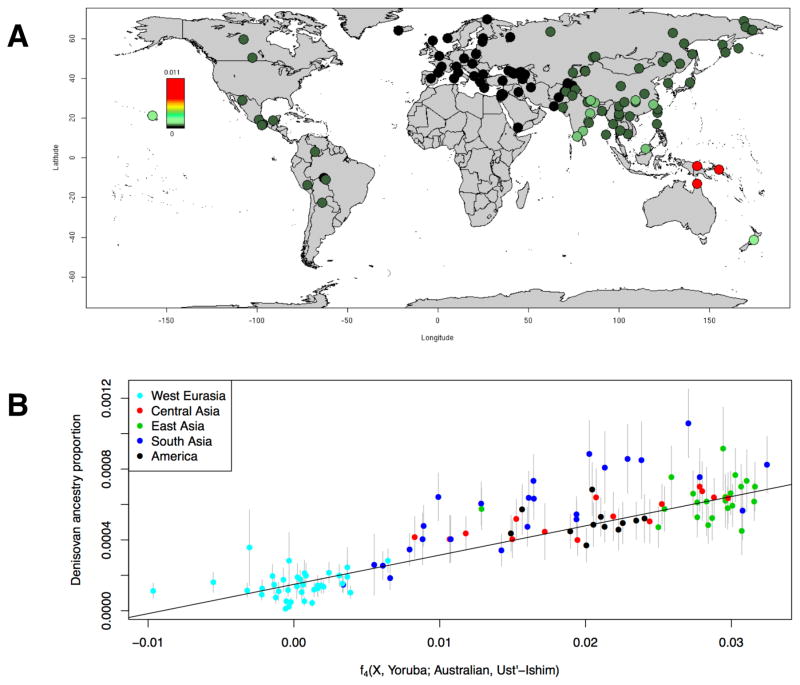
Some present-day humans derive up to ∼5% [1] of their ancestry from archaic Denisovans, an even larger proportion than the ∼2% from Neanderthals [2]. We developed methods that can disambiguate the locations of segments of Denisovan and Neanderthal ancestry in present-day humans and applied them to 257 high-coverage genomes from 120 diverse populations, among which were 20 individual Oceanians with high Denisovan ancestry [3]. In Oceanians, the average size of Denisovan fragments is larger than Neanderthal fragments, implying a more recent average date of Denisovan admixture in the history of these populations (p = 0.00004). We document more Denisovan ancestry in South Asia than is expected based on existing models of history, reflecting a previously undocumented mixture related to archaic humans (p = 0.0013). Denisovan ancestry, just like Neanderthal ancestry, has been deleterious on a modern human genetic background, as reflected by its depletion near genes. Finally, the reduction of both archaic ancestries is especially pronounced on chromosome X and near genes more highly expressed in testes than other tissues (p = 1.2 × 10(-7) to 3.2 × 10(-7) for Denisovan and 2.2 × 10(-3) to 2.9 × 10(-3) for Neanderthal ancestry even after controlling for differences in level of selective constraint across gene classes). This suggests that reduced male fertility may be a general feature of mixtures of human populations diverged by >500,000 years.
Copyright © 2016 Elsevier Ltd. All rights reserved.
Figures

References
-
- Seguin-Orlando A, et al. Paleogenomics. Genomic structure in Europeans dating back at least 36,200 years. Science. 2014;346(6213):1113–8. - PubMed
MeSH terms
Grants and funding
LinkOut - more resources
Full Text Sources
Other Literature Sources
