


Best Practices in Chronic Myeloid Leukemia Monitoring and Management
- PMID: 27032870
- PMCID: PMC4861357
- DOI: 10.1634/theoncologist.2015-0337
Best Practices in Chronic Myeloid Leukemia Monitoring and Management
Abstract
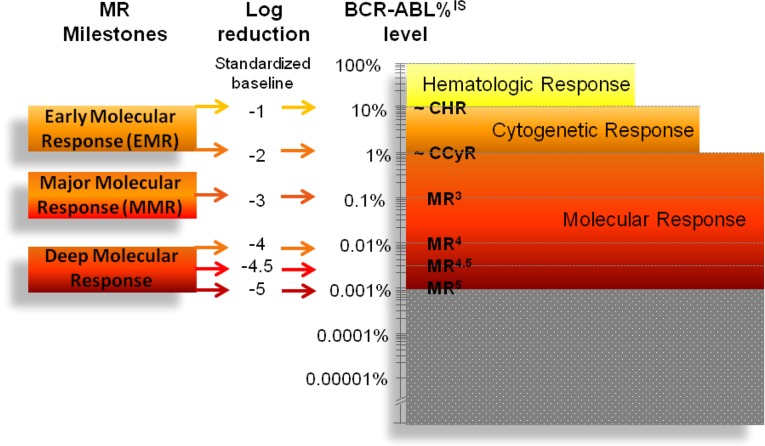
: Optimal use of current therapeutic opportunities for chronic myeloid leukemia patients requires integration of clinical and laboratory monitoring. Assessment of molecular response (MR) by real-time quantitative polymerase chain reaction is the most sensitive way to monitor tyrosine kinase inhibitor (TKI) treatment efficacy. Besides major molecular response, which has emerged as a safe haven for survival since the initial studies of first-line imatinib treatment, two additional MR milestones have recently been defined: early molecular response and deep molecular response. The achievement of such MR milestones within defined time points during therapy is thought to draw the ideal trajectory toward optimal long-term outcome and, possibly, successful treatment discontinuation. Sensitive and reproducible MR measurement and proper interpretation of MR results are therefore critical to correctly inform therapeutic decisions. In patients who do not achieve an optimal response to TKI therapy, BCR-ABL1 mutation screening should also be performed, because it may deliver useful information for TKI choice. This review aims to help clinicians apply and translate the latest response definitions and clinical recommendations into practice. We provide a critical update on how these recommendations have incorporated MR levels in the clinical decision algorithms and how detection of BCR-ABL1 mutations should be interpreted. We also include a practical guide for pathologists and molecular biologists to best perform molecular testing and for hematologists and oncologists to best integrate it into routine practice.
Implications for practice: Ever-more-potent therapeutic strategies have been developed for chronic myeloid leukemia (CML) in parallel with the evolution of therapeutic goals and the refinement of response definitions and monitoring schemes and procedures. Terminology and methodology continue to evolve rapidly, making it difficult for busy hematology/oncology professionals to keep abreast of the newest developments. Optimal CML patient management results from the timely and rational use of molecular testing, the critical assessment of the power and pitfalls of current technology, and the appropriate interpretation and contextualization of results.
Keywords: BCR-ABL1; Leukemia, chronic myeloid; Minimal residual disease; Molecular testing; Tyrosine kinase inhibitor.
©AlphaMed Press.
Conflict of interest statement
Disclosures of potential conflicts of interest may be found at the end of this article.
Figures
References
-
- Sawyers CL. Chronic myeloid leukemia. N Engl J Med. 1999;340:1330–1340. - PubMed
-
- Nowell PC, Hungerford DA. Chromosome studies on normal and leukemic human leukocytes. J Natl Cancer Inst. 1960;25:85–109. - PubMed
-
- Rowley JD. Letter: A new consistent chromosomal abnormality in chronic myelogenous leukaemia identified by quinacrine fluorescence and Giemsa staining. Nature. 1973;243:290–293. - PubMed
-
- Lugo TG, Pendergast AM, Muller AJ, et al. Tyrosine kinase activity and transformation potency of bcr-abl oncogene products. Science. 1990;247:1079–1082. - PubMed
Publication types
MeSH terms
Substances
LinkOut - more resources
Full Text Sources
Other Literature Sources
Medical
Miscellaneous
