


A multi-ethnic genome-wide association study identifies novel loci for non-syndromic cleft lip with or without cleft palate on 2p24.2, 17q23 and 19q13
- PMID: 27033726
- PMCID: PMC5181632
- DOI: 10.1093/hmg/ddw104
A multi-ethnic genome-wide association study identifies novel loci for non-syndromic cleft lip with or without cleft palate on 2p24.2, 17q23 and 19q13
Abstract
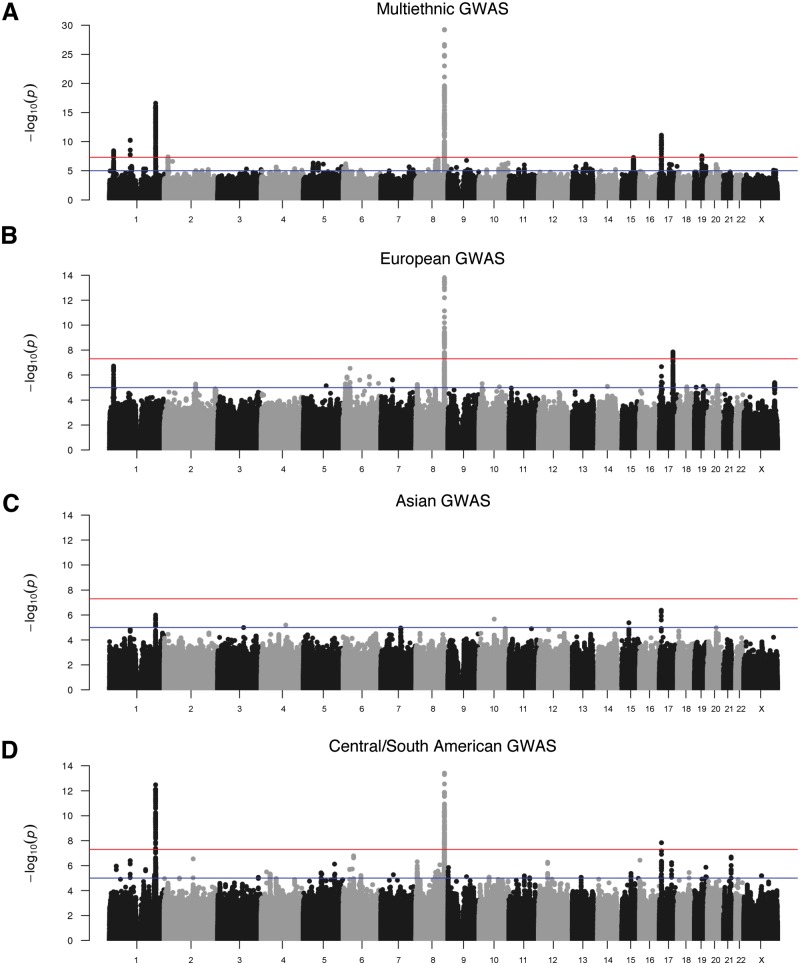
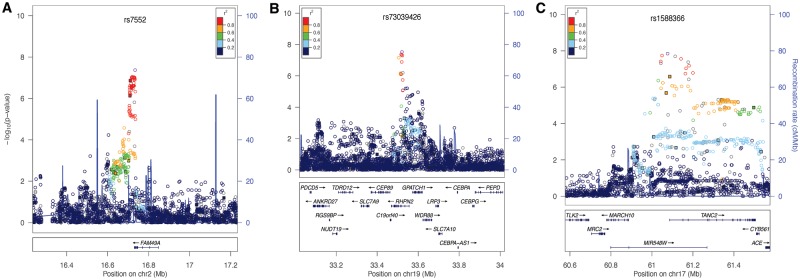
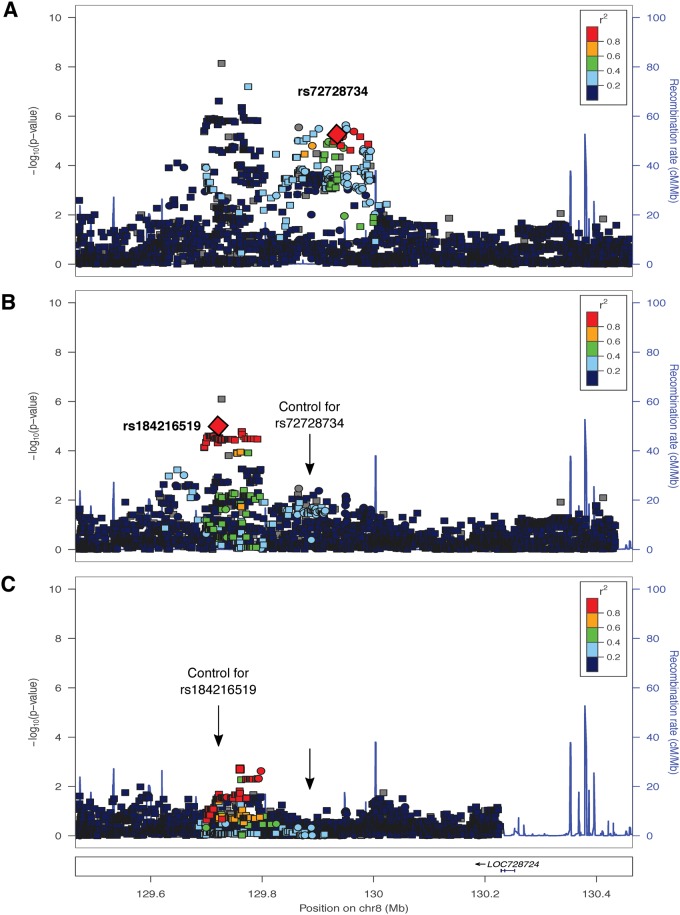
Orofacial clefts (OFCs), which include non-syndromic cleft lip with or without cleft palate (CL/P), are among the most common birth defects in humans, affecting approximately 1 in 700 newborns. CL/P is phenotypically heterogeneous and has a complex etiology caused by genetic and environmental factors. Previous genome-wide association studies (GWASs) have identified at least 15 risk loci for CL/P. As these loci do not account for all of the genetic variance of CL/P, we hypothesized the existence of additional risk loci. We conducted a multiethnic GWAS in 6480 participants (823 unrelated cases, 1700 unrelated controls and 1319 case-parent trios) with European, Asian, African and Central and South American ancestry. Our GWAS revealed novel associations on 2p24 near FAM49A, a gene of unknown function (P = 4.22 × 10⁻⁸), and 19q13 near RHPN2, a gene involved in organizing the actin cytoskeleton (P = 4.17 × 10⁻⁸). Other regions reaching genome-wide significance were 1p36 (PAX7), 1p22 (ARHGAP29), 1q32 (IRF6), 8q24 and 17p13 (NTN1), all reported in previous GWASs. Stratification by ancestry group revealed a novel association with a region on 17q23 (P = 2.92 × 10⁻⁸) among individuals with European ancestry. This region included several promising candidates including TANC2, an oncogene required for development, and DCAF7, a scaffolding protein required for craniofacial development. In the Central and South American ancestry group, significant associations with loci previously identified in Asian or European ancestry groups reflected their admixed ancestry. In summary, we have identified novel CL/P risk loci and suggest new genes involved in craniofacial development, confirming the highly heterogeneous etiology of OFCs.
© The Author 2016. Published by Oxford University Press. All rights reserved. For permissions, please e-mail: journals.permissions@oup.com.
Figures
References
-
- Beaty T.H., Murray J.C., Marazita M.L., Munger R.G., Ruczinski I., Hetmanski J.B., Liang K.Y., Wu T., Murray T., Fallin M.D. et al. (2010) A genome-wide association study of cleft lip with and without cleft palate identifies risk variants near MAFB and ABCA4. Nat. Genet., 42, 525–529. - PMC - PubMed
-
- Birnbaum S., Ludwig K.U., Reutter H., Herms S., Steffens M., Rubini M., Baluardo C., Ferrian M., Almeida de Assis N., Alblas M.A. et al. (2009) Key susceptibility locus for nonsyndromic cleft lip with or without cleft palate on chromosome 8q24. Nat. Genet., 41, 473–477. - PubMed
-
- Grant S.F., Wang K., Zhang H., Glaberson W., Annaiah K., Kim C.E., Bradfield J.P., Glessner J.T., Thomas K.A., Garris M. et al. (2009) A genome-wide association study identifies a locus for nonsyndromic cleft lip with or without cleft palate on 8q24. J. Pediatr., 155, 909–913. - PubMed
MeSH terms
Grants and funding
- R01 DE014667/DE/NIDCR NIH HHS/United States
- R25 MD007607/MD/NIMHD NIH HHS/United States
- U54 MD007587/MD/NIMHD NIH HHS/United States
- K99 DE025060/DE/NIDCR NIH HHS/United States
- HHSN268201200008C/HL/NHLBI NIH HHS/United States
- U01 DD001035/DD/NCBDD CDC HHS/United States
- R01 DE011948/DE/NIDCR NIH HHS/United States
- U01 DE024425/DE/NIDCR NIH HHS/United States
- R21 DE016930/DE/NIDCR NIH HHS/United States
- R00 DE022378/DE/NIDCR NIH HHS/United States
- K99 DE024571/DE/NIDCR NIH HHS/United States
- R01 DD000295/DD/NCBDD CDC HHS/United States
- R37 DE008559/DE/NIDCR NIH HHS/United States
- R01 DE011931/DE/NIDCR NIH HHS/United States
- K99 DE022378/DE/NIDCR NIH HHS/United States
- R01 DE016148/DE/NIDCR NIH HHS/United States
- R01 DE020895/DE/NIDCR NIH HHS/United States
- R21 DE016877/DE/NIDCR NIH HHS/United States
- HHSN268201200008I/HL/NHLBI NIH HHS/United States
- R01 DE009886/DE/NIDCR NIH HHS/United States
LinkOut - more resources
Full Text Sources
Other Literature Sources
Medical
Molecular Biology Databases
Miscellaneous
