


Trajectories of Unhealthy Behaviors in Midlife and Risk of Disability at Older Ages in the Whitehall II Cohort Study
- PMID: 27034508
- PMCID: PMC5055647
- DOI: 10.1093/gerona/glw060
Trajectories of Unhealthy Behaviors in Midlife and Risk of Disability at Older Ages in the Whitehall II Cohort Study
Abstract
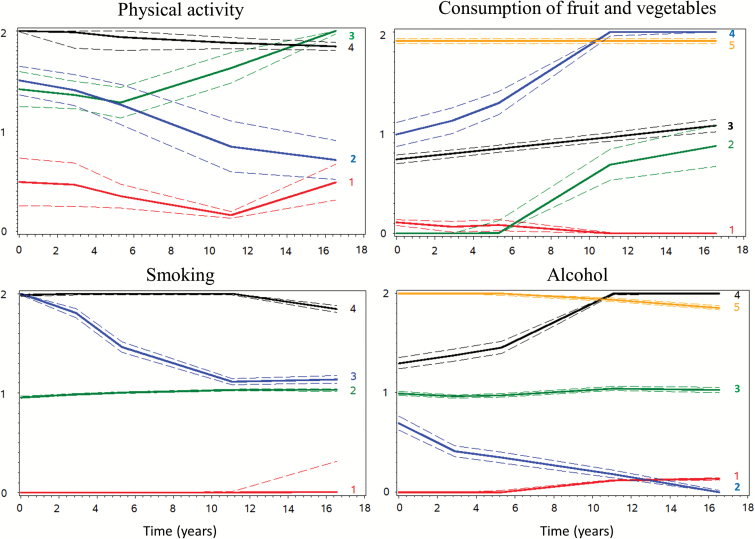
Background: Most of the evidence on the association between unhealthy behaviors and disability comes from studies in the elderly, where reverse causation and selection bias may distort associations; thus, studies based on midlife trajectories of health behaviors are needed. We examined the association of trajectories of four health behaviors (physical activity, fruit and vegetable consumption, smoking, alcohol), starting in midlife and over 20 years, with subsequent disability risk in early old age (range = 54-84 years) in the Whitehall II cohort study.
Methods: Disability was assessed three times over 3 years. A hierarchical disability indicator was constructed; participants were considered disabled if they reported difficulties with mobility and instrumental activities of daily living or with mobility and instrumental and basic activities of daily living. Behavior trajectories were defined using group-based trajectory models. Multivariable generalized estimating equations logistic models were used to examine their independent associations with disability.
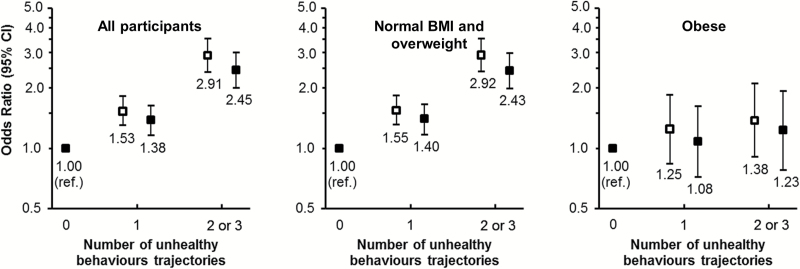
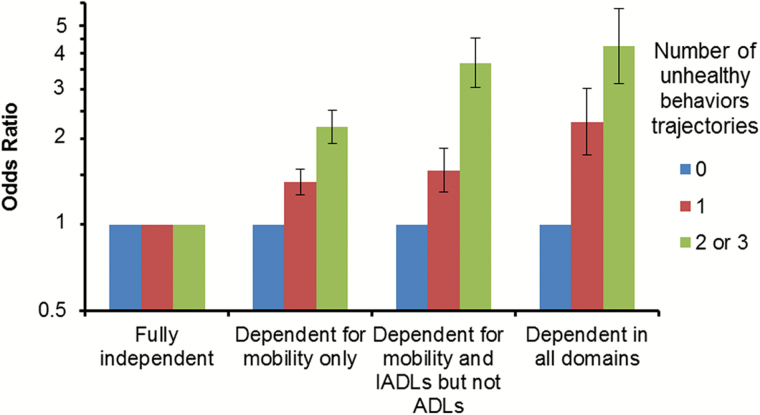
Results: Of 6,825 participants, 19.2% reported being disabled at least once. In mutually adjusted models, participants with persistent inactivity or declining physical activity, recent ex- or current smokers, and persistent/recent abstainers or persistent heavy drinkers had a higher disability risk, whereas fruit and vegetable consumption was not associated with disability. Disability risk increased progressively with the number of unhealthy behavior trajectories: the odds ratio of disability for 2-3 unhealthy trajectories was 2.69 (95% confidence interval = 2.26-3.19); these associations remained after adjustment for a wide range of covariates.
Conclusions: Unhealthy behavior trajectories in midlife are associated with greater disability risk later in life.
Keywords: Aging; Cohort study; Disability; Epidemiology; Health behaviors.
© The Author 2016. Published by Oxford University Press on behalf of The Gerontological Society of America.
Figures
References
-
- Donald IP, Foy C, Jagger C. Trends in disability prevalence over 10 years in older people living in Gloucestershire. Age Ageing. 2010;39:337–342. doi:10.1093/ageing/afq015 - PubMed
-
- Falk H, Johansson L, Ostling S, et al. Functional disability and ability 75-year-olds: a comparison of two Swedish cohorts born 30 years apart. Age Ageing. 2014;43:636–641. doi:10.1093/ageing/afu018 - PubMed
-
- Fried LP, Kronmal RA, Newman AB, et al. Risk factors for 5-year mortality in older adults: the Cardiovascular Health Study. JAMA. 1998;279:585–592. doi:joc7046 [pii] - PubMed
Publication types
MeSH terms
Grants and funding
LinkOut - more resources
Full Text Sources
Other Literature Sources
Medical
