Review
. 2016 Apr;3(2):47-62.
doi: 10.1177/2049936115624630. Epub 2015 Dec 30.

The implications of whole-genome sequencing in the control of tuberculosis

Affiliations
Review

The implications of whole-genome sequencing in the control of tuberculosis

Robyn S Lee et al. Ther Adv Infect Dis. 2016 Apr.

Abstract

The availability of whole-genome sequencing (WGS) as a tool for the diagnosis and clinical management of tuberculosis (TB) offers considerable promise in the fight against this stubborn epidemic. However, like other new technologies, the best application of WGS remains to be determined, for both conceptual and technical reasons. In this review, we consider the potential value of WGS in the clinical laboratory for the detection of Mycobacterium tuberculosis and the prediction of antibiotic resistance. We also discuss issues pertaining to data generation, interpretation and dissemination, given that WGS has to date been generally performed in research labs where results are not necessarily packaged in a clinician-friendly format. Although WGS is far more accessible now than it was in the past, the transition from a research tool to study TB into a clinical test to manage this disease may require further fine-tuning. Improvements will likely come through iterative efforts that involve both the laboratories ready to move TB into the genomic era and the front-line clinical/public health staff who will be interpreting the results to inform management decisions.

Keywords: Mycobacterium tuberculosis; clinical microbiology; diagnostics; drug resistance; whole-genome sequencing.


Figures
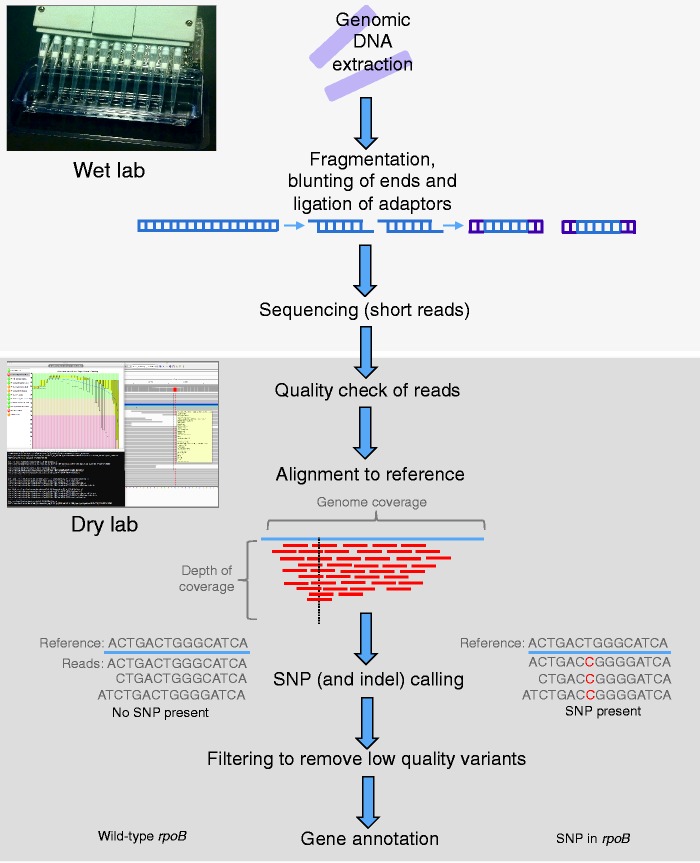
Figure 1.
Figure 1.
WGS workflow for Mycobacterium tuberculosis. In brief, whole-genome sequencing (WGS) begins in the wet lab (top panel), wherein genomic DNA (gDNA) is extracted. For a M. tuberculosis culture, this is done in a biosafety level 3 laboratory. After DNA extraction, library preparation is conducted, wherein genomic DNA is fragmented into pieces. Uneven ends of gDNA are blunted and adaptor sequences are added. After passing quality control, libraries are advanced to sequencing. Further analysis occurs in the dry lab (bottom panel). Potential contamination is assessed and the quality of sequencing is evaluated on a per isolate basis, including the examination of Phred quality scores of the sequenced bases (where Phred = –10*logPerror). FastQC, for example, is a software that can be used for such quality control, and is applied directly on raw sequence data (available from http://www.bioinformatics.bbsrc.ac.uk/projects/fastqc/, shown in the screenshot). Adaptors (and potentially low-quality base pairs) are trimmed and reads of length under a prespecified limit (e.g. 70 base pairs used by the 1000 Genomes Project) may be excluded (not shown). High-quality reads are aligned to a reference genome (this can be visualized in Integrative Genomics Viewer, also shown in screenshot [Thorvaldsdottir et al. 2013]), and metrics such as genome coverage (the percentage of the reference genome that has at least one read mapped to it) and depth of coverage (the average number of reads mapped to each locus) are evaluated. Isolates are retained if a priori quality measures are met. Reads are excluded if they map to more than one locus in the genome, and additional quality measures may be applied such as removing polymerase chain reaction duplicates and local realignment around indels. Once quality control steps are conducted, single-nucleotide polymorphisms and indels can then be ‘called’ compared with the reference genome. Low-quality variants are then removed using various filtering parameters to reduce the number of false positives. Genes are then annotated and repetitive regions and mobile elements may be filtered out of further analyses.
Figure 2.
Figure 2.
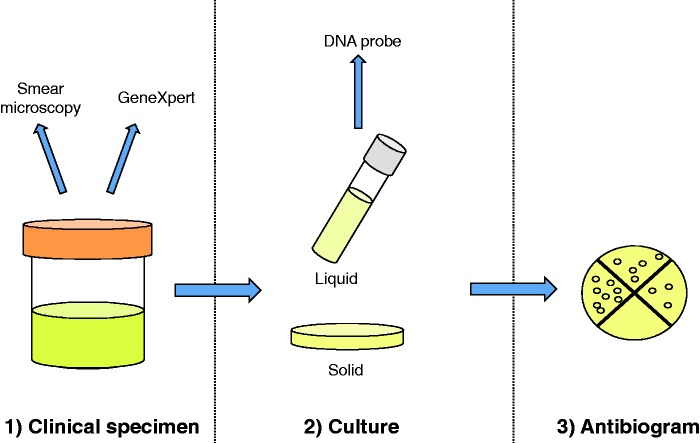
Clinical diagnostic workflow for Mycobacterium tuberculosis. The three main steps in the current diagnostic workflow for M. tuberculosis are shown. As described in the text, whole-genome sequencing may have a potential role at each of these steps: (1) by being applied directly to the unprocessed clinical specimen or (2) by being conducted on the positive culture to predict drug resistance.

References

    1. Altschul S., Gish W., Miller W., Myers E., Lipman D. (1990) Basic local alignment search tool. J Mol Biol 215: 403–410. - PubMed
    1. Alvarez G., Van Dyk D., Desjardins M., Yasseen A., III, Aaron S., Cameron D., et al. (2015) The feasibility, accuracy, and impact of Xpert MTB/RIF testing in a remote aboriginal community in Canada. Chest 148: 767–773. - PubMed
    1. Behr M., Warren S., Salamon H., Hopewell P., Ponce de Leon A., Daley C., et al. (1999) Transmission of Mycobacterium tuberculosis from patients smear-negative for acid-fast bacilli. Lancet 353: 444–449. - PubMed
    1. Boehme C., Nabeta P., Hillemann D., Nicol M., Shenai S., Krapp F., et al. (2010) Rapid molecular detection of tuberculosis and rifampin resistance. N Engl J Med 363: 1005–1015. - PMC - PubMed
    1. Brown A., Bryant J., Einer-Jensen K., Holdstock J., Houniet D., Chan J., et al. (2015) Rapid whole-genome sequencing of Mycobacterium tuberculosis isolates directly from clinical samples. J Clin Microbiol 53: 2230–2237. - PMC - PubMed

LinkOut - more resources