. 2016 Apr 12;113(15):4116-21.
doi: 10.1073/pnas.1517242113. Epub 2016 Mar 29.

Horizontally acquired genes in early-diverging pathogenic fungi enable the use of host nucleosides and nucleotides

Affiliations

Horizontally acquired genes in early-diverging pathogenic fungi enable the use of host nucleosides and nucleotides

William G Alexander et al. Proc Natl Acad Sci U S A. .

Abstract

Horizontal gene transfer (HGT) among bacteria, archaea, and viruses is widespread, but the extent of transfers from these lineages into eukaryotic organisms is contentious. Here we systematically identify hundreds of genes that were likely acquired horizontally from a variety of sources by the early-diverging fungal phyla Microsporidia and Cryptomycota. Interestingly, the Microsporidia have acquired via HGT several genes involved in nucleic acid synthesis and salvage, such as those encoding thymidine kinase (TK), cytidylate kinase, and purine nucleotide phosphorylase. We show that these HGT-derived nucleic acid synthesis genes tend to function at the interface between the metabolic networks of the host and pathogen. Thus, these genes likely play vital roles in diversifying the useable nucleic acid components available to the intracellular parasite, often through the direct capture of resources from the host. Using an in vivo viability assay, we also demonstrate that one of these genes, TK, encodes an enzyme that is capable of activating known prodrugs to their active form, which suggests a possible treatment route for microsporidiosis. We further argue that interfacial genes with well-understood activities, especially those horizontally transferred from bacteria or viruses, could provide medical treatments for microsporidian infections.

Keywords: Cryptomycota; Microsporidia; horizontal gene transfer; metabolic networks; thymidine kinase.


Conflict of interest statement

The authors declare no conflict of interest.

Figures
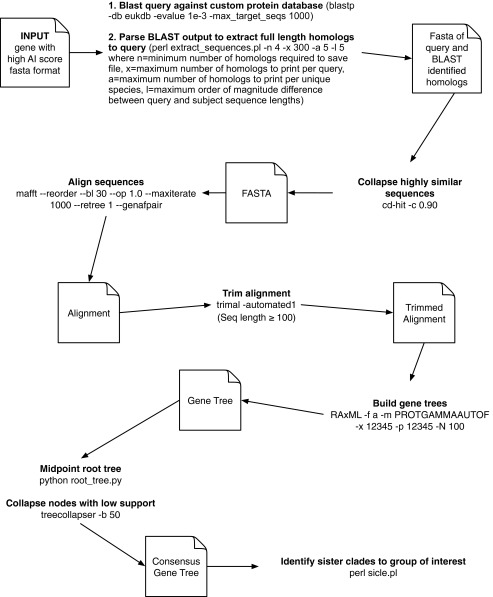
Fig. S1.
Fig. S1.
Workflow for genome-wide AI score calculation. See Methods for specific details on genome-wide AI calculation.
Fig. 1.
Fig. 1.
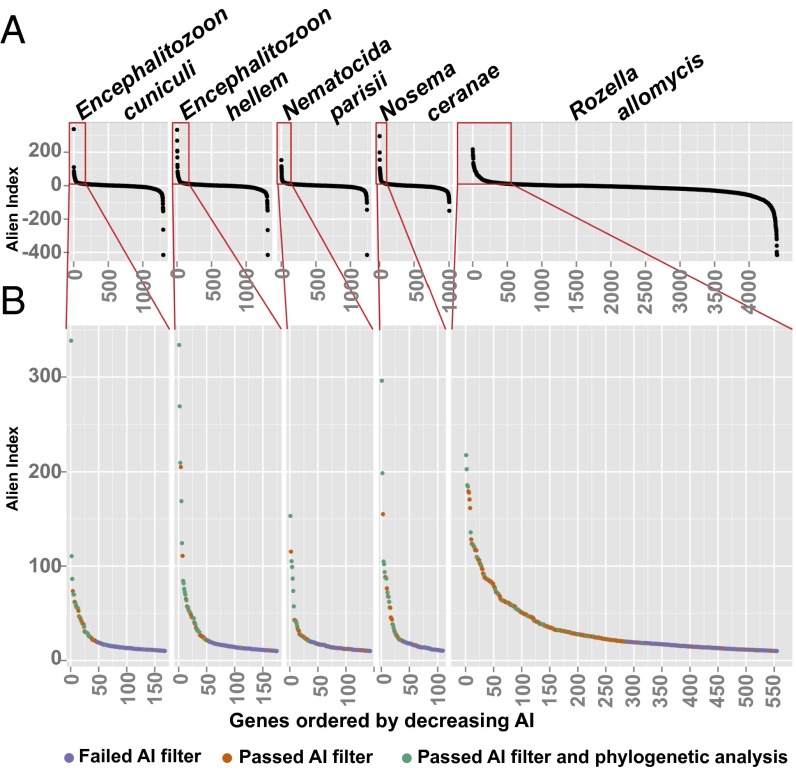
Plots of the AI for five early-diverging fungal eukaryotes. (A) AI scores were calculated for every gene in the five genomes analyzed, and they were ordered by decreasing AI score. (B) Genes with an AI score ≥ 10 were plotted with colors corresponding to whether they passed or failed the AI score or phylogenetic filters (see main text).
Fig. 2.
Fig. 2.
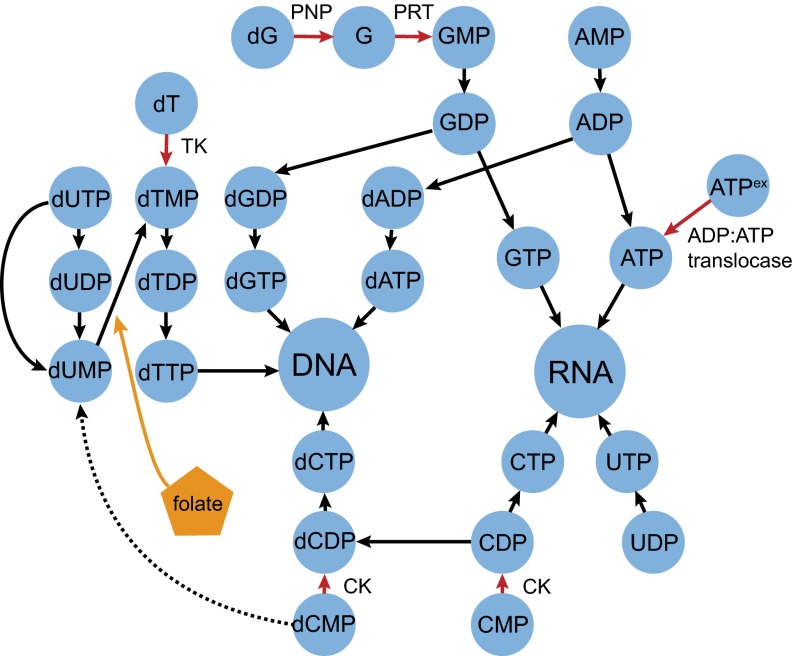
Early-diverging fungal HGT events and nucleic acid metabolism. A schematic of the E. hellem nucleic acid anabolic subpathway indicates that HGT-derived genes are found near the host–parasite interface, which provides the parasite with additional sources of nucleosides and nucleotides. HGT-derived enzymatic functions are denoted by red arrows (10, 11, 29), whereas the dCMP deaminase present in some other Microsporidia (but absent in E. hellem) is denoted by a dashed black arrow. HGTs are also contained within the E. hellem folate biosynthesis pathway (orange), which donates a methyl group to convert dUMP to dTMP. CK, cytidylate kinase; PNP, purine nucleotide phosphorylase; PRT, phosphoribosyltransferase; TK, thymidine kinase.
Fig. 3.
Fig. 3.
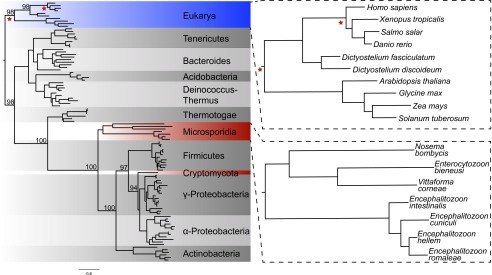
TK has been transferred from bacteria into Microsporidia and Cryptomycota by independent HGT events. Top BLASTP hits for E. cuniculi, No. ceranae, and R. allomycis TK were aligned along with TK sequences from representative eukaryotes and other bacterial phyla, and the resulting alignment was used to infer a maximum-likelihood phylogeny. Red stars indicate the location on the tree where likelihood-ratio tests were performed to evaluate the relationship of the sequences in question with Animalia or other Eukarya representatives. Bootstrap values for key nodes are noted. The N. parisii TK results from a third independent HGT, but is absent from the phylogenetic tree because of its distinctive viral domain structure and amino acid sequence (Fig. S2). Note that the No. ceranae TK has also been excluded due its long branch length (Dataset S2), but Nosema bombycis is shown.
Fig. 4.
Fig. 4.
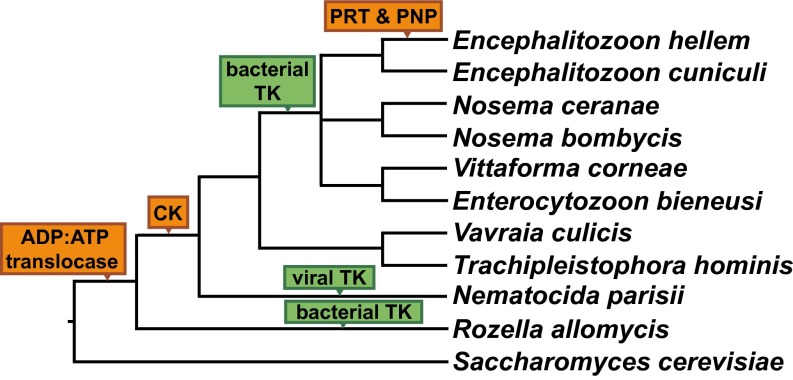
Schematic of nucleic acid metabolism HGT events in the Microsporidia and Cryptomycota. A cladogram of representative members of early-diverging fungi highlighting HGT-derived genes that function in the nucleic acid subpathway. Green boxes denote three independent horizontal transfers of TK, while orange boxes denote other horizontal transfers of nucleic acid metabolism genes (10, 11, 27).
Fig. S2.
Fig. S2.
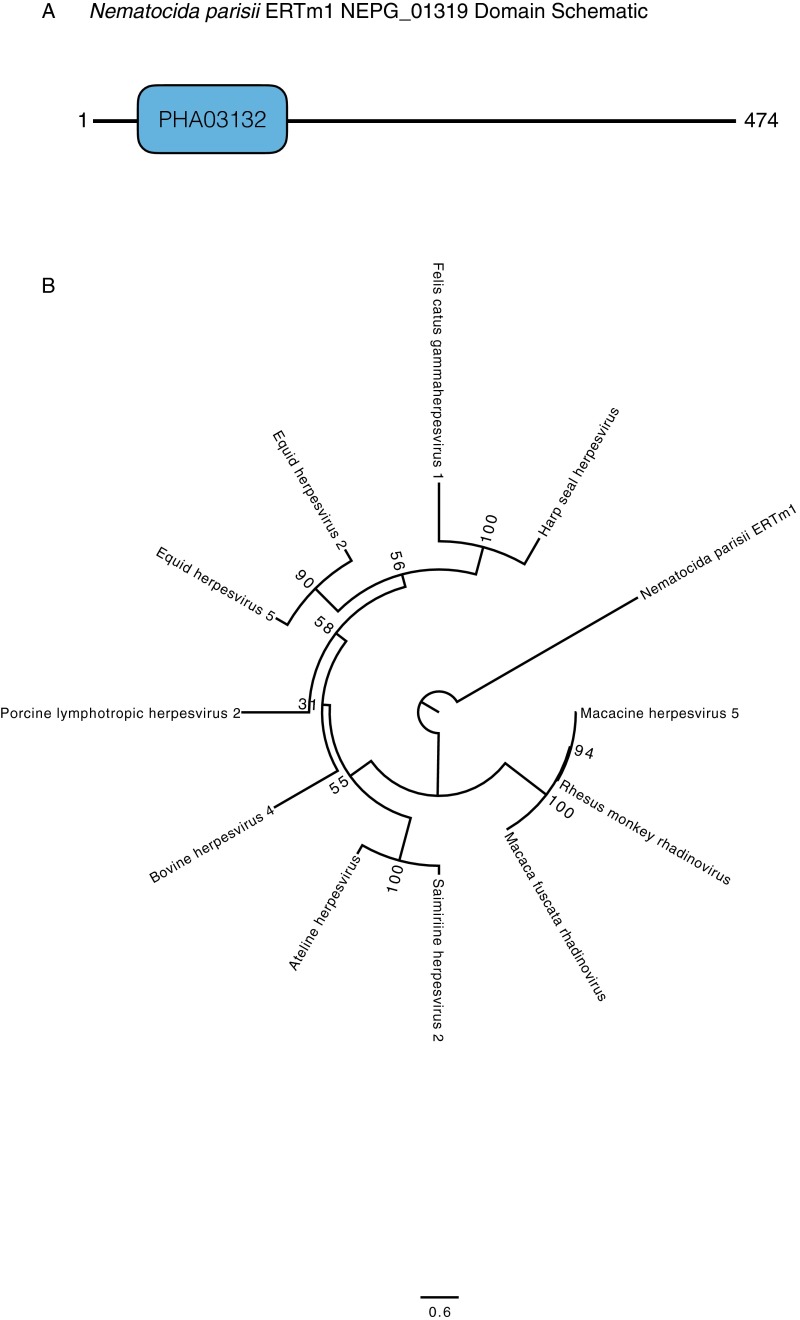
N. parisii has a putative viral TK. (A) Domain analysis of the N. parisii gene suggests the presence of a viral-like TK gene similar to those found in herpesviruses from various animals. (B) Phylogenetic analysis suggests a loose relationship between this hypothetical N. parisii gene and herpesvirus TK.

References

    1. Pál C, Papp B, Lercher MJ. Adaptive evolution of bacterial metabolic networks by horizontal gene transfer. Nat Genet. 2005;37(12):1372–1375. - PubMed
    1. Treangen TJ, Rocha EPC. Horizontal transfer, not duplication, drives the expansion of protein families in prokaryotes. PLoS Genet. 2011;7(1):e1001284. - PMC - PubMed
    1. Moreira D, López-García P. Ten reasons to exclude viruses from the tree of life. Nat Rev Microbiol. 2009;7(4):306–311. - PubMed
    1. Keeling PJ, Palmer JD. Horizontal gene transfer in eukaryotic evolution. Nat Rev Genet. 2008;9(8):605–618. - PubMed
    1. Marcet-Houben M, Gabaldón T. Acquisition of prokaryotic genes by fungal genomes. Trends Genet. 2010;26(1):5–8. - PubMed

Publication types

LinkOut - more resources