


A novel cutoff for the waist-to-height ratio predicting metabolic syndrome in young American adults
- PMID: 27036488
- PMCID: PMC4818465
- DOI: 10.1186/s12889-016-2964-6
A novel cutoff for the waist-to-height ratio predicting metabolic syndrome in young American adults
Abstract
Background: Recent studies have shown the enhanced diagnostic capability of the waist-to-height ratio (WHtR) over BMI. However, while a structured cutoff hierarchy has been established for BMI, a rigorous analysis to define individuals as obese using the WHtR has not been performed on a sample of American adults. This study attempts to establish a cutoff for the WHtR using metabolic syndrome as the outcome.
Methods: The study sample consisted of individuals that were part of the National Longitudinal Study of Adolescent Health (Add Health). The final sample for analysis consisted of 7 935 participants (3 469 males, 4 466 females) that were complete respondents for the variables of interest at Wave IV. The participants ranged from 24.55-33.60 years. Weighted and unweighted receiver operator characteristics (ROC) analyses were performed predicting metabolic syndrome from the WHtR. Cutoffs were chosen using the Youden index. The derived cutoffs were validated by logistic regression analysis on the Add Health participants and an external sample of 1 236 participants from the National Health and Nutrition Examination Survey (NHANES).
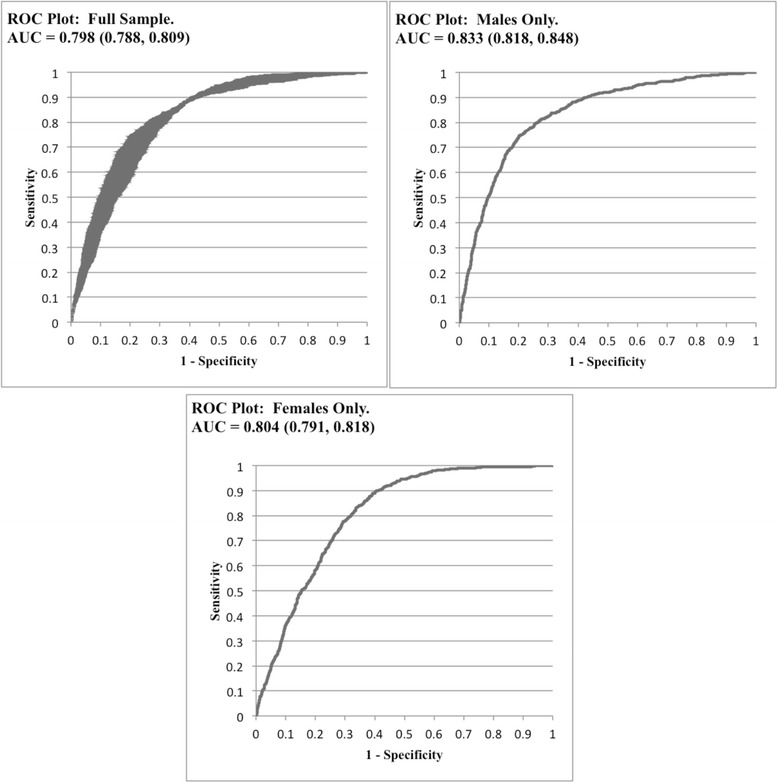
Results: The ROC analysis resulted in a WHtR cutoff of 0.578 (Youden Index = 0.50) for the full sample of complete respondents, 0.578 (Youden Index = 0.55) for males only, and 0.580 (Youden Index = 0.50) for females only. The area under the curve was 0.798 (95% CI (0.788, 0.809)) for the full sample of complete respondents, 0.833 (95% CI (0.818, 0.848)) for males only, and 0.804 (95% CI (0.791, 0.818)) for females only. Participants in the validation sample with a WHtR greater than the derived cutoff were more likely (Odds Ratio = 9.8, 95% CI (6.2, 15.3)) to have metabolic syndrome than those that were not.
Conclusion: A WHtR cutoff of 0.580 is optimal for discriminating individuals with metabolic syndrome in two nationally representative samples of young adults. This cutoff is an improvement over a previously recommended cutoff of 0.5 as well as other cutoffs derived from international samples.
Keywords: Cutoff; Epidemiology; Metabolic syndrome; Obesity; Waist-to-height ratio.
Figures
References
-
- National Center for Health Statistics. National Health and Nutrition Examination Survey. Questionnaires, datasets, and related documentation. Available at http://www.cdc.gov/nchs/nhanes/nhanes_questionnaires.htm.
-
- World Health Organization . Preventing chronic diseases: a vital investment. Geneva: WHO Global Report; 2005.
Publication types
MeSH terms
Grants and funding
LinkOut - more resources
Full Text Sources
Other Literature Sources
Medical
