. 2016 Mar 31:4:34.
doi: 10.1186/s40478-016-0299-2.

Upregulation of calpain activity precedes tau phosphorylation and loss of synaptic proteins in Alzheimer's disease brain

Affiliations

Upregulation of calpain activity precedes tau phosphorylation and loss of synaptic proteins in Alzheimer's disease brain

Ksenia Kurbatskaya et al. Acta Neuropathol Commun. .

Abstract

Alterations in calcium homeostasis are widely reported to contribute to synaptic degeneration and neuronal loss in Alzheimer's disease. Elevated cytosolic calcium concentrations lead to activation of the calcium-sensitive cysteine protease, calpain, which has a number of substrates known to be abnormally regulated in disease. Analysis of human brain has shown that calpain activity is elevated in AD compared to controls, and that calpain-mediated proteolysis regulates the activity of important disease-associated proteins including the tau kinases cyclin-dependent kinase 5 and glycogen kinase synthase-3. Here, we sought to investigate the likely temporal association between these changes during the development of sporadic AD using Braak staged post-mortem brain. Quantification of protein amounts in these tissues showed increased activity of calpain-1 from Braak stage III onwards in comparison to controls, extending previous findings that calpain-1 is upregulated at end-stage disease, and suggesting that activation of calcium-sensitive signalling pathways are sustained from early stages of disease development. Increases in calpain-1 activity were associated with elevated activity of the endogenous calpain inhibitor, calpastatin, itself a known calpain substrate. Activation of the tau kinases, glycogen-kinase synthase-3 and cyclin-dependent kinase 5 were also found to occur in Braak stage II-III brain, and these preceded global elevations in tau phosphorylation and the loss of post-synaptic markers. In addition, we identified transient increases in total amyloid precursor protein and pre-synaptic markers in Braak stage II-III brain, that were lost by end stage Alzheimer's disease, that may be indicative of endogenous compensatory responses to the initial stages of neurodegeneration. These findings provide insight into the molecular events that underpin the progression of Alzheimer's disease, and further highlight the rationale for investigating novel treatment strategies that are based on preventing abnormal calcium homeostasis or blocking increases in the activity of calpain or important calpain substrates.

Keywords: Alzheimer’s disease; Braak stage; Calpain; GSK-3; Postmortem brain; Synapse; Tau.


Figures
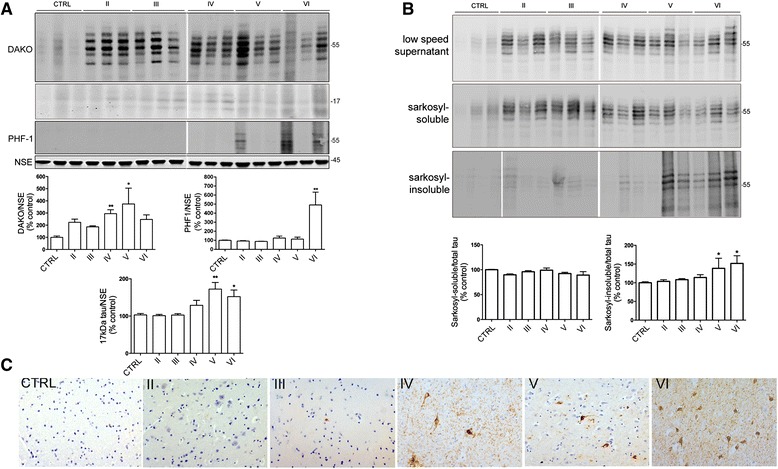
Fig. 1
Fig. 1
Total tau amounts are elevated throughout AD progression, whereas increased tau phosphorylation is only detectable at end-stage disease. a Representative immunoblots of cortical homogenates from postmortem brain. Blots were probed with antibodies to detect total (phosphorylated and non-phosphorylated) amounts of tau (DAKO) at 50 to 70 kDa, and tau phosphorylated at Ser396/404 (PHF-1) at 50 to 70 kDa. Blots were also probed with an antibody against neuron-specific enolase (NSE, 45 kDa) which acted as a loading control. Bar graphs show the amounts of DAKO and PHF-1 once standardized to NSE content in each sample. b Representative immunoblots of samples from sarkosyl extraction protocols showing low speed supernatants, sarkosyl-soluble and sarkosyl-insoluble tau probed with antibodies against total tau (DAKO). Bar charts show sarkosyl-soluble and sarkosyl-insoluble tau as a proportion of tau in low speed supernatants as a measure of total tau. c Postmortem brain sections immunostained with an anti-tau (AT8) antibody show Braak staging of AD brain. NFTs are absent from age-matched control brain. CTRL: control (n = 5), Braak II AD (n = 4), Braak III AD (n = 3), Braak IV AD (n = 4), Braak V AD (n = 3), Braak VI AD (n = 5). Data is mean ± SEM. *p < 0.05, **p < 0.01
Fig. 2
Fig. 2
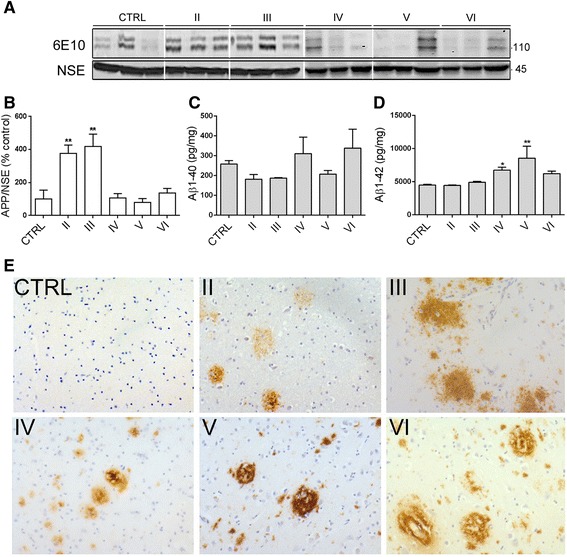
Transient elevations of total APP amounts in early AD, and persistent accumulation of Aβ1-42 at end-stage disease. a Representative immunoblots of cortical homogenates from postmortem brain. Blots were probed with the 6E10 antibody to detect full-length amyloid precursor protein (APP) at 110 to 130 kDa. Blots were also probed with an anti-neuron-specific enolase (NSE, 45 kDa) as a loading control. b Bar graph shows APP amounts in brain following standardization to NSE protein in the same sample. Aβ ELISAs were used to measure Aβ1-40 and Aβ1-42 amounts in pg mg−1 in these tissues. Bar graphs show (c) Aβ1-40 and (d) Aβ1-42 amounts in each sample. e postmortem brain sections immunostained with an anti-Aβ antibody show the progressive development of amyloid plaque pathology in AD brain. CTRL: control (n = 5), Braak II AD (n = 4), Braak III AD (n = 3), Braak IV AD (n = 4), Braak V AD (n = 3), Braak VI AD (n = 5). Data is mean ± SEM. *p < 0.05, **p < 0.01
Fig. 3
Fig. 3
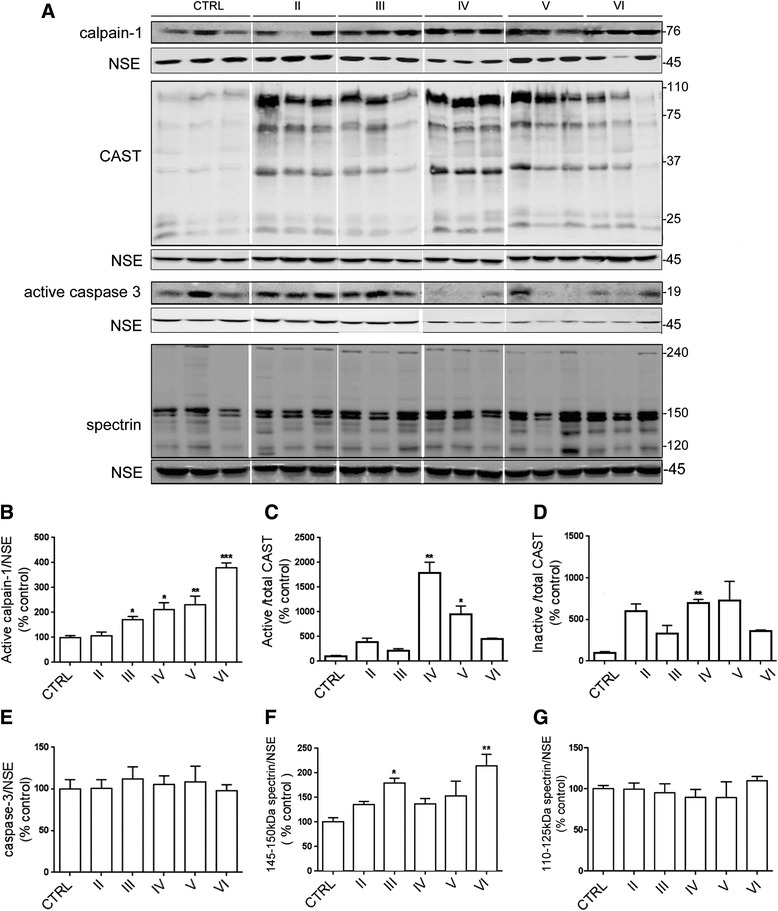
Active calpain-1 amounts are elevated early in AD and are sustained throughout disease progression. a Representative blots of cortical homogenates from postmortem brain. Blots were probed with antibodies to detect active calpain-1 at 76 kDa and active/cleaved caspase-3 at 19 kDa. An antibody against calpastatin (CAST) was used to detect CAST holoprotein at 110 kDa, active CAST at > 25 kDa and inactive CAST at < 25 kDa. An antibody against α-spectrin was used to detect holoprotein at 240 kDa, calpain- and caspase-cleaved fragments at 140 to 150 kDa and caspase-cleaved fragments at 110 to 130 kDa. Blots were also probed with an antibody against neuron-specific enolase (NSE, 45 kDa) as a loading control. Bar graphs show amounts of (b) active calpain-1 relative to NSE in each sample, (c) active CAST and (d) inactive CAST both as a proportion of total CAST (e) active caspase-3 relative to NSE, (f) caspase- and calpain- cleaved 140–150 kDa α-spectrin fragments and (g) caspase-cleaved 110–125 kD α-spectrin fragments, both standardized to NSE. CTRL: control (n = 5), Braak II AD (n = 4), Braak III AD (n = 3), Braak IV AD (n = 4), Braak V AD (n = 3), Braak VI AD (n = 5). Data is mean ± SEM. *p < 0.05, **p < 0.01, ***p < 0.001
Fig. 4
Fig. 4
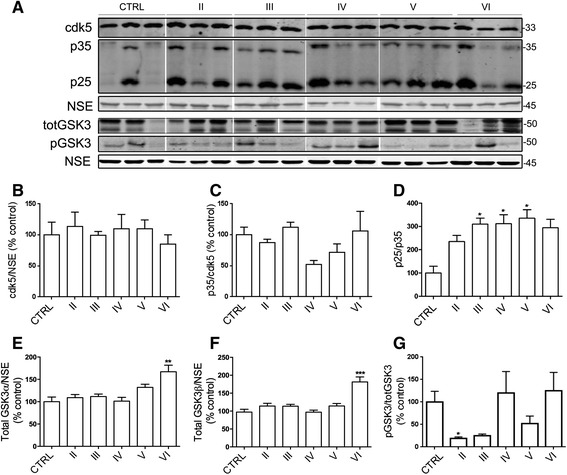
Changes in cdk5 and GSK-3 activities with AD progression. a Representative blots of cortical homogenates from postmortem brain. Blots were probed with antibodies against cyclin dependent kinase 5 (cdk5) to detect holoprotein at 33 kDa, p35 to detect holoprotein at 35 kDa and calpain-cleaved 25 kDa fragments (p25) at 25 kDa, total glycogen synthase kinase 3α/β (totGSK3) at 47 and 51 kDa, respectively and GSK3α/β phosphorylated at Ser21/9 (pGSK3). Blots were also probed with an antibody against neuron-specific enolase (NSE, 45 kDa) as a loading control. Bar graphs show amounts of (b) cdk5 relative to NSE, (c) p35 following normalisation to cdk5,  (d) the p25/p35 ratio, (e) GSK3α and (f) GSK3β relative to NSE, and (g) phosphorylated (inactive) GSK3 normalised to total GSK-3 protein. CTRL: control (n = 5), Braak II AD (n = 4), Braak III AD (n = 3), Braak IV AD (n = 4), Braak V AD (n = 3), Braak VI AD (n = 5). Data is mean ± SEM. *p < 0.05, **p < 0.01, ***p < 0.001
Fig. 5
Fig. 5
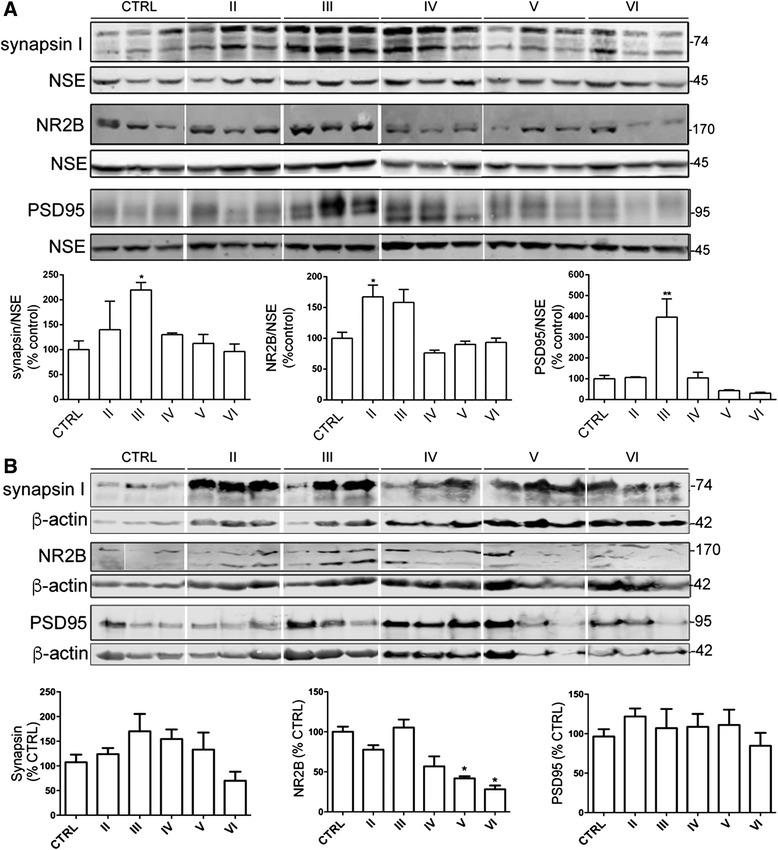
Pre- and post- synaptic protein amounts are altered during AD development. Representative blots of (a) supernatants and (b) pellets from cortical homogenates of postmortem brain. Blots were probed with antibodies against synapsin I holoprotein (74 kDa), the NR2B subunit of N-methyl D-aspartate receptor (NR2B,170 kDa) and post-synaptic density 95 protein (PSD95, 95 kDa. Blots were also probed with antibodies against neuron-specific enolase (NSE, 45 kDa) or β-actin (42 kDa) as loading controls. Bar graphs show amounts of synapsin I, NR2B and PSD95, all normalised to their respective loading control. CTRL: control (n = 5), Braak II AD (n = 4), Braak III AD (n = 3), Braak IV AD (n = 4), Braak V AD (n = 3), Braak VI AD (n = 5). Data is mean ± SEM. *p < 0.05, **p < 0.01
Fig. 6
Fig. 6
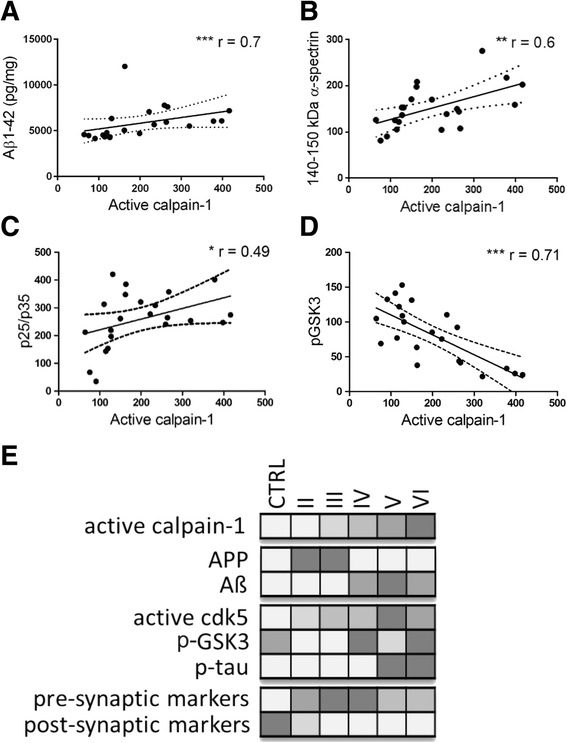
Calpain-1 activities in AD brain correlate with Aβ1-42 burden, cytoskeletal protein cleavage and kinase activities. Scatter plots show the correlation between amounts of active calpain-1 and (a) Aβ1-42, (b) calpain- and caspase-cleaved α-spectrin fragments and (c) p25 in all tissue samples. Correlation analysis was used to generate correlation co-efficients (r values) and significance. *p < 0.05, **p < 0.01, ***p < 0.001. d Qualitative plot illustrating the stage of disease at which changes were observed in calpain-1 activity, total APP protein, Aβ1-42 amounts, active cdk5 (p25/cdk5), active GSK-3 (reductions in pGSK-3), p-tau (tau phosphorylated at Ser396/404), pre- (synapsin-1) and post- (PSD-95) synaptic marker amounts. Relative amounts are indicated in grey scale, with low protein amounts signified by pale shading and large amounts by dark shading

References

    1. Ando K, Brion JP, Stygelbout V, Suain V, Authelet M, Dedecker R, Chanut A, Lacor P, Lavaur J, Sazdovitch V, Rogaeva E, Potier MC, Duyckaerts C. Clathrin adaptor CALM/PICALM is associated with neurofibrillary tangles and is cleaved in Alzheimer’s brains. Acta Neuropathol. 2013;125:861–878. doi: 10.1007/s00401-013-1111-z. - DOI - PubMed
    1. Atherton J, Kurbatskaya K, Bondulich M, Croft CL, Garwood CJ, Chhabra R, Wray S, Jeromin A, Hanger DP, Noble W. Calpain cleavage and inactivation of the sodium calcium exchanger-3 occur downstream of Aβ in Alzheimer’s disease. Aging Cell. 2014;13:49–59. doi: 10.1111/acel.12148. - DOI - PMC - PubMed
    1. Bähler M, Benfenati F, Valtorta F, Greengard P. The synapsins and the regulation of synaptic function. Bioessays. 1990;12:259–263. doi: 10.1002/bies.950120603. - DOI - PubMed
    1. Baki A, Tompa P, Alexa A, Molnár O, Friedrich P (1996) Autolysis parallels activation of mu-calpain. Biochem J 318 (Pt 3:897–901. - PMC - PubMed
    1. Bayés À, Collins MO, Galtrey CM, Simonnet C, Roy M, Croning MD, Gou G, van de Lagemaat LN, Milward D, Whittle IR, Smith C, Choudhary JS, Grant SG. Human post-mortem synapse proteome integrity screening for proteomic studies of postsynaptic complexes. Mol Brain. 2014;7:88. doi: 10.1186/s13041-014-0088-4. - DOI - PMC - PubMed

Publication types

MeSH terms