. 2016 Apr 1:16:260.
doi: 10.1186/s12885-016-2290-5.

Systematic review: brain metastases from colorectal cancer--Incidence and patient characteristics

Affiliations

Systematic review: brain metastases from colorectal cancer--Incidence and patient characteristics

Troels Dreier Christensen et al. BMC Cancer. .

Abstract

Background: Brain metastases (BM) from colorectal cancer (CRC) are a rare event. However, the implications for affected patients are severe, and the incidence has been reported to be increasing. For clinicians, knowledge about the characteristics associated with BM is important and could lead to earlier diagnosis and improved survival.

Method: In this paper, we describe the incidence as well as characteristics associated with BM based on a systematic review of the current literature, following the PRISMA guidelines.

Results: We show that the incidence of BM in CRC patients ranges from 0.6 to 3.2%. BM are a late stage phenomenon, and young age, rectal primary and lung metastases are associated with increased risk of developing BM. Molecular markers such as KRAS, BRAF, NRAS mutation as well as an increase in CEA and CA19.9 levels are suggested predictors of brain involvement. However, only KRAS mutations are reasonably well investigated and associated with an increased risk of BM.

Conclusion: The incidence of BM from CRC is 0.6 to 3.2% and did not seem to increase over time. Development of BM is associated with young age, lung metastases, rectal primary and KRAS mutation. Increased awareness of brain involvement in patients with these characteristics is necessary.

Keywords: Brain metastases; Colorectal cancer; Incidence; Lung metastases; RAS mutations.


Figures
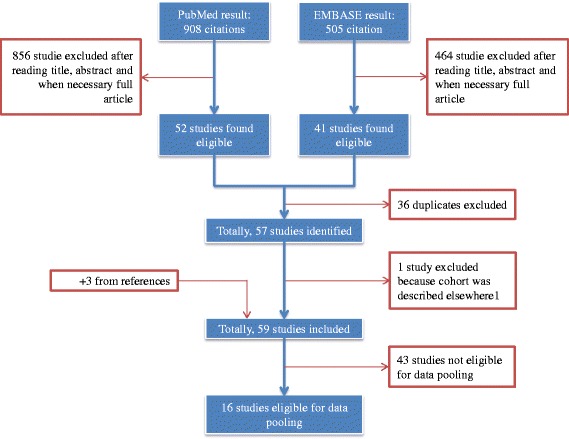
Fig. 1
Fig. 1
Consort diagram
Fig. 2
Fig. 2
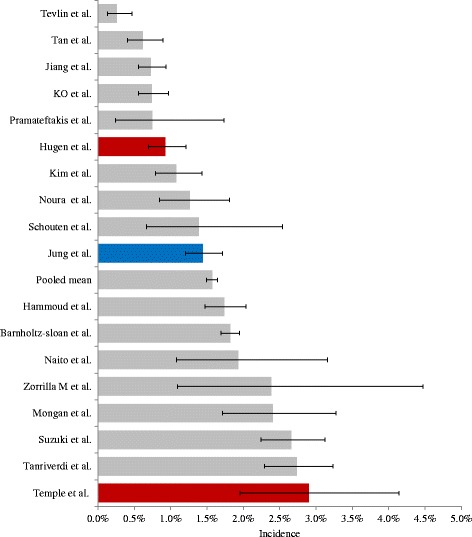
Incidence of brain metastases in patients with colorectal cancer. Incidence of brain metastases (BM) from colorectal cancer (CRC) in the 19 studies that identified patient with BM from populations including all patients diagnosed with CRC. Error bars indicate 95 % confidence interval. Gray: Studies with radiologically diagnosed brain metastases (17). Red: Autopsy studies (2). Blue: Pooled mean based on studies with radiologically diagnosed brain metastases
Fig. 3
Fig. 3
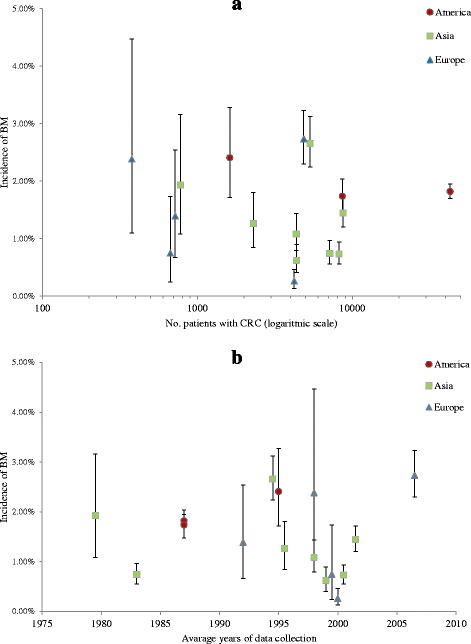
Incidence according to no. patients, years and region of data collection. Incidence of brain metastases (BM) in the 17 studies that included all patients diagnosed with colorectal cancer (CRC). Error bars indicate 95 % confidence interval. a - Incidence of BM according to size of cohorts. Studies sorted by regions. b - Incidence of BM from CRC according to average year of data collection. Studies sorted by region

References

    1. Ferlay J, Soerjomataram I, Dikshit R, Eser S, Mathers C, Rebelo M, Parkin DM, Forman D, Bray F. Cancer incidence and mortality worldwide: sources, methods and major patterns in GLOBOCAN 2012. Int J Cancer. 2015;136(5):E359–386. doi: 10.1002/ijc.29210. - DOI - PubMed
    1. Go PH, Klaassen Z, Meadows MC, Chamberlain RS. Gastrointestinal cancer and brain metastasis: a rare and ominous sign. Cancer. 2011;117(16):3630–3640. doi: 10.1002/cncr.25940. - DOI - PubMed
    1. Nayak L, Lee EQ, Wen PY. Epidemiology of brain metastases. Curr Oncol Rep. 2012;14(1):48–54. doi: 10.1007/s11912-011-0203-y. - DOI - PubMed
    1. Damiens K, Ayoub JP, Lemieux B, Aubin F, Saliba W, Campeau MP, Tehfe M. Clinical features and course of brain metastases in colorectal cancer: an experience from a single institution. Curr Oncol. 2012;19(5):254–258. doi: 10.3747/co.19.1048. - DOI - PMC - PubMed
    1. Moher D, Liberati A, Tetzlaff J, Altman DG. Preferred reporting items for systematic reviews and meta-analyses: the PRISMA statement. Ann Intern Med. 2009;151(4):264–269. doi: 10.7326/0003-4819-151-4-200908180-00135. - DOI - PubMed

Publication types

MeSH terms