


Improved eating behaviours mediate weight gain prevention of young adults: moderation and mediation results of a randomised controlled trial of TXT2BFiT, mHealth program
- PMID: 27039178
- PMCID: PMC4818870
- DOI: 10.1186/s12966-016-0368-8
Improved eating behaviours mediate weight gain prevention of young adults: moderation and mediation results of a randomised controlled trial of TXT2BFiT, mHealth program
Abstract
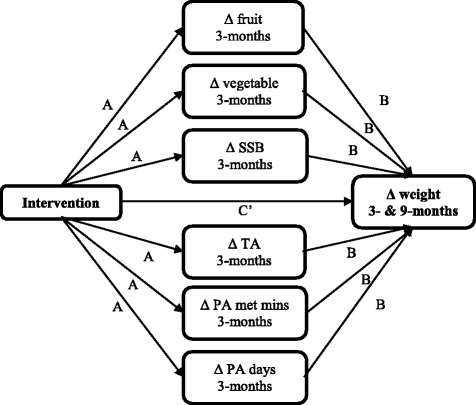
Background: Explanatory evaluation of interventions for prevention of weight gain is required beyond changes in weight, to determine for whom the intervention works and the underlying mechanisms of change. It was hypothesised that participant characteristics moderate intervention effect on weight change and improved eating and physical activity behaviours during the 3-month program mediate the relationship between intervention and weight.
Methods: In our randomised controlled trial, young adults at risk of weight gain (n = 250) were assigned either to an intervention group that received a 3-month mHealth (TXT2BFiT) program with 6-month maintenance or to a control group. Data were collected via online self-report surveys. Hypothesised moderators and mediators of the intervention effect on weight were independently assessed in PROCESS macro models for 3 and 9-month weight change.
Results: Males (P = 0.01), mid-20s age group (P = 0.04), and higher income earners (P = 0.02) moderated intervention effects on weight change at 3-months and males only at 9-months (P = 0.02). Weight change at 3 (-1.12 kg) and 9-months (-1.38 kg) remained significant when 3-month nutrition and physical activity behaviours were specified as mediators (P <0.01 and P = 0.01 respectively). Indirect paths explained 39% (0.72/1.85 kg) and 40 % (0.92/2.3 kg) of total effect on weight change at 3 and 9-months respectively. Increased vegetable intake by intervention group at 3-months accounted for 19 and 17% and decreased sugar-sweetened beverages accounted for 8 and 13% of indirect weight change effects at 3 and 9-months respectively.
Conclusions: TXT2BFiT was effective for both young men and women. Small sustained behavioural changes, including increased vegetable intake and decreased sugar-sweetened beverages consumption significantly mediated the intervention's effects on weight change. Improved eating behaviours and increased physical activity accounted for approximately 40% of the weight change.
Trial registration: The trial is registered with the Australian New Zealand Clinical Trials Registry ( ACTRN12612000924853 ).
Keywords: Lifestyle; Mediation; Moderation; Nutrition; Obesity prevention; Young adults; mHealth.
Figures
References
-
- Ng M, Fleming T, Robinson M, Thomson B, Graetz N, Margono C, et al. Global, regional, and national prevalence of overweight and obesity in children and adults during 1980–2013: a systematic analysis for the Global Burden of Disease Study 2013. Lancet. 2014;384(9945):766–81. doi: 10.1016/S0140-6736(14)60460-8. - DOI - PMC - PubMed
-
- Tanamas SK, Magliano DJ, Lynch B, Sethi P, Willenberg L, Polkinghorne K, et al. AusDiab 2012. The Australian Diabetes, Obesity and Lifestyle Study. Melbourne, Australia: Baker IDI Heart and Diabetes Institute; 2013.
-
- Australian Bureau of Statistics . Australian Health Survey: First Results, 2014–15 cat no. 4364.0.55.001. Canberra: ACT; 2015.
-
- Bertoia ML, Mukamal KJ, Cahill LE, Hou T, Ludwig DS, Mozaffarian D, et al. Changes in intake of fruits and vegetables and weight change in United States Men and Women followed for up to 24 years: analysis from three prospective cohort studies. PLoS Med. 2015;12(9):e1001878. doi: 10.1371/journal.pmed.1001878. - DOI - PMC - PubMed
Publication types
MeSH terms
Substances
Associated data
LinkOut - more resources
Full Text Sources
Other Literature Sources
Medical
