


Sex differences in the functional connectivity of the amygdalae in association with cortisol
- PMID: 27039701
- PMCID: PMC6594554
- DOI: 10.1016/j.neuroimage.2016.03.064
Sex differences in the functional connectivity of the amygdalae in association with cortisol
Abstract
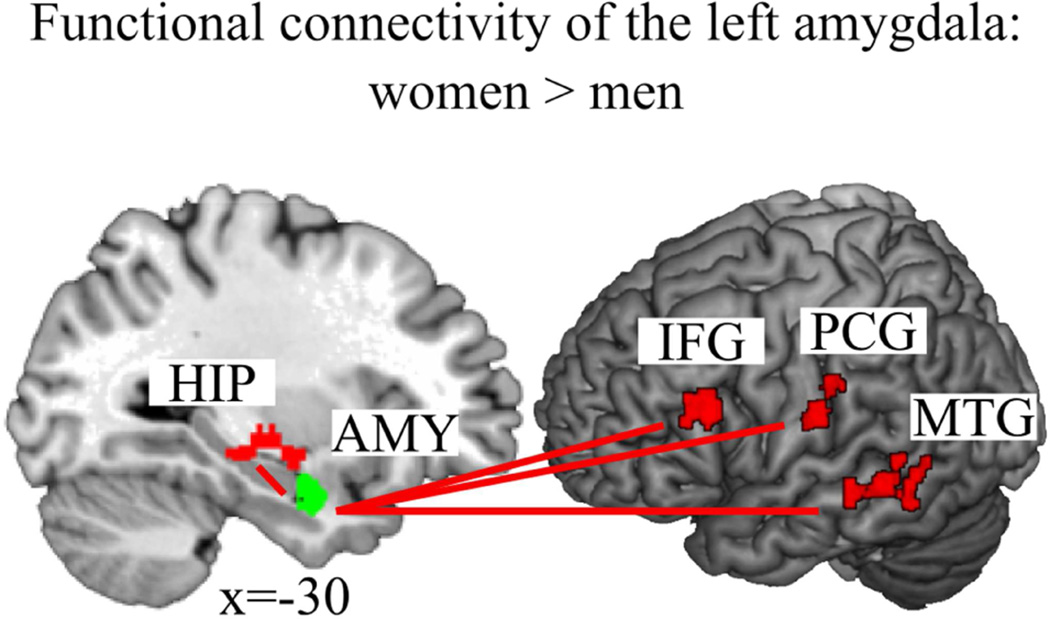
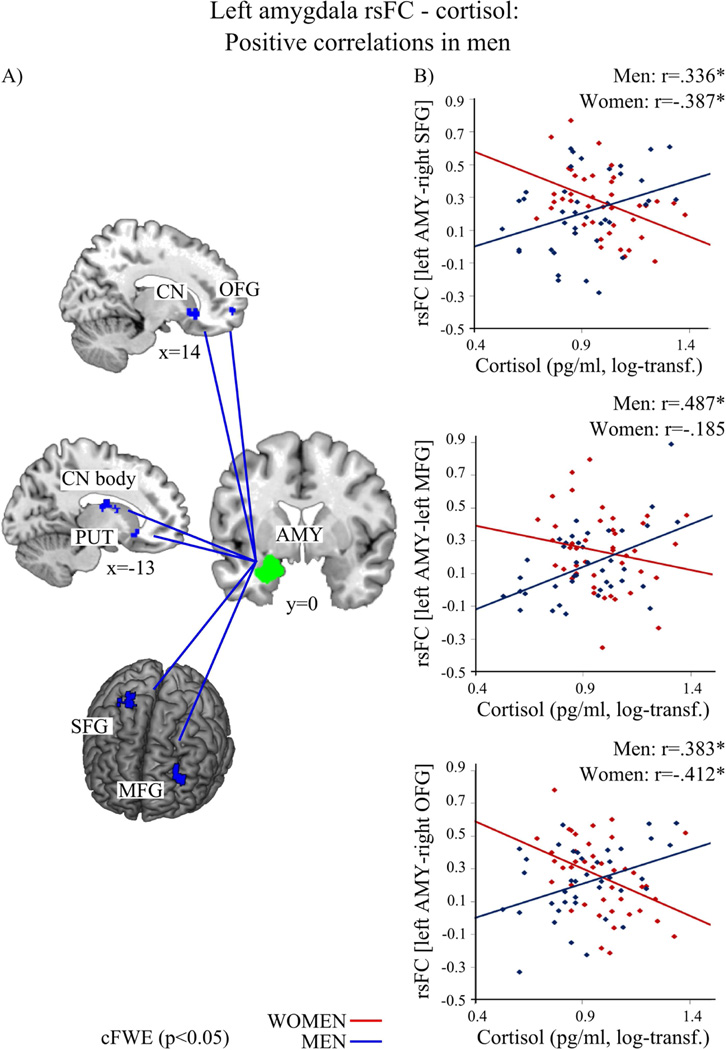
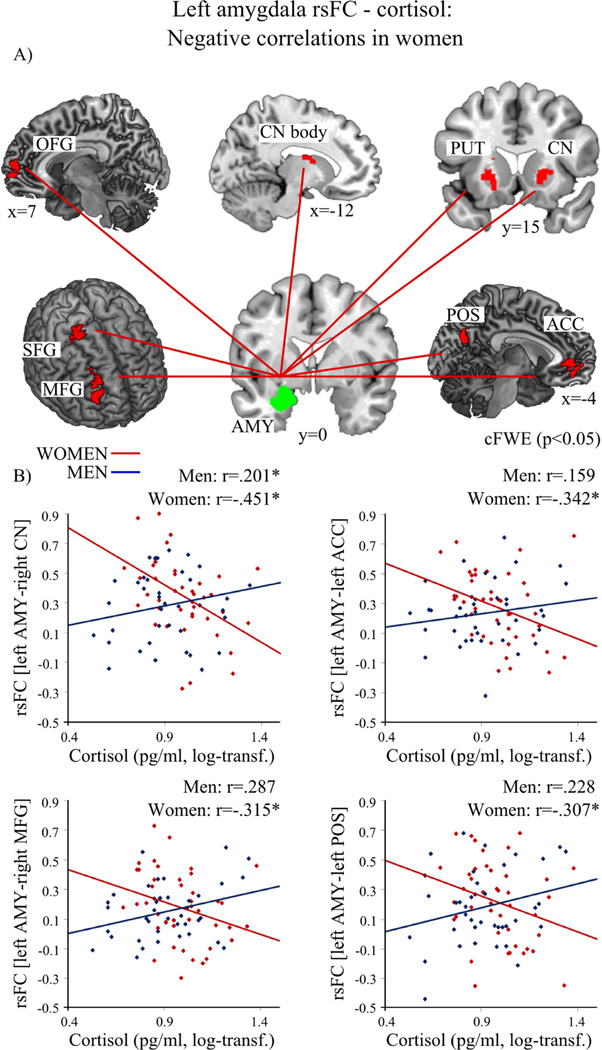
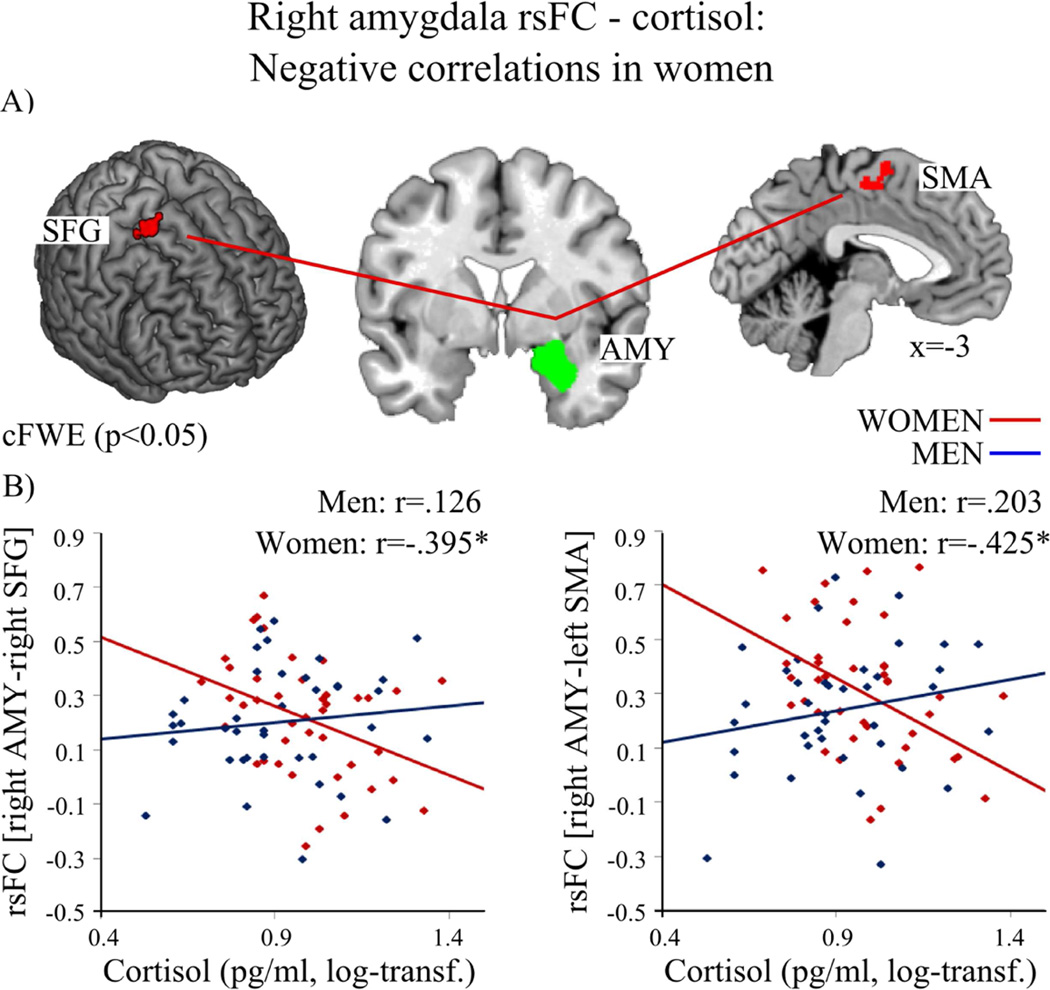
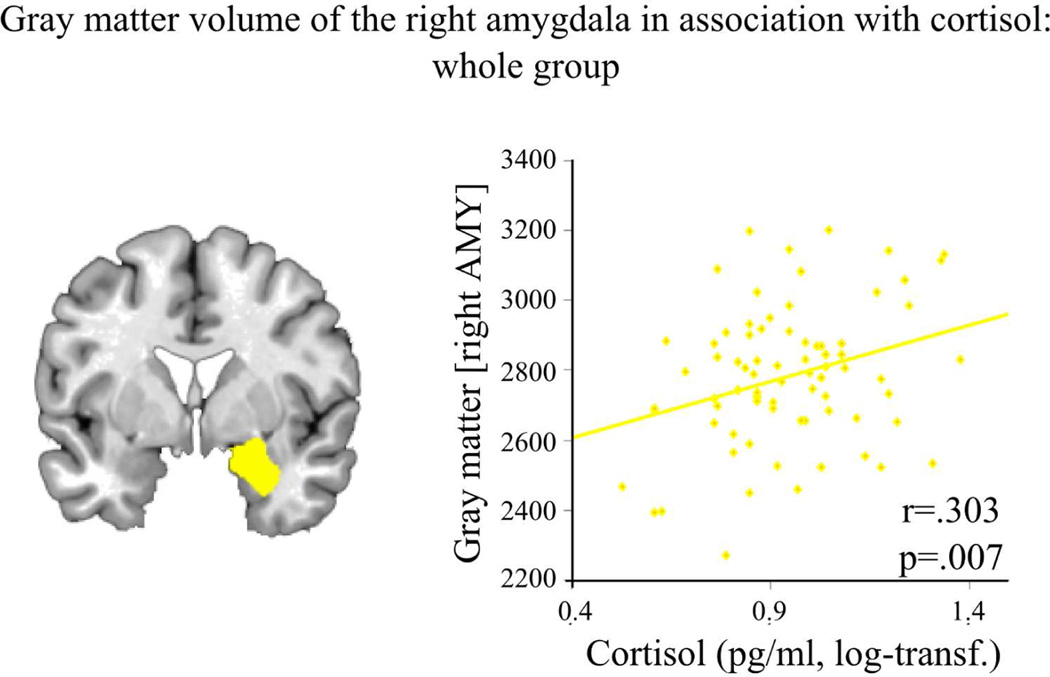
Human amygdalae are involved in various behavioral functions such as affective and stress processing. For these behavioral functions, as well as for psychophysiological arousal including cortisol release, sex differences are reported. Here, we assessed cortisol levels and resting-state functional connectivity (rsFC) of left and right amygdalae in 81 healthy participants (42 women) to investigate potential modulation of amygdala rsFC by sex and cortisol concentration. Our analyses revealed that rsFC of the left amygdala significantly differed between women and men: Women showed stronger rsFC than men between the left amygdala and left middle temporal gyrus, inferior frontal gyrus, postcentral gyrus and hippocampus, regions involved in face processing, inner-speech, fear and pain processing. No stronger connections were detected for men and no sex difference emerged for right amygdala rsFC. Also, an interaction of sex and cortisol appeared: In women, cortisol was negatively associated with rsFC of the amygdalae with striatal regions, mid-orbital frontal gyrus, anterior cingulate gyrus, middle and superior frontal gyri, supplementary motor area and the parietal-occipital sulcus. Contrarily in men, positive associations of cortisol with rsFC of the left amygdala and these structures were observed. Functional decoding analyses revealed an association of the amygdalae and these regions with emotion, reward and memory processing, as well as action execution. Our results suggest that functional connectivity of the amygdalae as well as the regulatory effect of cortisol on brain networks differs between women and men. These sex-differences and the mediating and sex-dependent effect of cortisol on brain communication systems should be taken into account in affective and stress-related neuroimaging research. Thus, more studies including both sexes are required.
Keywords: Cortisol; Frontal cortex; Hippocampus; Resting-state; Striatum; Task-independent.
Copyright © 2016 The Authors. Published by Elsevier Inc. All rights reserved.
Conflict of interest statement
All authors declare no conflict of interest in relation to the manuscript.
Figures
Similar articles
-
Developmental sex differences in resting state functional connectivity of amygdala sub-regions.Neuroimage. 2015 Jul 15;115:235-44. doi: 10.1016/j.neuroimage.2015.04.013. Epub 2015 Apr 14. Neuroimage. 2015. PMID: 25887261 Free PMC article.
-
Sex-specific neural circuits of emotion regulation in the centromedial amygdala.Sci Rep. 2016 Mar 23;6:23112. doi: 10.1038/srep23112. Sci Rep. 2016. PMID: 27004933 Free PMC article.
-
Maternal Cortisol Concentrations During Pregnancy and Sex-Specific Associations With Neonatal Amygdala Connectivity and Emerging Internalizing Behaviors.Biol Psychiatry. 2019 Jan 15;85(2):172-181. doi: 10.1016/j.biopsych.2018.06.023. Epub 2018 Jul 7. Biol Psychiatry. 2019. PMID: 30122286 Free PMC article.
-
Associations between brain activity and endogenous and exogenous cortisol - A systematic review.Psychoneuroendocrinology. 2020 Oct;120:104775. doi: 10.1016/j.psyneuen.2020.104775. Epub 2020 Jun 18. Psychoneuroendocrinology. 2020. PMID: 32592873 Free PMC article.
-
Sex Differences in the Development of the Rodent Corticolimbic System.Front Neurosci. 2020 Sep 30;14:583477. doi: 10.3389/fnins.2020.583477. eCollection 2020. Front Neurosci. 2020. PMID: 33100964 Free PMC article. Review.
Cited by
-
Reversed patterns of resting state functional connectivity for females vs. males in posttraumatic stress disorder.Neurobiol Stress. 2021 Sep 1;15:100389. doi: 10.1016/j.ynstr.2021.100389. eCollection 2021 Nov. Neurobiol Stress. 2021. PMID: 34527793 Free PMC article.
-
The capacity of action observation to drag the trainees' motor pattern toward the observed model.Sci Rep. 2023 Jun 5;13(1):9107. doi: 10.1038/s41598-023-35664-w. Sci Rep. 2023. PMID: 37277395 Free PMC article. Clinical Trial.
-
The waiting game: investigating the neurobiological transition from acute to persistent pain in adolescent rats.Cereb Cortex. 2023 May 9;33(10):6382-6393. doi: 10.1093/cercor/bhac511. Cereb Cortex. 2023. PMID: 36610738 Free PMC article.
-
Data-Driven Subgroups in Depression Derived from Directed Functional Connectivity Paths at Rest.Neuropsychopharmacology. 2017 Dec;42(13):2623-2632. doi: 10.1038/npp.2017.97. Epub 2017 May 12. Neuropsychopharmacology. 2017. PMID: 28497802 Free PMC article.
-
Resilience, pain, and the brain: Relationships differ by sociodemographics.J Neurosci Res. 2021 May;99(5):1207-1235. doi: 10.1002/jnr.24790. Epub 2021 Feb 19. J Neurosci Res. 2021. PMID: 33606287 Free PMC article.
References
-
- Achim M, Lepage M. Neural correlates of memory for items and for associations: An event-related functional magnetic resonance imaging study. J. Cogn. Neurosci. 2005;14:652–667. - PubMed
-
- Andreano JM, Arjomandi H, Cahill L. Menstrual cycle modulation of the relationship between cortisol and long-term memory. Psychoneuroendocrinology. 2008;33:874–882. - PubMed
Publication types
MeSH terms
Substances
Grants and funding
LinkOut - more resources
Full Text Sources
Other Literature Sources
