


Evaluating Usability of Radiology Information Systems in Hospitals of Tabriz University of Medical Sciences
- PMID: 27041810
- PMCID: PMC4789628
- DOI: 10.5455/aim.2016.24.42-46
Evaluating Usability of Radiology Information Systems in Hospitals of Tabriz University of Medical Sciences
Abstract
Introduction and purpose: Radiology information system (RIS) in order to reduce workload and improve the quality of services must be well-designed. Heuristic evaluation is one of the methods that understand usability problems with the least time, cost and resources. The aim of present study is to evaluate the usability of RISs in hospitals.
Research method: This is a cross-sectional descriptive study (2015) that uses heuristic evaluation method to evaluate the usability of RIS used in 3 hospitals of Tabriz city. The data are collected using a standard checklist based on 13 principles of Nielsen Heuristic evaluation method. Usability of RISs was investigated based on the number of components observed from Nielsen principles and problems of usability based on the number of non-observed components as well as non-existent or unrecognizable components.
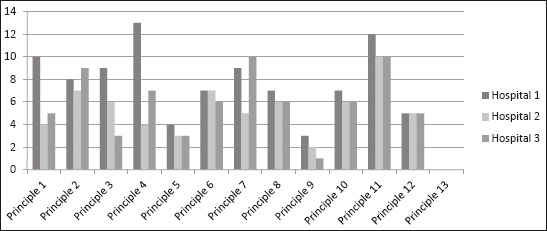
Results: by evaluation of RISs in each of the hospitals 1, 2 and 3, total numbers of observed components were obtained as 173, 202 and 196, respectively. It was concluded that the usability of RISs in the studied population, on average and with observing 190 components of the 291 components related to the 13 principles of Nielsen is 65.41 %. Furthermore, problems of usability were obtained as 26.35%.
Discussion and conclusion: The established and visible nature of some components such as response time of application, visual feedbacks, colors, view and design and arrangement of software objects cause more attention to these components as principal components in designing UI software. Also, incorrect analysis before system design leads to a lack of attention to secondary needs like Help software and security issues.
Keywords: Heuristic evaluation; Radiology information system; Usability; User interface.
Conflict of interest statement
Figures



References
-
- Sadoughi F, Khoshkam M, Farahi SR. Usability Evaluation of Hospital Information Systems in Hospitals Affiliated with Mashhad University of Medical Sciences, Iran. Health Information Management. 2012;9(3)
-
- Rabiei R, Moghaddasi H, Hosseini AS, Paydar S. A Study on Radiology Management Information System (RMIS) in Teaching Hospitals Affiliated to Medical Universities in Tehran. Health Information Management. 2013;12(1)
-
- Cimino JJ, Shortliffe EH. Biomedical Informatics: Computer Applications in Health Care and Biomedicine (Health Informatics) Springer-Verlag New York, Inc; 2006.
-
- Wolbarst AB. Imaging Systems for Medical Diagnosticsc: Fundamentals, Technical Solutions and Applications for Systems Applying Ionizing Radiation, Nuclear Magnetic Resonance and Ultrasound. LWW. 2006
-
- Houghton J. ICTs and the Environment in Developing Countries: Opportunities and Developments. The Development Dimension ICTs for Development Improving Policy Coherence: Improving Policy Coherence. 2010:149.
LinkOut - more resources
Full Text Sources
Other Literature Sources