Clinical Trial
. 2016 Apr 4;11(4):e0152781.
doi: 10.1371/journal.pone.0152781. eCollection 2016.

Reduction of Pavlovian Bias in Schizophrenia: Enhanced Effects in Clozapine-Administered Patients

Affiliations
Clinical Trial

Reduction of Pavlovian Bias in Schizophrenia: Enhanced Effects in Clozapine-Administered Patients

Matthew A Albrecht et al. PLoS One. .

Abstract

The negative symptoms of schizophrenia (SZ) are associated with a pattern of reinforcement learning (RL) deficits likely related to degraded representations of reward values. However, the RL tasks used to date have required active responses to both reward and punishing stimuli. Pavlovian biases have been shown to affect performance on these tasks through invigoration of action to reward and inhibition of action to punishment, and may be partially responsible for the effects found in patients. Forty-five patients with schizophrenia and 30 demographically-matched controls completed a four-stimulus reinforcement learning task that crossed action ("Go" or "NoGo") and the valence of the optimal outcome (reward or punishment-avoidance), such that all combinations of action and outcome valence were tested. Behaviour was modelled using a six-parameter RL model and EEG was simultaneously recorded. Patients demonstrated a reduction in Pavlovian performance bias that was evident in a reduced Go bias across the full group. In a subset of patients administered clozapine, the reduction in Pavlovian bias was enhanced. The reduction in Pavlovian bias in SZ patients was accompanied by feedback processing differences at the time of the P3a component. The reduced Pavlovian bias in patients is suggested to be due to reduced fidelity in the communication between striatal regions and frontal cortex. It may also partially account for previous findings of poorer "Go-learning" in schizophrenia where "Go" responses or Pavlovian consistent responses are required for optimal performance. An attenuated P3a component dynamic in patients is consistent with a view that deficits in operant learning are due to impairments in adaptively using feedback to update representations of stimulus value.


Conflict of interest statement

Competing Interests: The authors have declared that no competing interests exist.

Figures

Fig 1
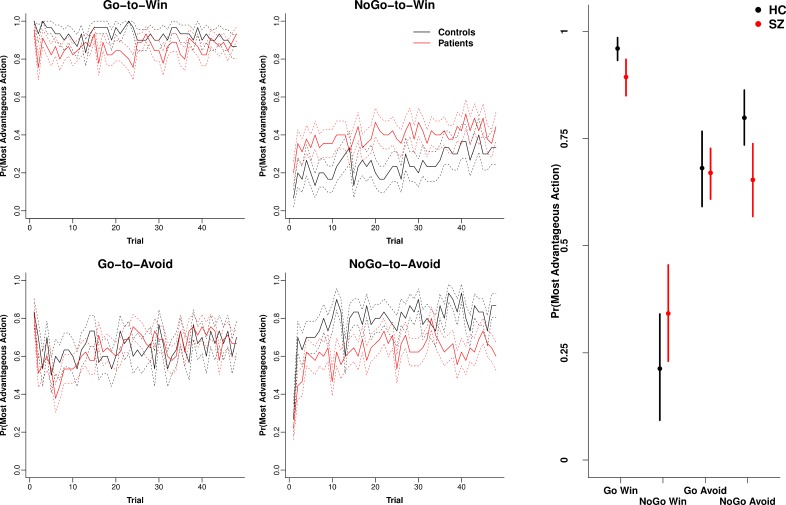
Fig 1. Performance accuracy.
Left) Averaged performance across trials (± SE) for controls and patients with schizophrenia for each of the four conditions. Right) Means and 95% HDI intervals obtained from the posterior of the Bayesian ANOVA-style model for each of the four conditions. Credible reductions in patients compared to controls were observed for the “Go-to-Win” and “NoGo-to-Win” conditions. N = 45 patients and 30 controls.
Fig 2
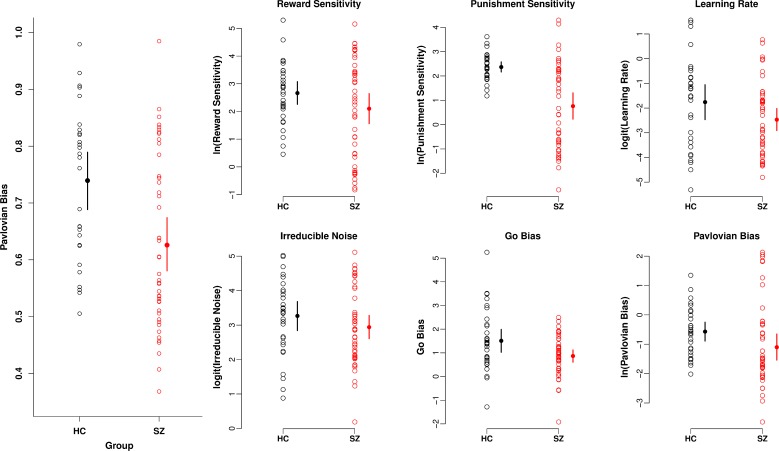
Fig 2. Pavlovian bias and modelled parameters.
Left) Pavlovian performance bias calculated from the behavioural data contrasting reward based invigoration and punishment based-suppression. A larger value indicates greater Pavlovian bias. Right) Parameters extracted from the final reinforcement learning model used to fit the data. Means and 95% HDI of the posterior are presented obtained from a robust Bayesian t-test.
Fig 3
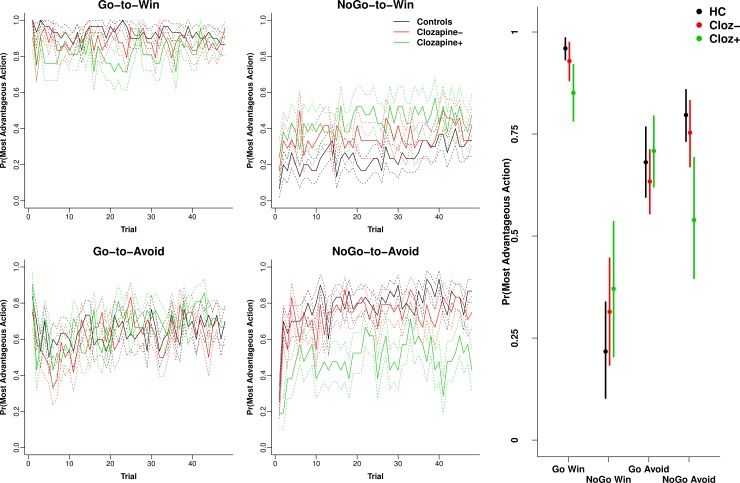
Fig 3. Clozapine Performance accuracy.
Left) Averaged performance across trials (± SE) for controls and patients broken down by clozapine status for each of the four conditions. Right) Means and 95% HDI intervals obtained from the posterior of the Bayesian ANOVA-style model for each of the four conditions. Clozapine enhanced the patient control differences depicted in Fig 1.
Fig 4
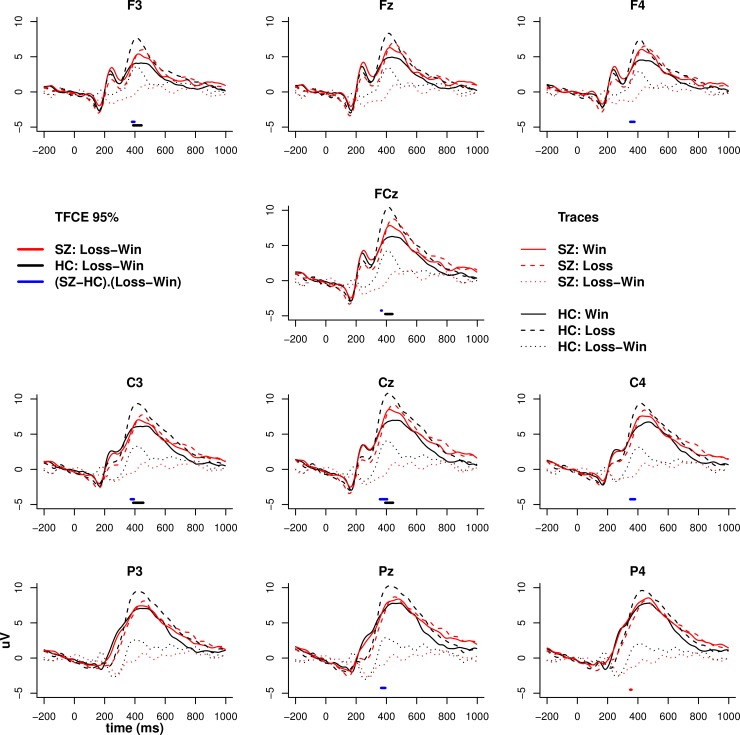
Fig 4. ERP to feedback.
ERP to wins (thumbs up; solid lines), losses (thumbs down; dashed lines) and their contrast (dotted lines) for patients and controls. Solid horizontal bars at the bottom of each trace represent Threshold Free Cluster Enhancement (TFCE) significance values at 0.05 obtained from permutation testing.
Fig 5
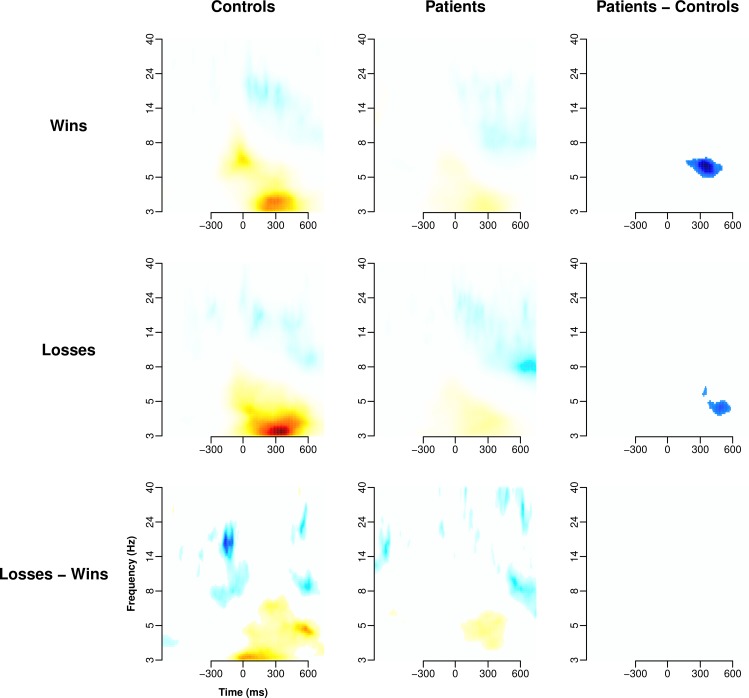
Fig 5. Time-frequency response to feedback.
TFCE filtered time-frequency maps for wins, losses and their contrasts. Time-frequency analysis was conducted on the average of the three central midline electrodes Fz, FCz, and Cz. Colours are arbitrary, but symmetrical, mappings derived from the TFCE analysis scaled for best contrast. White spaces represent no significant contrast.
Fig 6
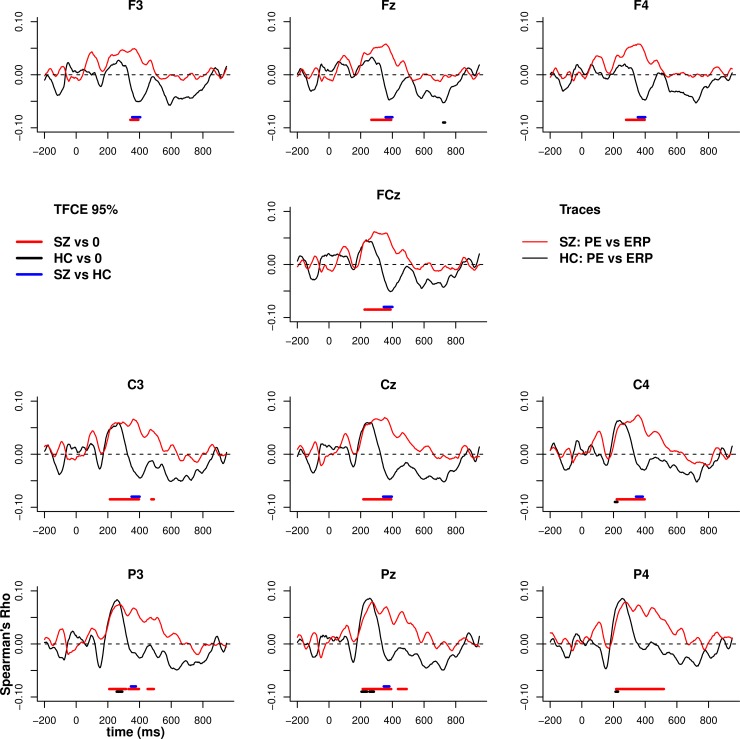
Fig 6. Relationship between PE and voltage.
Spearman's correlation between voltage and the estimate of prediction error (PE) obtained from the reinforcement learning model. Correlations between PE and voltage were calculated for each person across all trials at each time point then group averaged. Solid horizontal bars indicated TFCE significance at 0.05. The relationship between PE and voltage is significant for both phases using a directed contrast.

References

    1. Waltz JA, Gold JM. Probabilistic reversal learning impairments in schizophrenia: Further evidence of orbitofrontal dysfunction. Schizophr Res. 2007. July;93(1–3):296–303. - PMC - PubMed
    1. Strauss GP, Waltz JA, Gold JM. A Review of Reward Processing and Motivational Impairment in Schizophrenia. Schizophr Bull. 2014. January 3;40(Suppl 2):S107–16. 10.1093/schbul/sbt197 - DOI - PMC - PubMed
    1. Morris SE, Heerey EA, Gold JM, Holroyd CB. Learning-related changes in brain activity following errors and performance feedback in schizophrenia. Schizophr Res. 2008. February;99(1–3):274–85. - PMC - PubMed
    1. Koch K, Schachtzabel C, Wagner G, Schikora J, Schultz C, Reichenbach JR, et al. Altered activation in association with reward-related trial-and-error learning in patients with schizophrenia. NeuroImage. 2010. March;50(1):223–32. 10.1016/j.neuroimage.2009.12.031 - DOI - PubMed
    1. Premkumar P, Fannon D, Kuipers E, Simmons A, Frangou S, Kumari V. Emotional decision-making and its dissociable components in schizophrenia and schizoaffective disorder: A behavioural and MRI investigation. Neuropsychologia. 2008. June;46(7):2002–12. 10.1016/j.neuropsychologia.2008.01.022 - DOI - PMC - PubMed

Publication types