Randomized Controlled Trial
. 2016 Mar 14:20:92.
doi: 10.1186/s13054-016-1245-1.

Thiamine as an adjunctive therapy in cardiac surgery: a randomized, double-blind, placebo-controlled, phase II trial

Affiliations
Randomized Controlled Trial

Thiamine as an adjunctive therapy in cardiac surgery: a randomized, double-blind, placebo-controlled, phase II trial

Lars W Andersen et al. Crit Care. .

Abstract

Background: Thiamine is a vitamin that is essential for adequate aerobic metabolism. The objective of this study was to determine if thiamine administration prior to coronary artery bypass grafting would decrease post-operative lactate levels as a measure of increased aerobic metabolism.

Methods: We performed a randomized, double-blind, placebo-controlled trial of patients undergoing coronary artery bypass grafting. Patients were randomized to receive either intravenous thiamine (200 mg) or placebo both immediately before and again after the surgery. Our primary endpoint was post-operative lactate levels. Additional endpoints included pyruvate dehydrogenase activity, global and cellular oxygen consumption, post-operative complications, and hospital and intensive care unit length of stay.

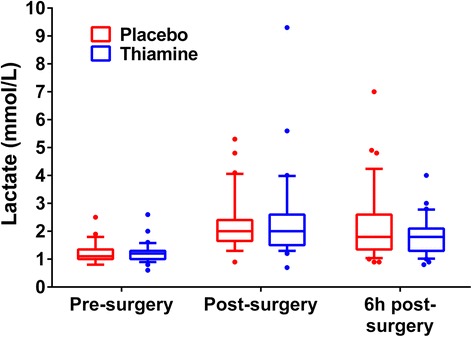
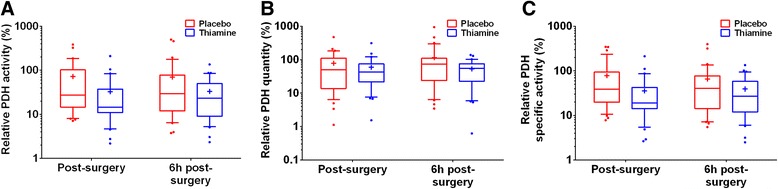
Results: Sixty-four patients were included. Thiamine levels were significantly higher in the thiamine group as compared to the placebo group immediately after surgery (1200 [683, 1200] nmol/L vs. 9 [8, 13] nmol/L, p < 0.001). There was no difference between the groups in the primary endpoint of lactate levels immediately after the surgery (2.0 [1.5, 2.6] mmol/L vs. 2.0 [1.7, 2.4], p = 0.75). Relative pyruvate dehydrogenase activity was lower immediately after the surgery in the thiamine group as compared to the placebo group (15% [11, 37] vs. 28% [15, 84], p = 0.02). Patients receiving thiamine had higher post-operative global oxygen consumption 1 hour after the surgery (difference: 0.37 mL/min/kg [95% CI: 0.03, 0.71], p = 0.03) as well as cellular oxygen consumption. We found no differences in clinical outcomes.

Conclusions: There were no differences in post-operative lactate levels or clinical outcomes between patients receiving thiamine or placebo. Post-operative oxygen consumption was significantly increased among patients receiving thiamine.

Trial registration: clinicaltrials.gov NCT02322892, December 14, 2014.

Keywords: Aerobic; Anaerobic; Cardiac surgery; Coronary artery bypass grafting; Lactate; Metabolism; Oxygen consumption; Pyruvate dehydrogenase; Thiamine.


Figures
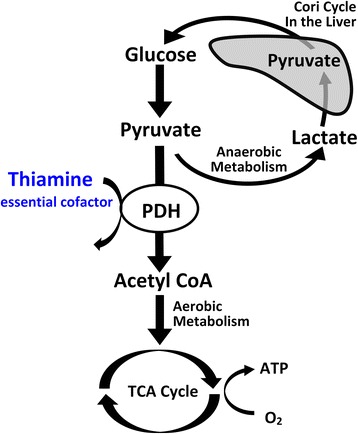
Fig. 1
Fig. 1
Simplified graphical presentation of PDH’s and thiamine’s role in aerobic metabolism. Aerobic metabolism occurs when pyruvate enters the mitochondria through pyruvate decarboxylation to acetyl-coenzyme A, facilitated by the rate-limiting enzyme pyruvate dehydrogenase (PDH). Adapted with permission from Andersen et al. [12]. ATP adenosine triphosphate, CoA coenzyme A, TCA tricarboxylic acid
Fig. 2
Fig. 2
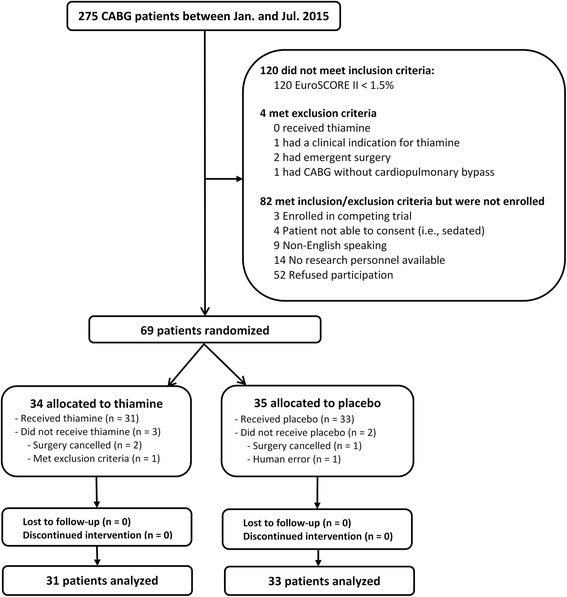
CONSORT diagram. Out of 275 patients screened, 69 were randomized and 64 were analyzed per the modified intention-to-treat analysis. No patients discontinued the intervention or were lost to follow-up. CABG coronary artery bypass grafting, EuroSCORE European System for Cardiac Operative Risk Evaluation
Fig. 3
Fig. 3
Lactate levels over time between the two groups. There was no difference between the thiamine and placebo groups in the primary endpoint of lactate levels immediately after the surgery (2.0 [1.5, 2.6] mmol/L vs. 2.0 [1.7, 2.4], p = 0.75). The boxplots represent the 1st quartiles, median, and 3rd quartile. The whiskers represent the 10th and 90th percentile and outliers are marked with dots
Fig. 4
Fig. 4
PDH values. Relative PDH activity (a), quantity (b) and specific activity (c) post-surgery and 6 hours post-surgery. Values were calculated as relative to the pre-surgery level, which was set at 100 %. The y-axis is logarithmic to better illustrate the findings. The boxplots represent the 1st quartiles, median, and 3rd quartile. The whiskers represent the 10th and 90th percentile and outliers are marked with dots
Fig. 5
Fig. 5
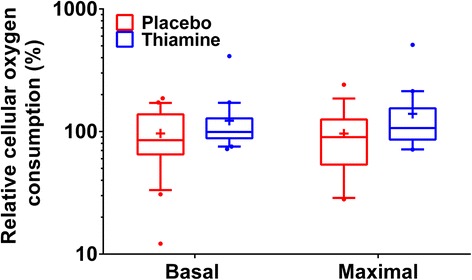
Cellular oxygen consumption. We found a significant difference in post-surgery relative basal oxygen consumption between groups (99 % [89, 126] vs. 85 % [66, 136], p = 0.04) and a significant difference in cellular maximal oxygen consumption between groups (107 % [86, 155] vs. 90 % [54, 125], p = 0.02). The boxplots represent the 1st quartiles, median, and 3rd quartile. The whiskers represent the 10th and 90th percentile and outliers are marked with dots. The y-axis is logarithmic to better illustrate the findings

References

    1. Hall MJ, DeFrances CJ, Williams SN, Golosinskiy A, Schwartzman A. National Hospital Discharge Survey: 2007 summary. Nat Health Stat Rep. 2010;29:1–20. 24. - PubMed
    1. Frost L, Molgaard H, Christiansen EH, Hjortholm K, Paulsen PK, Thomsen PE. Atrial fibrillation and flutter after coronary artery bypass surgery: epidemiology, risk factors and preventive trials. Int J Cardiol. 1992;36(3):253–61. doi: 10.1016/0167-5273(92)90293-C. - DOI - PubMed
    1. Saczynski JS, Marcantonio ER, Quach L, Fong TG, Gross A, Inouye SK, et al. Cognitive trajectories after postoperative delirium. N Engl J Med. 2012;367(1):30–9. doi: 10.1056/NEJMoa1112923. - DOI - PMC - PubMed
    1. Silber JH, Rosenbaum PR, Schwartz JS, Ross RN, Williams SV. Evaluation of the complication rate as a measure of quality of care in coronary artery bypass graft surgery. JAMA. 1995;274(4):317–23. doi: 10.1001/jama.1995.03530040045039. - DOI - PubMed
    1. Maillet JM, Le Besnerais P, Cantoni M, Nataf P, Ruffenach A, Lessana A, et al. Frequency, risk factors, and outcome of hyperlactatemia after cardiac surgery. Chest. 2003;123(5):1361–6. doi: 10.1378/chest.123.5.1361. - DOI - PubMed

Publication types

Associated data