Partially restored resting-state functional connectivity in women recovered from anorexia nervosa
- PMID: 27045551
- PMCID: PMC5082508
- DOI: 10.1503/jpn.150259
Partially restored resting-state functional connectivity in women recovered from anorexia nervosa
Abstract
Background: We have previously shown increased resting-state functional connectivity (rsFC) in the frontoparietal network (FPN) and the default mode network (DMN) in patients with acute anorexia nervosa. Based on these findings we investigated within-network rsFC in patients recovered from anorexia nervosa to examine whether these abnormalities are a state or trait marker of the disease. To extend the understanding of functional connectivity in patients with anorexia nervosa, we also estimated rsFC between large-scale networks.
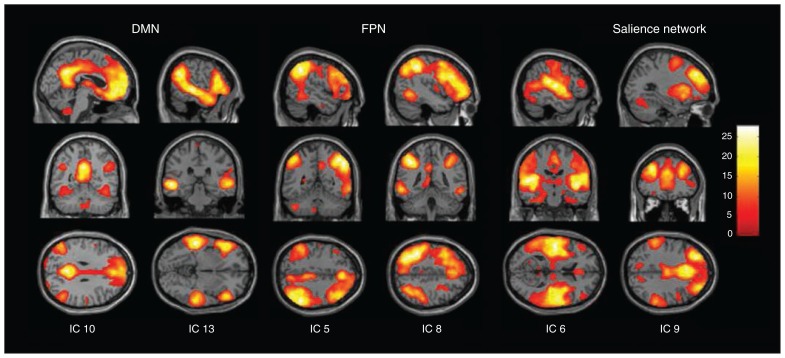
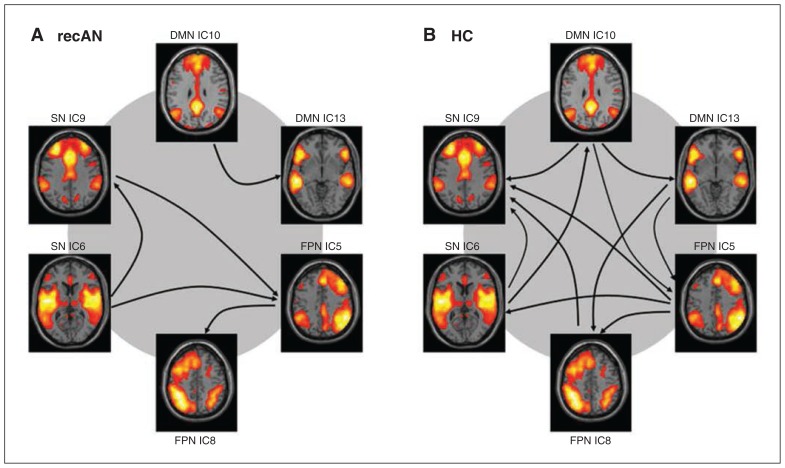
Methods: Girls and women recovered from anorexia nervosa and pair-wise, age- and sex-matched healthy controls underwent a resting-state fMRI scan. Using independent component analyses (ICA), we isolated the FPN, DMN and salience network. We used standard comparisons as well as a hypothesis-based approach to test the findings of our previous rsFC study in this recovered cohort. Temporal correlations between network time-course pairs were computed to investigate functional network connectivity (FNC).
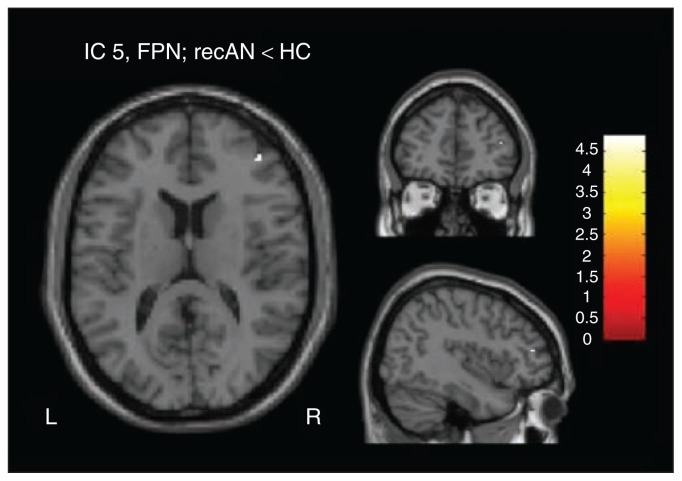
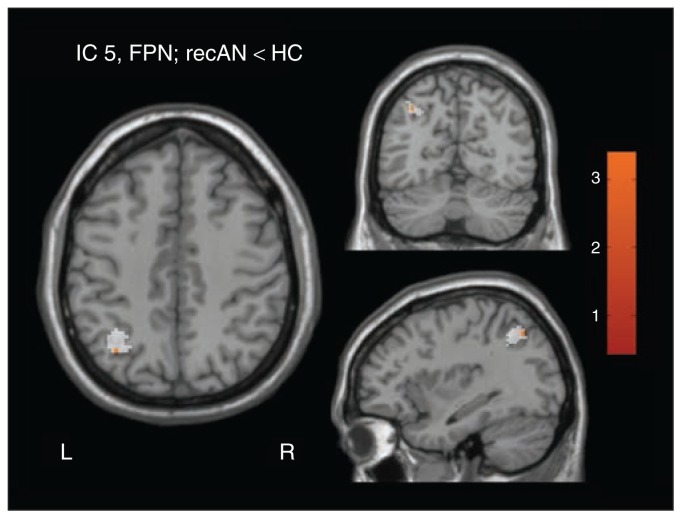
Results: Thirty-one patients recovered from anorexia nervosa and 31 controls participated in our study. Standard group comparisons revealed reduced rsFC between the dorsolateral prefrontal cortex (dlPFC) and the FPN in the recovered group. Using a hypothesis-based approach we extended the previous finding of increased rsFC between the angular gyrus and the FPN in patients recovered from anorexia nervosa. No group differences in FNC were revealed.
Limitations: The study design did not allow us to conclude that the difference found in rsFC constitutes a scar effect of the disease.
Conclusion: This study suggests that some abnormal rsFC patterns found in patients recovered from anorexia nervosa normalize after long-term weight restoration, while distorted rsFC in the FPN, a network that has been associated with cognitive control, may constitute a trait marker of the disorder.
Figures
Similar articles
-
Peripheral serotonin transporter DNA methylation is linked to increased salience network connectivity in females with anorexia nervosa.J Psychiatry Neurosci. 2020 May 1;45(3):206-213. doi: 10.1503/jpn.190016. J Psychiatry Neurosci. 2020. PMID: 31823595 Free PMC article.
-
Increased resting state functional connectivity in the default mode network in recovered anorexia nervosa.Hum Brain Mapp. 2014 Feb;35(2):483-91. doi: 10.1002/hbm.22202. Epub 2012 Oct 3. Hum Brain Mapp. 2014. PMID: 23033154 Free PMC article.
-
Resting-state functional brain connectivity in female adolescents with first-onset anorexia nervosa.Neuroimage Clin. 2025;45:103745. doi: 10.1016/j.nicl.2025.103745. Epub 2025 Jan 28. Neuroimage Clin. 2025. PMID: 39904205 Free PMC article.
-
Network Abnormalities in Ischemic Stroke: A Meta-analysis of Resting-State Functional Connectivity.Brain Topogr. 2025 Jan 4;38(2):19. doi: 10.1007/s10548-024-01096-6. Brain Topogr. 2025. PMID: 39755830 Review.
-
Impairments of large-scale functional networks in attention-deficit/hyperactivity disorder: a meta-analysis of resting-state functional connectivity.Psychol Med. 2019 Nov;49(15):2475-2485. doi: 10.1017/S003329171900237X. Epub 2019 Sep 10. Psychol Med. 2019. PMID: 31500674 Review.
Cited by
-
Ketamine as a Novel Psychopharmacotherapy for Eating Disorders: Evidence and Future Directions.Brain Sci. 2022 Mar 12;12(3):382. doi: 10.3390/brainsci12030382. Brain Sci. 2022. PMID: 35326338 Free PMC article. Review.
-
Disrupted longitudinal restoration of brain connectivity during weight normalization in severe anorexia nervosa.Transl Psychiatry. 2023 Apr 28;13(1):136. doi: 10.1038/s41398-023-02428-z. Transl Psychiatry. 2023. PMID: 37117179 Free PMC article.
-
The Neurobiology of Eating Disorders.Child Adolesc Psychiatr Clin N Am. 2019 Oct;28(4):629-640. doi: 10.1016/j.chc.2019.05.007. Epub 2019 Jul 4. Child Adolesc Psychiatr Clin N Am. 2019. PMID: 31443880 Free PMC article. Review.
-
Cortical thinning and associated connectivity changes in patients with anorexia nervosa.Transl Psychiatry. 2021 Feb 4;11(1):95. doi: 10.1038/s41398-021-01237-6. Transl Psychiatry. 2021. PMID: 33542197 Free PMC article.
-
The Role of the Human Hypothalamus in Food Intake Networks: An MRI Perspective.Front Nutr. 2022 Jan 3;8:760914. doi: 10.3389/fnut.2021.760914. eCollection 2021. Front Nutr. 2022. PMID: 35047539 Free PMC article. Review.
References
-
- Seitz J, Bühren K, von Polier GG, et al. Morphological changes in the brain of acutely ill and weight-recovered patients with anorexia nervosa. Z Kinder Jugendpsychiatr Psychother. 2014;42:7–17. - PubMed
-
- Kaye WH, Fudge J, Paulus M. New insights into symptoms and neurocircuit function of anorexia nervosa. Nat Rev Neurosci. 2009;10:573–84. - PubMed
-
- Wagner A, Greer P, Bailer UF, et al. Normal brain tissue volumes after long-term recovery in anorexia and bulimia nervosa. Biol Psychiatry. 2006;59:291–3. - PubMed
-
- King JA, Geisler D, Ritschel F, et al. Global cortical thinning in acute anorexia nervosa normalizes following long-term weight restoration. Biol Psychiatry. 2015;77:624. - PubMed
Publication types
MeSH terms
LinkOut - more resources
Full Text Sources
Other Literature Sources
Miscellaneous