


Diversity of Staphylococcus aureus strains colonizing various niches of the human body
- PMID: 27045982
- PMCID: PMC4875821
- DOI: 10.1016/j.jinf.2016.03.015
Diversity of Staphylococcus aureus strains colonizing various niches of the human body
Abstract
Objectives: As individuals may be colonized with multiple strains of Staphylococcus aureus at different body sites, the objectives of this study were to determine whether S. aureus polyclonal colonization exists within one body niche and the optimal sampling sites and culture methodology to capture the diversity of S. aureus strains in community-dwelling individuals.
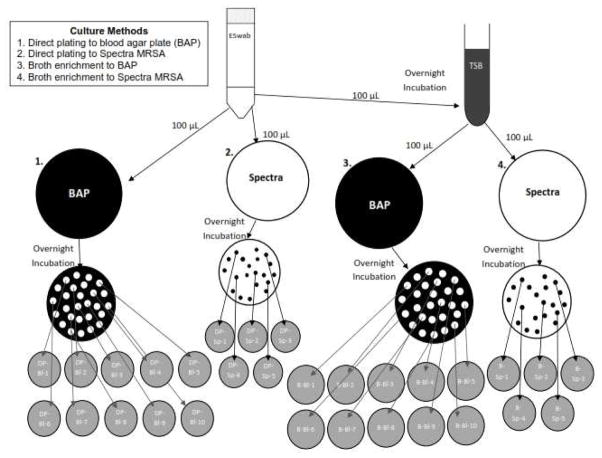
Methods: Swabs were collected from the nares, axillae, and inguinal folds of 3 children with community-associated S. aureus infections and 11 household contacts, all with known S. aureus colonization. S. aureus isolates were recovered from each body niche using 4 culture methods and evaluated for polyclonality using phenotypic and genotypic strain characterization methodologies.
Results: Within individuals, the mean (range) number of phenotypes and genotypes was 2.4 (1-4) and 3.1 (1-6), respectively. Six (43%) and 10 (71%) participants exhibited phenotypic and genotypic polyclonality within one body niche, respectively. Broth enrichment yielded the highest analytical sensitivity for S. aureus recovery, while direct plating to blood agar yielded the highest genotypic strain diversity.
Conclusions: This study revealed S. aureus polyclonality within a single body niche. Culture methodology and sampling sites influenced the analytical sensitivity of S. aureus colonization detection and the robustness of phenotypic and genotypic strain recovery.
Keywords: Broth enrichment; Polyclonal colonization; Staphylococcus aureus; Strain diversity.
Copyright © 2016 The British Infection Association. Published by Elsevier Ltd. All rights reserved.
Conflict of interest statement
None.
Figures
References
-
- Hulten KG, Kaplan SL, Gonzalez BE, Hammerman WA, Lamberth LB, Versalovic J, et al. Three-year surveillance of community onset health care-associated Staphylococcus aureus infections in children. Pediatr Infect Dis J. 2006;25(4):349–53. - PubMed
-
- Naimi TS, LeDell KH, Como-Sabetti K, Borchardt SM, Boxrud DJ, Etienne J, et al. Comparison of community- and health care-associated methicillin-resistant Staphylococcus aureus infection. JAMA. 2003;290(22):2976–84. - PubMed
-
- Faden H, Lesse AJ, Trask J, Hill JA, Hess DJ, Dryja D, et al. Importance of colonization site in the current epidemic of staphylococcal skin abscesses. Pediatrics. 2010;125(3):e618–624. - PubMed
-
- Fritz SA, Camins BC, Eisenstein KA, Fritz JM, Epplin EK, Burnham CA, et al. Effectiveness of measures to eradicate Staphylococcus aureus carriage in patients with community-associated skin and soft-tissue infections: a randomized trial. Infect Control Hosp Epidemiol. 2011;32(9):872–80. - PMC - PubMed
Publication types
MeSH terms
Grants and funding
LinkOut - more resources
Full Text Sources
Other Literature Sources
Medical
Research Materials
