


A sign on CT that predicts a hazardous ureteral anomaly
- PMID: 27046105
- PMCID: PMC4823473
- DOI: 10.1016/j.ijscr.2016.03.029
A sign on CT that predicts a hazardous ureteral anomaly
Abstract
Introduction: An aberrant course of the distal ureter can pose a risk of ureteral injury during surgery for inguinal hernia repair and other groin operations. In a recent case series of inguinoscrotal hernation of the ureter, we found that each affected ureter was markedly anterior to the psoas muscle at its mid-point on abdominal CT. We hypothesized that this abnormality in the abdominal course of the ureter would predict the potentially hazardous aberrant course of the distal ureter.
Presentation of cases: We reviewed all evaluable CT urograms performed at St. Louis University Hospital from June 2012 to July 2013 and measured the ureteral course at several anatomically fixed points.
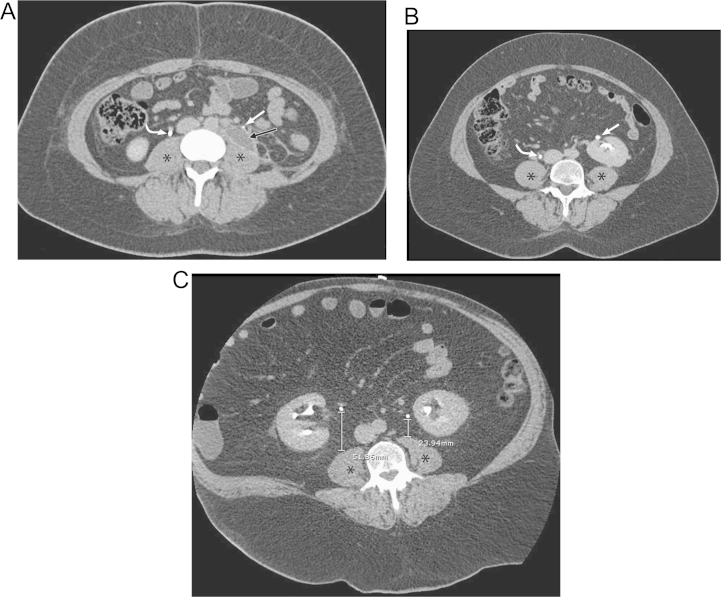
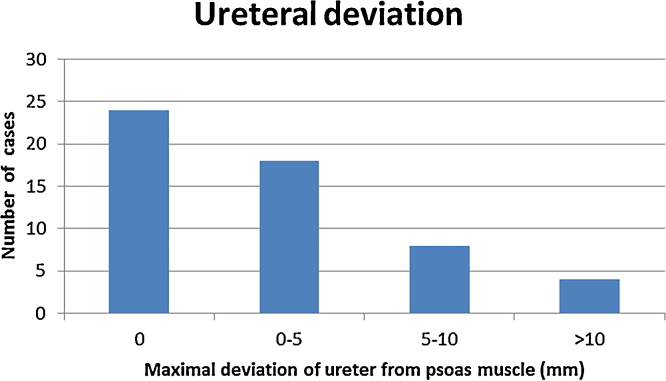
Discussion: 93% (50/54) of ureters deviated by less than 1cm from the psoas muscle in their mid-course (at the level of the L4 vertebra). Reasons for anterior deviation of the ureter in this study included morbid obesity with prominent retroperitoneal fat, congenital renal abnormality, and post-traumatic renal/retroperitoneal hematoma. We determined that the optimal level on abdominal CT to detect the displaced ureter was the mid-body of the L4 vertebra.
Conclusion: Anterior deviation of the ureter in its mid-course appears to predict inguinoscrotal herniation of the ureter. This finding is a sensitive predictor and should raise concern for this anomaly in the appropriate clinical setting. It is not entirely specific as morbid obesity and congenital anomalies may result in a similar imaging appearance. We believe that this association has not been reported previously. Awareness of this anomaly can have significant operative implications.
Keywords: CT urogram; Inguinal hernia; Inguinoscrotal herniation; Ureteral herniation.
Copyright © 2016 The Authors. Published by Elsevier Ltd.. All rights reserved.
Figures
References
-
- Oruç M.T., Akbulut Z., Ozozan O., Coşkun F. Urological findings in inguinal hernias: a case report and review of the literature. Hernia. 2004;8(February 1):76–79. - PubMed
-
- Pollack H.M., Popky G.L., Blumberg M.L. Hernias of the ureter—An anatomic-roentgenographic study. Radiology. 1975;117(November 2):275–281. - PubMed
-
- Giuly J., François G.F., Giuly D., Leroux C., Nguyen-Cat R.R. Intrascrotal hernia of the ureter and fatty hernia. Hernia. 2003;7(March 1):47–49. - PubMed
LinkOut - more resources
Full Text Sources
Other Literature Sources
Research Materials
