doi: 10.1371/journal.pmed.1001990.
eCollection 2016 Apr.
Why Are Some Population Interventions for Diet and Obesity More Equitable and Effective Than Others? The Role of Individual Agency
Affiliations
- PMID: 27046234
- PMCID: PMC4821622
- DOI: 10.1371/journal.pmed.1001990
Item in Clipboard
Why Are Some Population Interventions for Diet and Obesity More Equitable and Effective Than Others? The Role of Individual Agency
PLoS Med.
.
Erratum in
-
Correction: Why Are Some Population Interventions for Diet and Obesity More Equitable and Effective Than Others? The Role of Individual Agency.PLoS Med. 2016 May 24;13(5):e1002045. doi: 10.1371/journal.pmed.1002045. eCollection 2016 May. PLoS Med. 2016. PMID: 27218824 Free PMC article.
Abstract
Jean Adams and colleagues argue that population interventions that require individuals to use a low level of agency to benefit are likely to be most effective and most equitable.
Conflict of interest statement
The authors have declared that no competing interests exist.
Figures
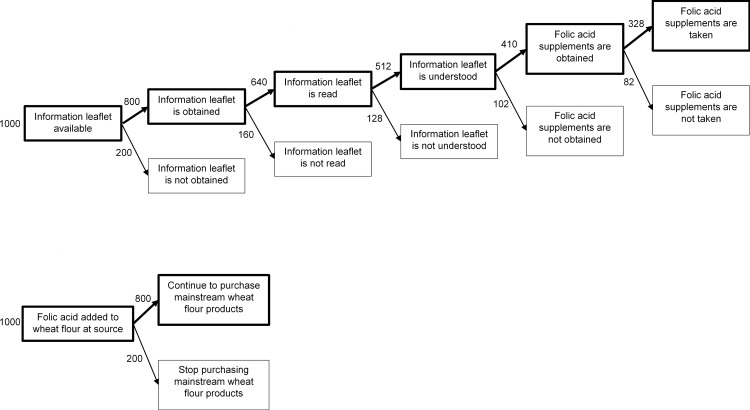
Both examples illustrate population interventions to increase folate in women trying to conceive. The top panel illustrates an information leaflet encouraging women to take folic acid supplements (a high-agency population intervention). The bottom panel illustrates the universal addition of folic acid to mainstream wheat flour (a low-agency intervention). Numbers are illustrative and indicate how many women might be in each pathway if it is hypothetically assumed that there is 20% attrition at each step. The steps shown in both cases are illustrative and not necessarily exhaustive.
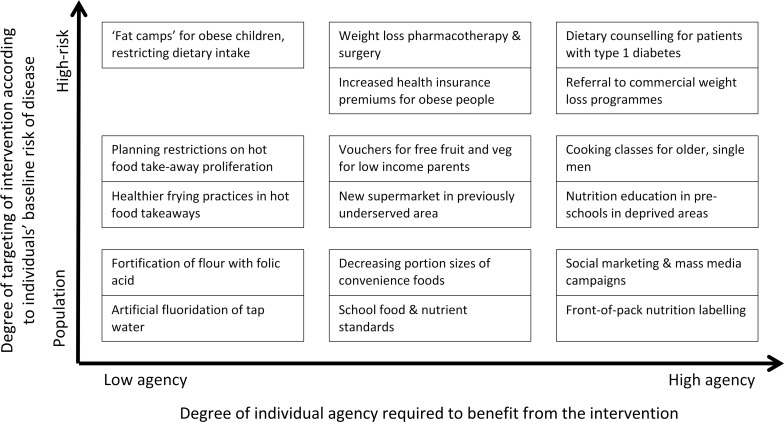
Interventions grouped together fall at similar points on the two continuums; we have not attempted to make fine-grained distinctions of where interventions fall on each continuum.
References
-
- Ng M, Fleming T, Robinson M, Thomson B, Graetz N, Margono C, et al. Global, regional, and national prevalence of overweight and obesity in children and adults during 1980–2013: a systematic analysis for the Global Burden of Disease Study 2013. The Lancet. 2014;384(9945):766–81. 10.1016/S0140-6736(14)60460-8 - DOI - PMC - PubMed
-
- Lim SS, Vos T, Flaxman AD, Danaei G, Shibuya K, Adair-Rohani H, et al. A comparative risk assessment of burden of disease and injury attributable to 67 risk factors and risk factor clusters in 21 regions, 1990–2010: a systematic analysis for the Global Burden of Disease Study 2010. Lancet. 2012;380(9859):2224–60. Epub 2012/12/19. 10.1016/s0140-6736(12)61766-8 ; PubMed Central PMCID: PMCPmc4156511. - DOI - PMC - PubMed
-
- Darmon N, Drewnowski A. Does social class predict diet quality? Am J Clin Nutr. 2008;87(5):1107–17. Epub 2008/05/13. . - PubMed
-
- Jones-Smith JC, Gordon-Larsen P, Siddiqi A, Popkin BM. Is the burden of overweight shifting to the poor across the globe? Time trends among women in 39 low- and middle-income countries (1991–2008). Int J Obes (Lond). 2012;36(8):1114–20. Epub 2011/09/14. 10.1038/ijo.2011.179 ; PubMed Central PMCID: PMCPmc3516372. - DOI - PMC - PubMed
-
- Rose G. The strategy of preventive medicine Guildford: Oxford University Press; 1992.
Publication types
MeSH terms
Grants and funding
LinkOut - more resources
Full Text Sources
Other Literature Sources
Medical