


Giant Viruses of Amoebas: An Update
- PMID: 27047465
- PMCID: PMC4801854
- DOI: 10.3389/fmicb.2016.00349
Giant Viruses of Amoebas: An Update
Abstract
During the 12 past years, five new or putative virus families encompassing several members, namely Mimiviridae, Marseilleviridae, pandoraviruses, faustoviruses, and virophages were described. In addition, Pithovirus sibericum and Mollivirus sibericum represent type strains of putative new giant virus families. All these viruses were isolated using amoebal coculture methods. These giant viruses were linked by phylogenomic analyses to other large DNA viruses. They were then proposed to be classified in a new viral order, the Megavirales, on the basis of their common origin, as shown by a set of ancestral genes encoding key viral functions, a common virion architecture, and shared major biological features including replication inside cytoplasmic factories. Megavirales is increasingly demonstrated to stand in the tree of life aside Bacteria, Archaea, and Eukarya, and the megavirus ancestor is suspected to be as ancient as cellular ancestors. In addition, giant amoebal viruses are visible under a light microscope and display many phenotypic and genomic features not found in other viruses, while they share other characteristics with parasitic microbes. Moreover, these organisms appear to be common inhabitants of our biosphere, and mimiviruses and marseilleviruses were isolated from human samples and associated to diseases. In the present review, we describe the main features and recent findings on these giant amoebal viruses and virophages.
Keywords: 4th TRUC; Acanthamoeba; Megavirales; amoeba; giant virus; mimivirus; virophage.
Figures
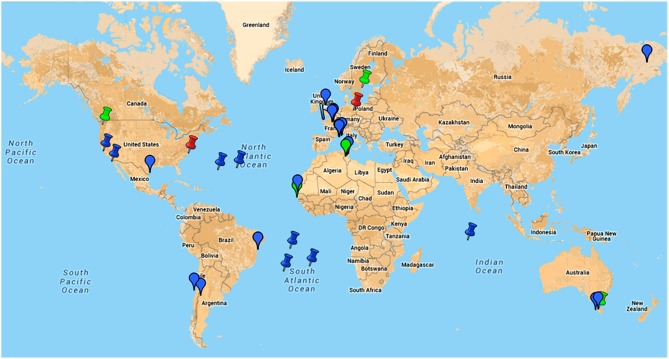
 , indicates location of samples from which an amoebal virus was isolated;
  , indicates location of samples from which reads related to an amoebal virus were generated by metagenomics;
  , indicates the discovery of giant viral particles for which a virus could not be isolated. Blue color indicates environmental samples; green color indicates human samples; red color indicates animal (non-human) samples. This figure is a screenshot of a goggle map that is freely available at the following URL:
 References
Publication types
LinkOut - more resources
Full Text Sources
Other Literature Sources
Miscellaneous
