


Common environmental chemicals do not explain atopy contrast in the Finnish and Russian Karelia
- PMID: 27047657
- PMCID: PMC4819273
- DOI: 10.1186/s13601-016-0103-1
Common environmental chemicals do not explain atopy contrast in the Finnish and Russian Karelia
Abstract
Background: Atopic allergy is much more common in Finnish compared with Russian Karelia, although these areas are geographically and genetically close. To explore the role of environmental chemicals on the atopy difference a random sample of 200 individuals, 25 atopic and 25 non-atopic school-aged children and their mothers, were studied. Atopy was defined as having at least one positive skin prick test response to 14 common inhalant and food allergens tested. Concentrations of 11 common environmental pollutants were measured in blood samples.
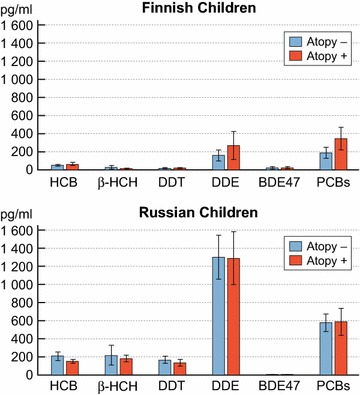
Results: Overall, the chemical levels were much higher in Russia than in Finland, except for 2,2',4,4'-tetra-bromodiphenyl ether (BDE47). In Finland but not in Russia, the atopic children had higher concentrations of polychlorinated biphenyls and 1,1-Dichloro-2,2-bis-(p-chlorophenyl)-ethylene (DDE) than the non-atopic children. In Russia but not in Finland, the atopic mothers had higher DDE concentrations than the non-atopic mothers.
Conclusions: Higher concentrations of common environmental chemicals were measured in Russian compared with Finnish Karelian children and mothers. The chemicals did not explain the higher prevalence of atopy on the Finnish side.
Keywords: Allergy; Atopy; Environmental chemicals; Finnish Karelia; Russian Karelia.
Figures
References
-
- Crinnion WJ. Do environmental toxicants contribute to allergy and asthma? Altern Med Rev. 2012;17(1):6–18. - PubMed
LinkOut - more resources
Full Text Sources
Other Literature Sources
Miscellaneous
