Prevention and Treatment of Recurrent Hepatitis B after Liver Transplantation
- PMID: 27047773
- PMCID: PMC4807144
- DOI: 10.14218/JCTH.2015.00041
Prevention and Treatment of Recurrent Hepatitis B after Liver Transplantation
Abstract
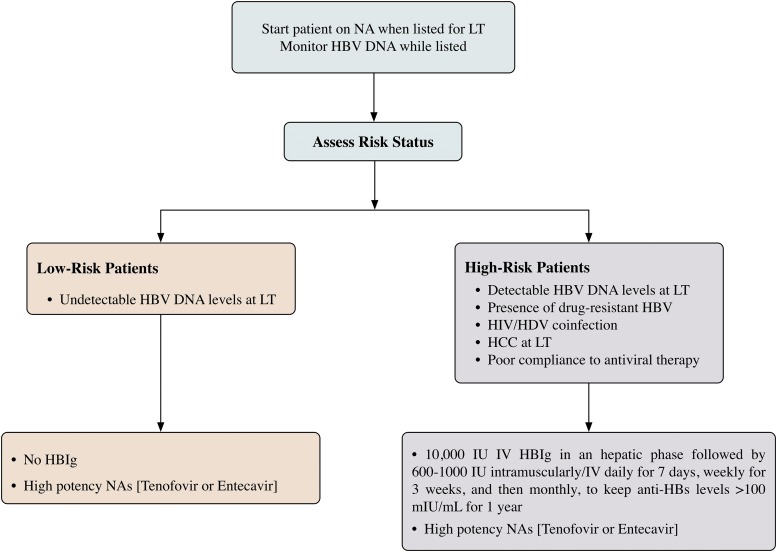
Chronic hepatitis B is a global health problem that leads to development of various complications, such as cirrhosis, liver cancer, and liver failure requiring liver transplantation. The recurrence of hepatitis B virus (HBV) post-liver transplantation is a major cause of allograft dysfunction, cirrhosis of the allograft, and graft failure. Patients with high viral load at the time of transplantation, hepatitis B e antigen (HBeAg) positivity, or those with a history of anti-viral drug resistance are considered as high-risk for recurrent HBV post-liver transplantation, while patients with low viral load, including HBeAg negative status, acute liver failure, and hepatitis D virus (HDV) co-infection are considered to be at low-risk for recurrent HBV post-liver transplantation. Antivirals for patients awaiting liver transplantation(LT) cause suppression of HBV replication and reduce the risk of recurrent HBV infection of the allograft and, therefore, all HBV patients with decompensated cirrhosis should be treated with potent antivirals with high genetic barrier to resistance (entecavir or tenofovir) prior to liver transplantation. Prevention of post-liver transplantation recurrence should be done using a combination of hepatitis B immunoglobulin (HBIG) and antivirals in patients at high risk of recurrence. Low dose HBIG, HBIG-free protocols, and monoprophylaxis with high potency antivirals can still be considered in patients at low risk of recurrence. Even, marginal grafts from anti-HBc positive donors can be safely used in hepatitis B surface antigen (HBsAg) negative, preferably in anti-hepatitis B core (HBc)/anti-hepatitis B surface (HBs) positive recipients. In this article, we aim to review the mechanisms and risk factors of HBV recurrence post-LT in addition to the various treatment strategies proposed for the prevention of recurrent HBV infection.
Keywords: Hepatitis B; Liver transplant; Recurrent.
Conflict of interest statement
Figures

References
-
- http://www.who.int/mediacentre/factsheets/fs204/en/. Accessed 2 Feb 2016.
-
- Samuel D, Muller R, Alexander G, Fassati L, Ducot B, Benhamou JP, et al. Liver transplantation in European patients with the hepatitis B surface antigen. N Engl J Med. 1993;329:1842–1847. doi: 10.1056/NEJM199312163292503. - PubMed
Publication types
LinkOut - more resources
Full Text Sources
Other Literature Sources