


THORACOLUMBAR BURST FRACTURE: CORRELATION BETWEEN KYPHOSIS AND FUNCTION AFTER SURGICAL TREATMENT
- PMID: 27047853
- PMCID: PMC4799454
- DOI: 10.1016/S2255-4971(15)30131-2
THORACOLUMBAR BURST FRACTURE: CORRELATION BETWEEN KYPHOSIS AND FUNCTION AFTER SURGICAL TREATMENT
Abstract
Objective: To assess the correlation between post-traumatic kyphosis in patients with thoracolumbar burst fractures undergoing surgical treatment and the functional result from treatment.
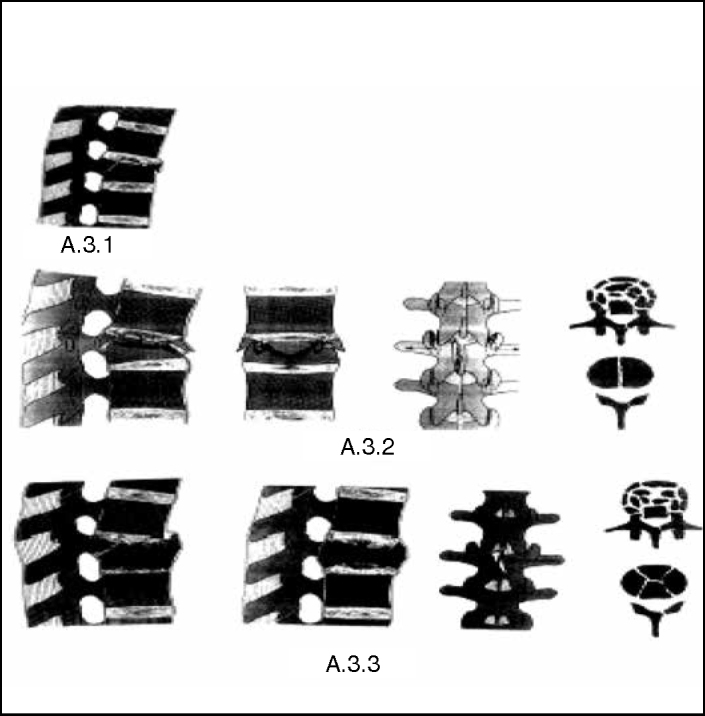
Methods: A retrospective study was conducted on 27 patients with thoracolumbar burst fractures according to Denis and A3 to Margerl's classification who met the inclusion criteria for this sample and underwent surgical treatment with a minimum follow-up of six months. The patients' mean age was 46.96, with a range from 16 to 73 years. The treatment outcome was evaluated based on applying the short-form 36 (SF-36) quality of life questionnaire, Denis pain and work scale and visual pain scale. The kyphosis was measured according to the Cobb method at the end of the follow-up.
Results: The residual kyphosis was found not to correlate with the SF-36, Denis pain and work scale or visual pain score (p > 0.05).
Conclusion: There is no correlation between the final clinical result and residual kyphosis in patients with thoracolumbar burst fractures who undergo surgical treatment.
Keywords: Kyphosis; Spinal Fractures/complications; Spinal Fractures/therapy.
Figures
References
-
- Denis F. The three column spine and its significance in the classification of acute thoracolumbar spinal injuries. Spine (Phila Pa 1976) 1983;8(8):817–831. - PubMed
-
- Kraemer WJ, Schemitsch EH, Lever J, McBroom RJ, McKee MD, Waddell JP. Functional outcome of thoracolumbar burst fractures without neurological deficit. J Orthop Trauma. 1996;10(8):541–544. - PubMed
-
- Thomas KC, Bailey CS, Dvorak MF, Kwon B, Fisher C. Comparison of operative and nonoperative treatment for thoracolumbar burst fractures in patients without neurological deficit: a systematic review. J Neurosurg Spine. 2006;4(5):351–358. - PubMed
-
- Knight RQ, Stornelli DP, Chan DP, Devanny JR, Jackson KV. Comparison of operative versus nonoperative treatment of lumbar burst fractures. Clin Orthop Relat Res. 1993;(293):112–121. - PubMed
-
- Magerl F, Aebi M, Gertzbein SD, Harms J, Nazarian S. A comprehensive classification of thoracic and lumbar injuries. Eur Spine J. 1994;3(4):184–201. - PubMed
LinkOut - more resources
Full Text Sources
Miscellaneous