Hormonal stimulation of starfish oocytes induces partial degradation of the 3' termini of cyclin B mRNAs with oligo(U) tails, followed by poly(A) elongation
- PMID: 27048146
- PMCID: PMC4878609
- DOI: 10.1261/rna.054882.115
Hormonal stimulation of starfish oocytes induces partial degradation of the 3' termini of cyclin B mRNAs with oligo(U) tails, followed by poly(A) elongation
Abstract
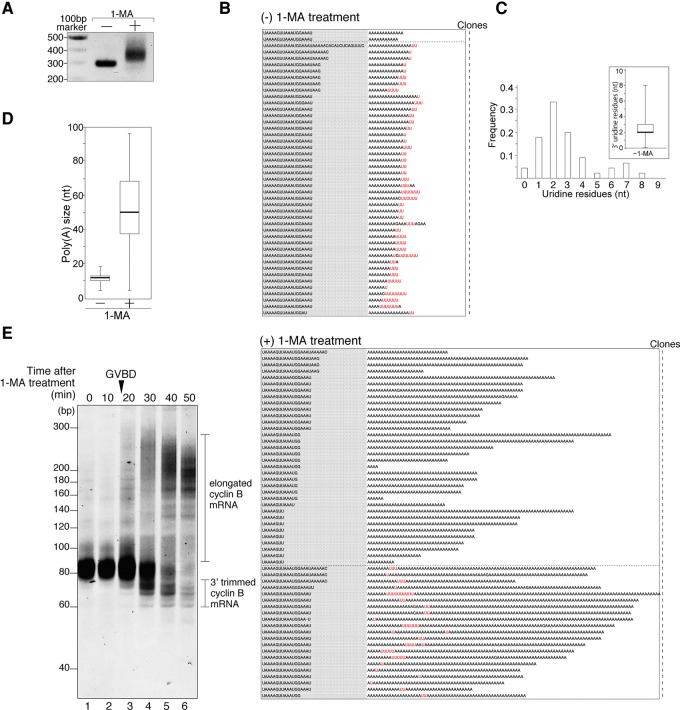
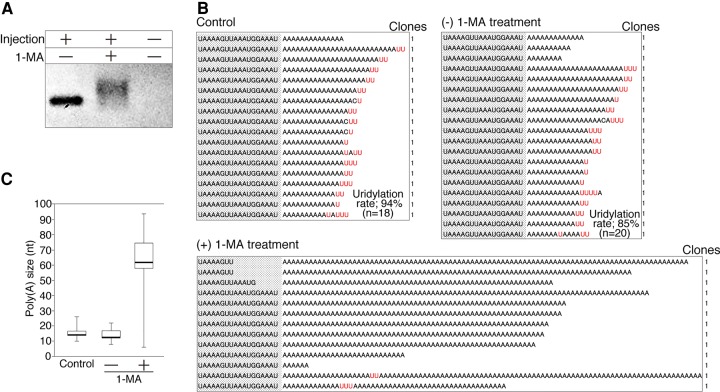
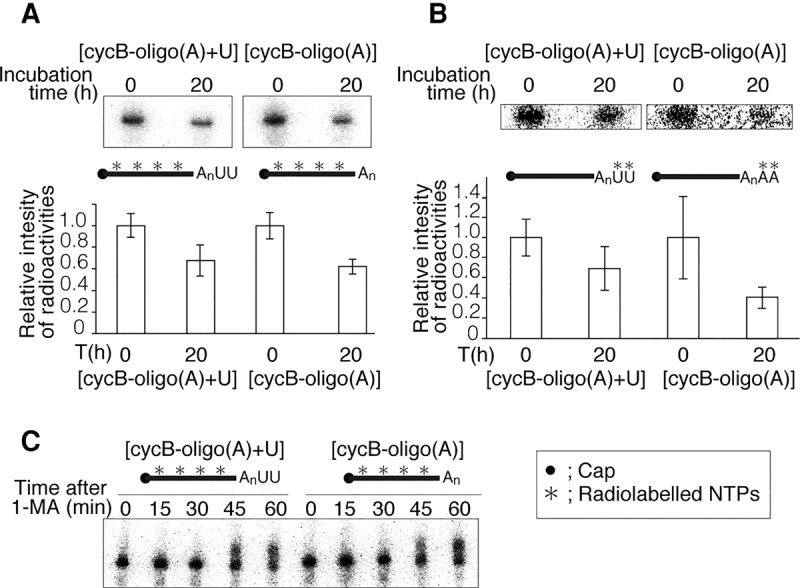
In yeast, plant, and mammalian somatic cells, short poly(A) tails on mRNAs are subject to uridylation, which mediates mRNA decay. Although mRNA uridylation has never been reported in animal oocytes, maternal mRNAs with short poly(A) tails are believed to be translationally repressed. In this study, we found that 96% of cyclin B mRNAs with short poly(A) tails were uridylated in starfish oocytes. Hormonal stimulation induced poly(A) elongation of cyclin B mRNA, and 62% of long adenine repeats did not contain uridine residues. To determine whether uridylated short poly(A) tails destabilize cyclin B mRNA, we developed a method for producing RNAs with the strict 3' terminal sequences of cyclin B, with or without oligo(U) tails. When we injected these synthetic RNAs into starfish oocytes prior to hormonal stimulation, we found that uridylated RNAs were as stable as nonuridylated RNAs. Following hormonal stimulation, the 3' termini of short poly(A) tails of synthesized RNAs containing oligo(U) tails were trimmed, and their poly(A) tails were subsequently elongated. These results indicate that uridylation of short poly(A) tails in cyclin B mRNA of starfish oocytes does not mediate mRNA decay; instead, hormonal stimulation induces partial degradation of uridylated short poly(A) tails in the 3'-5' direction, followed by poly(A) elongation. Oligo(U) tails may be involved in translational inactivation of mRNAs.
Keywords: mRNA uridylation; oligo(U); oocyte; poly(A); polyadenylation; starfish.
© 2016 Ochi and Chiba; Published by Cold Spring Harbor Laboratory Press for the RNA Society.
Figures
References
-
- Barckmann B, Simonelig M. 2013. Control of maternal mRNA stability in germ cells and early embryos. Biochim Biophys Acta 1829: 714–724. - PubMed
-
- Bhattacharyya SN, Habermacher R, Martine U, Closs EI, Filipowicz W. 2006. Relief of microRNA-mediated translational repression in human cells subjected to stress. Cell 125: 1111–1124. - PubMed
Publication types
MeSH terms
Substances
LinkOut - more resources
Full Text Sources
Other Literature Sources
Miscellaneous