. 2016 Apr 5;7(1):51.
doi: 10.1186/s13287-016-0308-1.

Transplantation of bone marrow-derived mesenchymal stem cells expressing elastin alleviates pelvic floor dysfunction

Affiliations

Transplantation of bone marrow-derived mesenchymal stem cells expressing elastin alleviates pelvic floor dysfunction

Minfei Jin et al. Stem Cell Res Ther. .

Abstract

Background: Pelvic floor dysfunction (PFD) is a group of clinical conditions including stress urinary incontinence (SUI) and pelvic organ prolapse (POP). The abnormality of collagen and elastin metabolism in pelvic connective tissues is implicated in SUI and POP.

Methods: To reconstitute the connective tissues with normal distribution of collagen and elastin, we transduced elastin to bone marrow-derived mesenchymal stem cells (BMSC). Elastin-expressing BMSCs were then differentiated to fibroblasts using bFGF, which produced collagen and elastin. To achieve the sustained release of bFGF, we formulated bFGF in poly (lactic-co-glycolic acid) (PLGA) nanoparticles (NP).

Results: In an in vitro cell culture system of 7 days, when no additional bFGF was administrated, the initial PLGA-loaded bFGF NP induced prolonged production of collagen and elastin from elastin-expressing BMSCs. In vivo, co-injection of PLGA-loaded bFGF NP and elastin-expressing BMSCs into the PFD rats significantly improved the outcome of urodynamic tests. Together, these results provided an efficient model of connective tissue engineering using BMSC and injectable PLGA-loaded growth factors.

Conclusions: Our results provided the first instance of a multidisciplinary approach, combining both stem cell and nanoparticle technologies, for the treatment of PFD.

Keywords: Basic fibroblast growth factor; Bone marrow-derived mesenchymal stem cells; Pelvic floor dysfunction; Stress urinary incontinence.


Figures
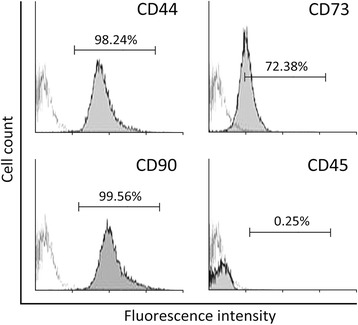
Fig. 1
Fig. 1
Flow cytometry identified rat BMSC-positive markers CD44, CD73, and CD90, but not negative marker CD45, on the surface of the cells
Fig. 2
Fig. 2
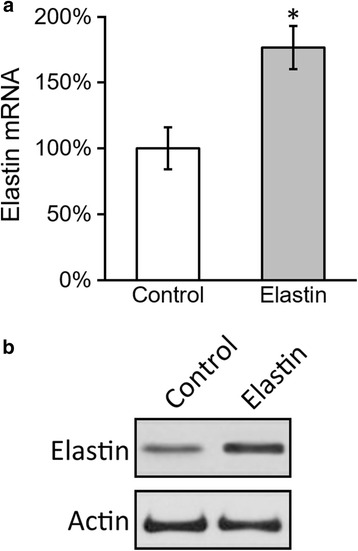
Effect of elastin transduction in BMSCs. Levels of mRNA a and protein b of elastin in BMSCs were examined 24 hours after transduction. Values are mean ± SD. *P <0.05 vs control
Fig. 3
Fig. 3
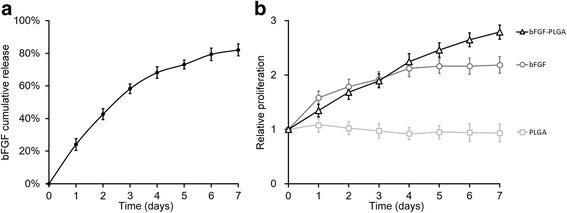
bFGF-PLGA promotes the proliferation of BMSCs. a In vitro cumulative release profile of bFGF-loaded PLGA. b Elastin-transfected BMSCs were cultured in the presence of either empty PLGA, free bFGF without PLGA (bFGF), or bFGF-loaded PLGA (bFGF-PLGA), and cell proliferation was measured by MTT assay. bFGF basic fibroblast growth factor, PLGA poly(lactic-co-glycolic acid)
Fig. 4
Fig. 4
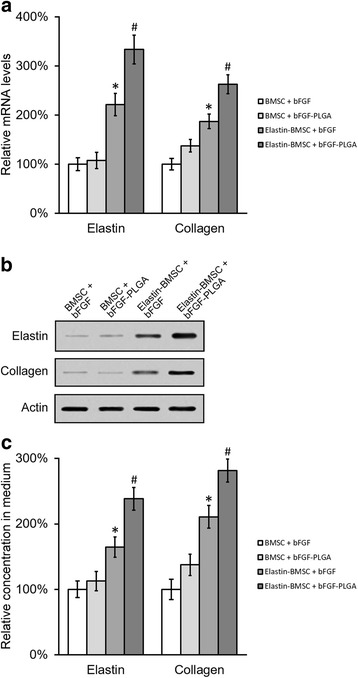
bFGF-PLGA promotes the expression and secretion of elastin and collagen in differentiated BMSCs. BMSCs with or without elastin transduction were differentiated in the presence of either bFGF or bFGF-PLGA for 7 days. Levels of mRNA a and protein b, and concentration in medium c of elastin and collagen were examined by RT-PCR, western blot, and ELISA assays. Values are mean ± SD. *P <0.05 vs BMSC + bFGF and BMSC + bFGF-PLGA. #P <0.05 vs elastin-BMSC + bFGF. bFGF basic fibroblast growth factor, BMSC bone marrow-derived mesenchymal stem cell, PLGA poly(lactic-co-glycolic acid)
Fig. 5
Fig. 5
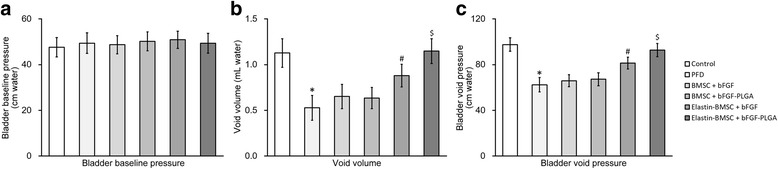
bFGF-PLGA and elastin transfection improve CMG in PFD rats after BMSC transplantation. The rat PFD model was established and housed for 14 days, after which the rats were transplanted with BMSCs and housed for a further 7 days. CMG including a bladder baseline pressure, b void volume, and c bladder void pressure was then performed on all rats (n = 8) in each experimental groups. Values are mean ± SD. *P <0.05 vs Control. #P <0.05 vs PFD. $P <0.05 vs Control and elastin-BMSC + bFGF. bFGF basic fibroblast growth factor, BMSC bone marrow-derived mesenchymal stem cell, PFD pelvic floor dysfunction, PLGA poly(lactic-co-glycolic acid)
Fig. 6
Fig. 6
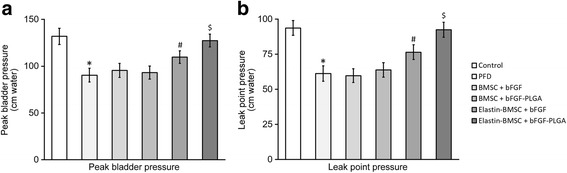
bFGF-PLGA and elastin transfection improve LPP in PFD rats after BMSC transplantation. The PFD rat model was established and housed for 14 days, after which the rats were transplanted with BMSCs and housed for a further 7 days. a Peak bladder pressure and b LPP were then performed on all rats (n = 8) in each experimental group. Values are mean ± SD. *P <0.05 vs Control. #P <0.05 vs PFD. $P <0.05 vs Control and elastin-BMSC + bFGF. bFGF basic fibroblast growth factor, BMSC bone marrow-derived mesenchymal stem cell, PFD pelvic floor dysfunction, PLGA poly(lactic-co-glycolic acid)

References

    1. Boyle R, Hay-Smith EJ, Cody JD, Morkved S. Pelvic floor muscle training for prevention and treatment of urinary and fecal incontinence in antenatal and postnatal women: a short version Cochrane review. Neurourol Urodyn. 2014;33:269–276. doi: 10.1002/nau.22402. - DOI - PubMed
    1. Olsen AL, Smith VJ, Bergstrom JO, Colling JC, Clark AL. Epidemiology of surgically managed pelvic organ prolapse and urinary incontinence. Obstet Gynecol. 1997;89:501–506. doi: 10.1016/S0029-7844(97)00058-6. - DOI - PubMed
    1. Fitz FF, Resende AP, Stupp L, Sartori MG, Girao MJ, Castro RA. Biofeedback for the treatment of female pelvic floor muscle dysfunction: a systematic review and meta-analysis. Int Urogynecol J. 2012;23:1495–1516. doi: 10.1007/s00192-012-1707-1. - DOI - PubMed
    1. Alvarez J, Cvach K, Dwyer P. Complications in pelvic floor surgery. Minerva Ginecol. 2013;65:53–67. - PubMed
    1. Reid RI. Repair of recurrent prolapse. Best Pract Res Clin Obstet Gynaecol. 2011;25:175–196. doi: 10.1016/j.bpobgyn.2010.12.002. - DOI - PubMed

Publication types

MeSH terms