


Insulin Pump Therapy Is Associated with Lower Rates of Retinopathy and Peripheral Nerve Abnormality
- PMID: 27050468
- PMCID: PMC4822832
- DOI: 10.1371/journal.pone.0153033
Insulin Pump Therapy Is Associated with Lower Rates of Retinopathy and Peripheral Nerve Abnormality
Abstract
Objective: To compare rates of microvascular complications in adolescents with type 1 diabetes treated with continuous subcutaneous insulin infusion (CSII) versus multiple daily injections (MDI).
Research design and methods: Prospective cohort of 989 patients (aged 12-20 years; diabetes duration >5 years) treated with CSII or MDI for >12 months. Microvascular complications were assessed from 2000-14: early retinopathy (seven-field fundal photography), peripheral nerve function (thermal and vibration threshold testing), autonomic nerve abnormality (heart rate variability analysis of electrocardiogram recordings) and albuminuria (albumin creatinine ratio/timed overnight albumin excretion). Generalized estimating equations (GEE) were used to examine the relationship between treatment and complications rates, adjusting for socio-economic status (SES) and known risk factors including HbA1c and diabetes duration.
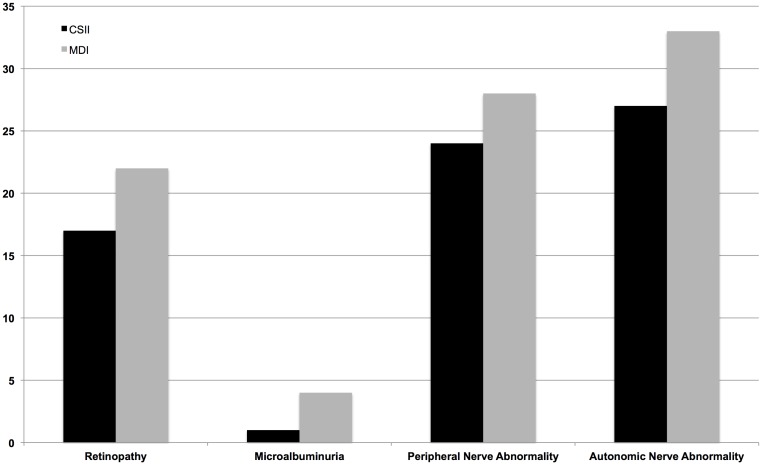
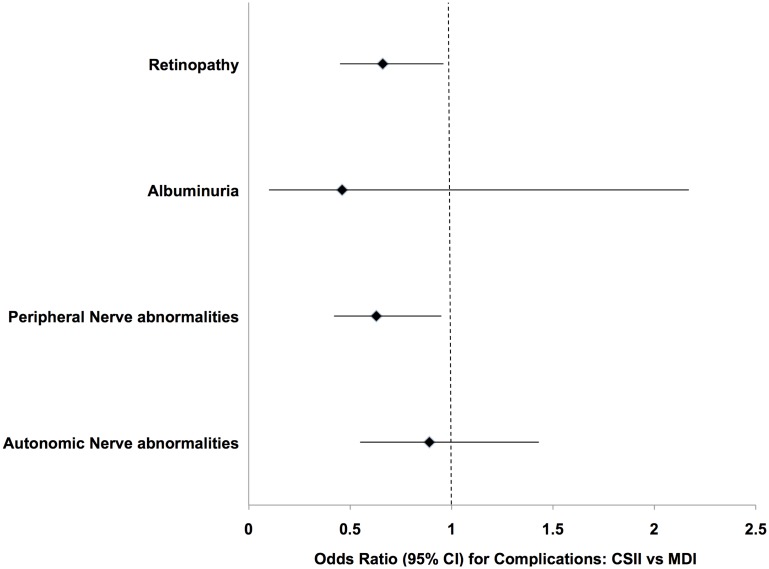
Results: Comparing CSII with MDI: HbA1C was 8.6% [70mmol/mol] vs. 8.7% [72 mmol/mol]) (p = 0.7), retinopathy 17% vs. 22% (p = 0.06); microalbuminuria 1% vs. 4% (p = 0.07), peripheral nerve abnormality 27% vs. 33% (p = 0.108) and autonomic nerve abnormality 24% vs. 28% (p = 0.401). In multivariable GEE, CSII use was associated with lower rates of retinopathy (OR 0.66, 95% CI 0.45-0.95, p = 0.029) and peripheral nerve abnormality (OR 0.63, 95% CI 0.42-0.95, p = 0.026), but not albuminuria (OR 0.46, 95% CI 0.10-2.17, p = 0.33). SES was not associated with any of the complication outcomes.
Conclusions: In adolescents, CSII use is associated with lower rates of retinopathy and peripheral nerve abnormality, suggesting an apparent benefit of CSII over MDI independent of glycemic control or SES.
Conflict of interest statement
Figures
References
-
- Leonard MJ, Reeves GD. Continuous subcutaneous insulin infusion: a comprehensive review of insulin pump therapy. Arch Intern Med 2001;19: 2293–300. - PubMed
-
- Mecklenburg RS, Benson JW Jr, Becker NM, Brazel PL, Fredlund PN, Metz RJ, et al. Clinical use of the insulin infusion pump in 100 patients with type I diabetes. N Engl J Med. 1982;307:513–8. - PubMed
-
- Hoogma RP, Hammond PJ, Gomis R, Kerr D, Bruttomesso D, Bouter KP, et al. Comparison of the effects of continuous subcutaneous insulin infusion (CSII) and NPH-based multiple daily insulin injections (MDI) on glycaemic control and quality of life: results of the 5-nations trial. Diabet Med. 2006;23: 141–7. - PubMed
MeSH terms
LinkOut - more resources
Full Text Sources
Other Literature Sources
Medical
