Review
. 2016 Apr 6;6(2):20150083.
doi: 10.1098/rsfs.2015.0083.

Multiphysics and multiscale modelling, data-model fusion and integration of organ physiology in the clinic: ventricular cardiac mechanics

Affiliations
Review

Multiphysics and multiscale modelling, data-model fusion and integration of organ physiology in the clinic: ventricular cardiac mechanics

Radomir Chabiniok et al. Interface Focus. .

Abstract

With heart and cardiovascular diseases continually challenging healthcare systems worldwide, translating basic research on cardiac (patho)physiology into clinical care is essential. Exacerbating this already extensive challenge is the complexity of the heart, relying on its hierarchical structure and function to maintain cardiovascular flow. Computational modelling has been proposed and actively pursued as a tool for accelerating research and translation. Allowing exploration of the relationships between physics, multiscale mechanisms and function, computational modelling provides a platform for improving our understanding of the heart. Further integration of experimental and clinical data through data assimilation and parameter estimation techniques is bringing computational models closer to use in routine clinical practice. This article reviews developments in computational cardiac modelling and how their integration with medical imaging data is providing new pathways for translational cardiac modelling.

Keywords: cardiac mechanics; data–model fusion; heart mechanics; patient-specific modelling; translational cardiac modelling.


Figures
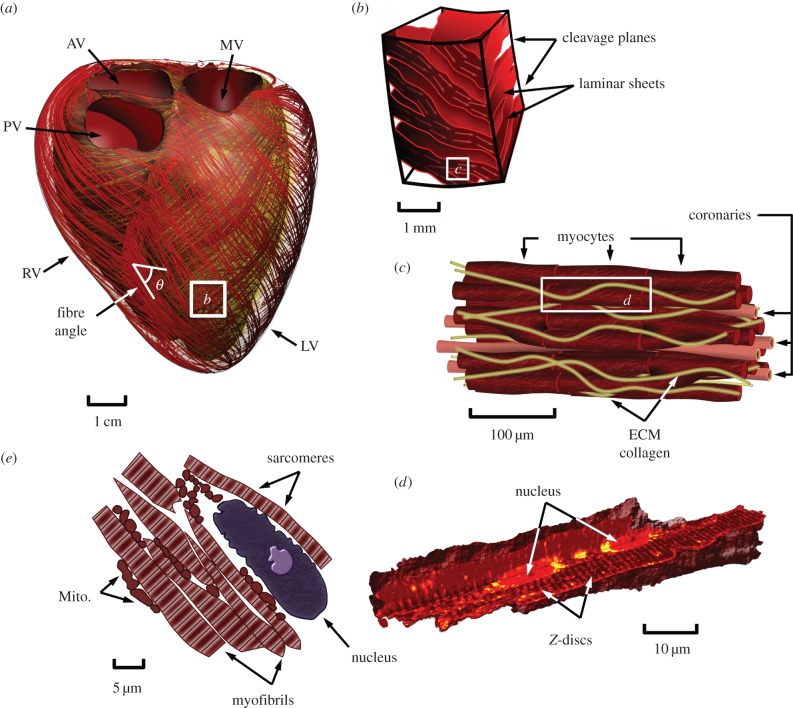
Figure 1.
Figure 1.
Illustrative representation of multiscale cardiac anatomy. (a) Geometric representation of the biventricular anatomy of the heart with streamlines illustrating its fibre architecture, (b) tissue block illustrating the laminar structure of the heart comprising fibre bundles arranged into sheets separated by cleavage planes, (c) local structural arrangement of myocytes and coronary capillaries, (d) 3D view of the cardiomyocyte cut to view internal structures (data courtesy of Dr Rajagopal and Dr Soeller [1,2]), (e) anatomy of the cell illustrating nucleus, myofibres (comprising crossbridges) and mitochondria. RV, right ventricle; LV, left ventricle; PV, pulmonary valve; AV, aortic valve; MV, mitral valve; ECM, extracellular matrix; Mito., mitochondria.
Figure 2.
Figure 2.
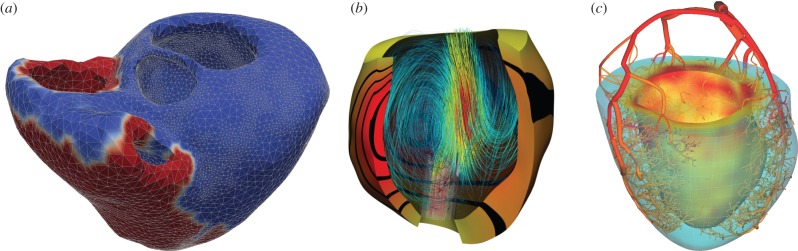
Samples of multiphysics modelling in the heart. (a) Biventricular electromechanical model of the heart illustrating the propagation of electrical potential over the heart [99]. (b) Fluid–solid mechanical model of the assisted LV. Fluid flow streamlines (coloured blue-red indicating increasing velocity magnitude) and myocardial displacements (yellow-red with equally spaced bands illustrating displacement magnitude) are illustrated [100,101]. (c) Coupled 1D flow-poroelastic perfusion model shown at early systole. Flow velocities are shown in the vessel segment. The pore pressure in the myocardium shows increased systolic compressive forces preferentially towards the subendocardium [102].
Figure 3.
Figure 3.
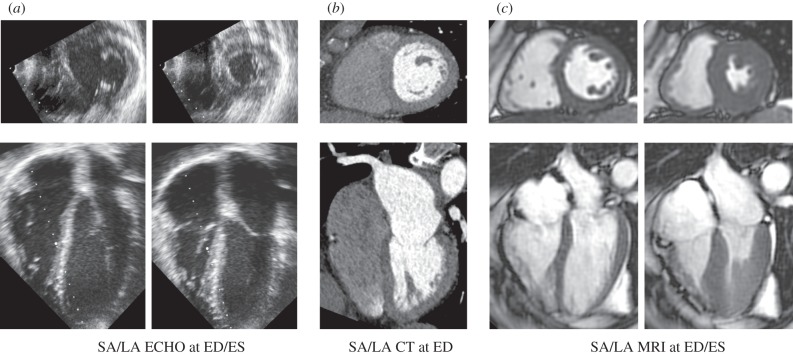
Example of typical medical images of short-axis and long-axis views of the heart. (a) ECHO images at two points in the cardiac cycle. (b) CT images at end diastole (single time point usually acquired due to radiation dose) with contrast bolus illuminating the LV blood pool. (c) CINE MRI at two points in the cardiac cycle. SA, short-axis; LA, long axis; ED, end diastole; ES, end systole.
Figure 4.
Figure 4.
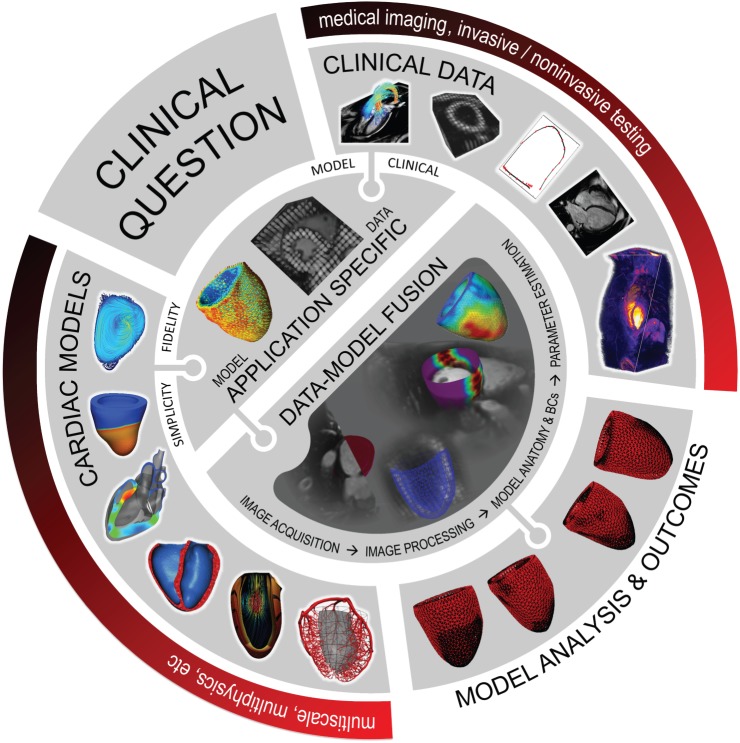
TCM pathway, illustrating the formative steps of model-based analysis. The driver for TCM efforts starts with the clinical question, informing the selection of an application-specific model that brings together the appropriate data and model components. Data–model fusion is then required, personalizing the model with sufficient data (either patient-specific or population average data) to address the clinical need. Once formulated, modelling can be executed and used to generate specific clinically relevant outcomes, informing diagnosis, treatment optimization or treatment planning.
Figure 5.
Figure 5.
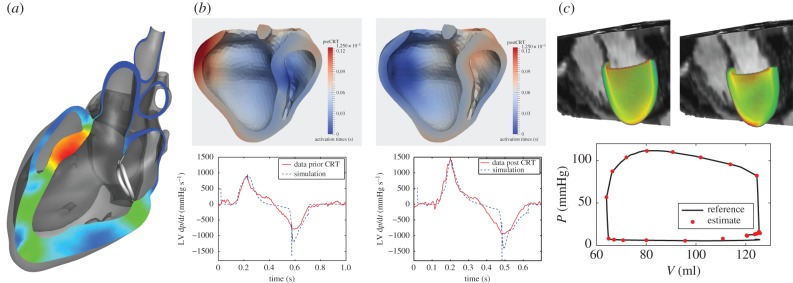
Example applications bringing TCM to the clinic. (a) Evaluation of mitral annuloplasty device using a four chamber electromechanical heart model, assessing the degree to which the device improves mitral valve regurgitation [274]. (b) Examination of biventricular CRT, using an electromechanical model tuned to baseline data to predict therapy response of left ventricular dp/dt [99]. (c) Left ventricular mechanics model parametrization using CINE, 3D tagged and 4D PC MRI providing estimates of tissue properties through the cardiac cycle [244,252].

References

    1. Hou Y, Crossman DJ, Rajagopal V, Baddeley D, Jayasinghe I, Soeller C. 2014. Super-resolution fluorescence imaging to study cardiac biophysics: α-actinin distribution and z-disk topologies in optically thick cardiac tissue slices. Prog. Biophys. Mol. Biol. 115, 328–339. ( 10.1016/j.pbiomolbio.2014.07.003) - DOI - PubMed
    1. Rajagopal V, et al. 2015. Examination of the effects of heterogeneous organization of RyR clusters, myofibrils and mitochondria on Ca2+ release patterns in cardiomyocytes. PLOS Comput. Biol. 11, e1004417 ( 10.1371/journal.pcbi.1004417) - DOI - PMC - PubMed
    1. Woods RH. 1892. A few applications of a physical theorem to membranes in the human body in a state of tension. Trans. R. Acad. Med. Ireland 10, 417–427. ( 10.1007/BF03171228) - DOI - PMC - PubMed
    1. Mirsky I. 1969. Left ventricular stresses in the intact human heart. Biophys. J. 9, 189–208. ( 10.1016/S0006-3495(69)86379-4) - DOI - PMC - PubMed
    1. Ghista DN, Patil KM, Gould P, Woo K. 1973. Computerized left ventricular mechanics and control system analyses models relevant for cardiac diagnosis. Comput. Biol. Med. 3, 27–46. ( 10.1016/0010-4825(73)90017-6) - DOI - PubMed