. 2016 Apr 6:16:60.
doi: 10.1186/s12866-016-0684-9.

A method for culturing Gram-negative skin microbiota

Affiliations

A method for culturing Gram-negative skin microbiota

Ian A Myles et al. BMC Microbiol. .

Abstract

Background: Commensal Gram-negative (CGN) microbiota have been identified on human skin by DNA sequencing; however, methods to reliably culture viable Gram-negative skin organisms have not been previously described.

Results: Through the use of selective antibiotics and minimal media we developed methods to culture CGN from skin swabs. We identified several previously uncharacterized CGN at the species level by optimizing growth conditions and limiting the inhibitory effects of nutrient shock, temperature, and bacterial competition, factors that may have previously limited CGN isolation from skin cultures.

Conclusions: Our protocol will permit future functional studies on the influences of CGN on skin homeostasis and disease.

Keywords: Bacteriology; Culture techniques; Microbiome; Skin.


Figures
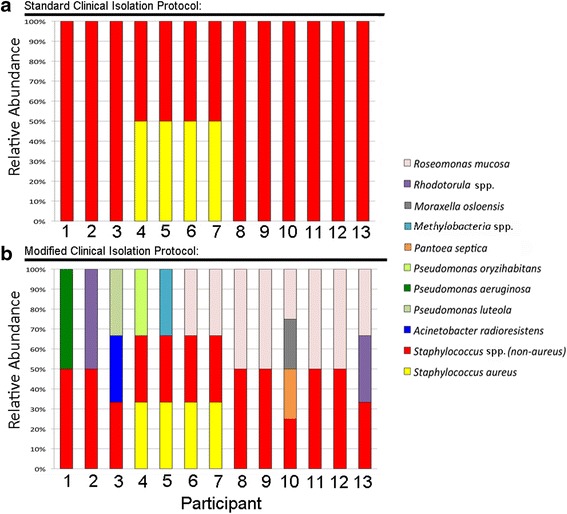
Fig. 1
Fig. 1
Culture protocol modifications allow isolation of Gram-negative skin microbiota. a Thirteen participants underwent standard clinical skin bacteria isolation using swabs plated onto blood, mannitol salt, BHI, chocolate, and MacConkey agar incubated at 37 °C. b The same participants underwent modified bacterial isolation as described. The relative abundance of cultured bacterial isolates from each participant is shown on the vertical axis. All bacteria were identified by MALDI-TOF mass spectrometry analysis, except Staphylococcus species were identified by characteristic growth on mannitol salt agar plates with positives confirmed by coagulase testing. For participants that were re-sampled, no discrepancies between initial and subsequent isolations were found
Fig. 2
Fig. 2
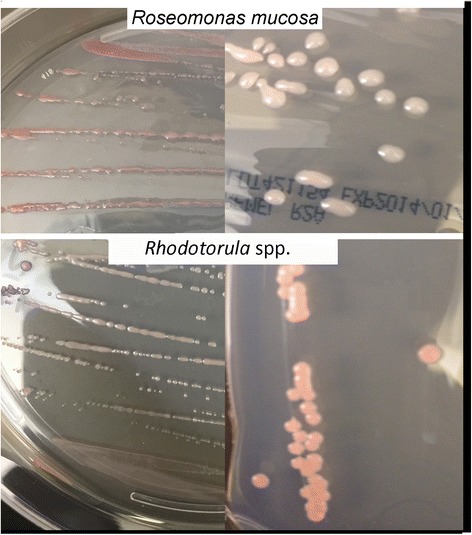
Colony morphology for Roseomonas mucosa and Rhodotorula spp. Colony morphology for two different strains of Roseomonas mucosa (top) and Rhodotorula spp. (bottom; R. mucilaginosa, right; R. minuta/slooffiae, left) streaked linearly (left) or with four-quadrant technique (right) on R2A agar
Fig. 3
Fig. 3
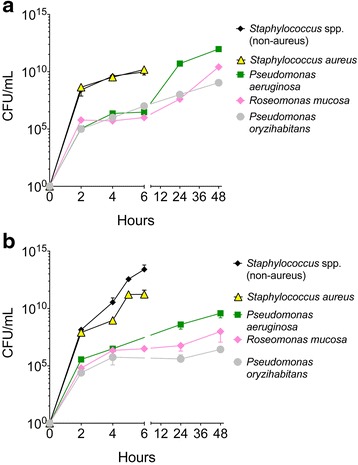
Growth curves for select commensal Gram-negative and Staphylococcus species. A single colony of bacteria was added to liquid media at time zero for all indicated isolates. Colony forming units (CFU) assessed by serial dilutions at indicated time points. a Growth performed at 32 °C, in R2A broth for both CGN and staphylococcal species for direct comparison of growth kinetics. b Comparison of optimized growth kinetics; CGN cultured at 32 °C in R2A broth, Staphylococcus species cultured at 37 °C in TSB. Data are representative of two or more independent experiments and depicted as mean + SD. Each species represented by 1–3 clinical isolates

References

    1. Grice EA, Kong HH, Conlan S, Deming CB, Davis J, Young AC, Program NCS, Bouffard GG, Blakesley RW, Murray PR, et al. Topographical and temporal diversity of the human skin microbiome. Science. 2009;324(5931):1190–1192. doi: 10.1126/science.1171700. - DOI - PMC - PubMed
    1. Oh J, Byrd AL, Deming C, Conlan S, Program NCS, Kong HH, Segre JA. Biogeography and individuality shape function in the human skin metagenome. Nature. 2014;514(7520):59–64. doi: 10.1038/nature13786. - DOI - PMC - PubMed
    1. Marples MJ. The normal flora of the human skin. Br J Dermatol. 1969;81(Suppl 1):2–13. doi: 10.1111/j.1365-2133.1969.tb12827.x. - DOI - PubMed
    1. Lowbury EJ. Gram-negative bacilli on the skin. Br J Dermatol. 1969;81(Suppl 1):55+. doi: 10.1111/j.1365-2133.1969.tb12834.x. - DOI - PubMed
    1. Conlan S, Kong HH, Segre JA. Species-level analysis of DNA sequence data from the NIH Human Microbiome Project. PLoS One. 2012;7(10):e47075. doi: 10.1371/journal.pone.0047075. - DOI - PMC - PubMed

Publication types

MeSH terms