


Preemptive Medicine for Cerebral Aneurysms
- PMID: 27053328
- PMCID: PMC5027238
- DOI: 10.2176/nmc.st.2016-0063
Preemptive Medicine for Cerebral Aneurysms
Abstract
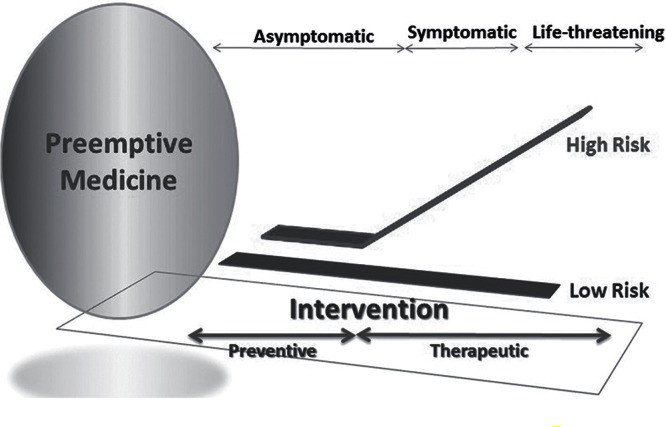
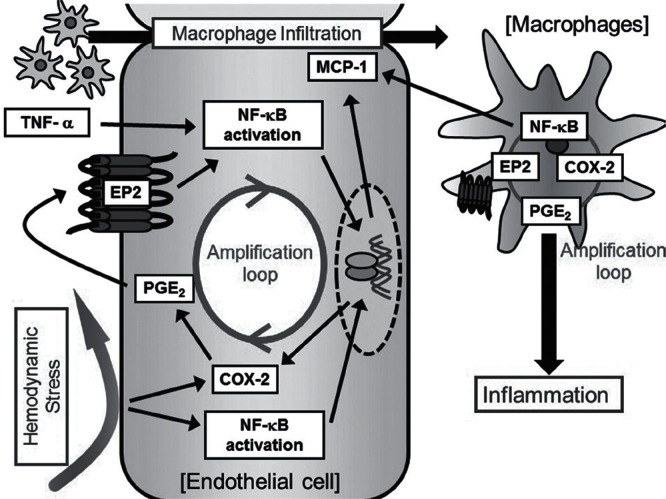
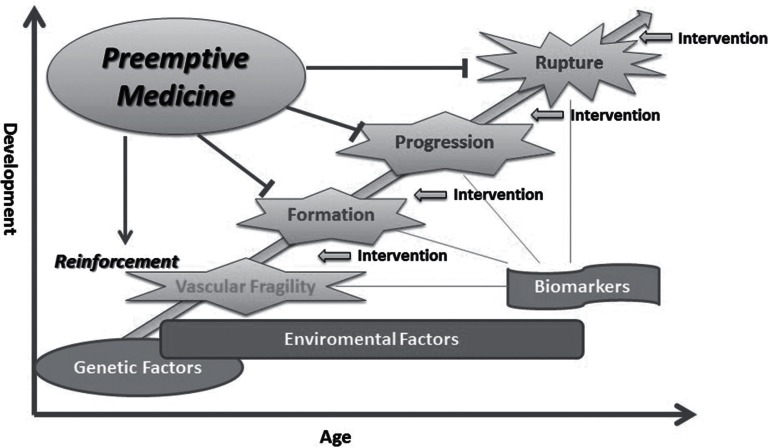
Most of cerebral aneurysms (CAs) are incidentally discovered without any neurological symptoms and the risk of rupture of CAs is relatively higher in Japanese population. The goal of treatments for patients with CAs is complete exclusion of the aneurysmal rupture risk for their lives. Since two currently available major treatments, microsurgical clipping and endovascular coiling, have inherent incompleteness to achieve cure of CAs with some considerable treatment risks, and there is no effective surgical or medical intervention to inhibit the formation of CAs in patients with ruptured and unruptured CAs, new treatment strategies with lower risk and higher efficacy should be developed to prevent the formation, growth, and rupture of CAs. Preemptive medicine for CAs should be designed to prevent or delay the onset of symptoms from CAs found in an asymptomatic state or inhibit the de novo formation of CAs, but we have no definite methods to distinguish rupture-prone aneurysms from rupture-resistant ones. Recent advancements in the research of CAs have provided us with some clues, and one of the new treatment strategies for CAs will be developed based on the findings that several inflammatory pathways may be involved in the formation, growth, and rupture of CAs. Preemptive medicine for CAs will be established with specific biomarkers and imaging modalities which can sensor the development of CAs.
Conflict of interest statement
The authors, who are members of the Japan Neurosurgical Society, have registered the online Self-reported COI Disclosure Statement Forms. T. A. is supported by the coordination fund from Japan Science and Technology Agency (JST) and Astellas Pharma Inc., Tokyo, Japan. K. N. has no conflicts of interest.
Figures
References
-
- Thompson BG, Brown RD, Jr, Amin-Hanjani S, Broderick JP, Cockroft KM, Connolly ES, Jr, Duckwiler GR, Harris CC, Howard VJ, Johnston SC, Meyers PM, Molyneux A, Ogilvy CS, Ringer AJ, Torner J, American Heart Association Stroke Council. Council on Cardiovascular and Stroke Nursing. Council on Epidemiology and Prevention. American Heart Association; American Stroke Association : Guidelines for the Management of Patients With Unruptured Intracranial Aneurysms: A Guideline for Healthcare Professionals From the American Heart Association/American Stroke Association. Stroke 46: 2368– 2400, 2015. - PubMed
-
- Wermer MJ, van der Schaaf IC, Algra A, Rinkel GJ: Risk of rupture of unruptured intracranial aneurysms in relation to patient and aneurysm characteristics: an updated meta-analysis. Stroke 38: 1404– 1410, 2007. - PubMed
-
- Korja M, Lehto H, Juvela S: Lifelong rupture risk of intracranial aneurysms depends on risk factors: a prospective Finnish cohort study. Stroke 45: 1958– 1963, 2014. - PubMed
-
- UCAS Japan Investigators. Morita A, Kirino T, Hashi K, Aoki N, Fukuhara S, Hashimoto N, Nakayama T, Sakai M, Teramoto A, Tominari S, Yoshimoto T: The natural course of unruptured cerebral aneurysms in a Japanese cohort. N Engl J Med 366: 2474– 2482, 2012. - PubMed
-
- Steiner T, Juvela S, Unterberg A, Jung C, Forsting M, Rinkel G, European Stroke Organization : European Stroke Organization guidelines for the management of intracranial aneurysms and subarachnoid haemorrhage. Cerebrovasc Dis 35: 93– 112, 2013. - PubMed
