. 2016 Apr 13;283(1828):20160084.
doi: 10.1098/rspb.2016.0084.

Rare species contribute disproportionately to the functional structure of species assemblages

Affiliations

Rare species contribute disproportionately to the functional structure of species assemblages

Rafael P Leitão et al. Proc Biol Sci. .

Abstract

There is broad consensus that the diversity of functional traits within species assemblages drives several ecological processes. It is also widely recognized that rare species are the first to become extinct following human-induced disturbances. Surprisingly, however, the functional importance of rare species is still poorly understood, particularly in tropical species-rich assemblages where the majority of species are rare, and the rate of species extinction can be high. Here, we investigated the consequences of local and regional extinctions on the functional structure of species assemblages. We used three extensive datasets (stream fish from the Brazilian Amazon, rainforest trees from French Guiana, and birds from the Australian Wet Tropics) and built an integrative measure of species rarity versus commonness, combining local abundance, geographical range, and habitat breadth. Using different scenarios of species loss, we found a disproportionate impact of rare species extinction for the three groups, with significant reductions in levels of functional richness, specialization, and originality of assemblages, which may severely undermine the integrity of ecological processes. The whole breadth of functional abilities within species assemblages, which is disproportionately supported by rare species, is certainly critical in maintaining ecosystems particularly under the ongoing rapid environmental transitions.

Keywords: conservation; extinction; functional diversity; null models; rarity index; tropical biodiversity.


Figures

Figure 1.
Figure 1.
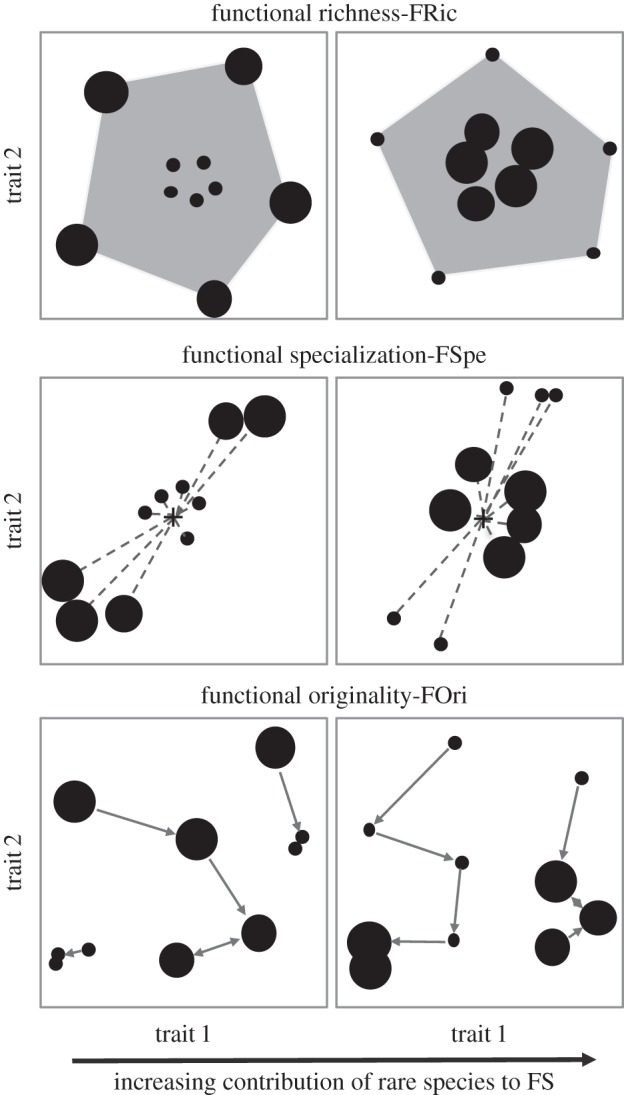
Hypothetical scenarios for the contribution of rare species to the functional structure (FS) of species assemblages. Each plot represents a different study case where species (dots) are distributed across a two-dimensional functional space. The level of species commonness (accounting for abundance, geographical range, and habitat breadth) is illustrated by the size of the dots, rare species being represented by small dots. Three FS indices are illustrated separately: functional richness (convex-hull volume of the functional space filled by all species within the assemblage; grey polygon projected); functional specialization (mean distance between each species and the average position—black cross—of all species; dashed lines); and functional originality (mean distance between a given species and its nearest neighbour; grey arrows). The contribution of rare species to FS increases from the left to the right of the figure in the sense that their loss would significantly reduce the value for each index.
Figure 2.
Figure 2.
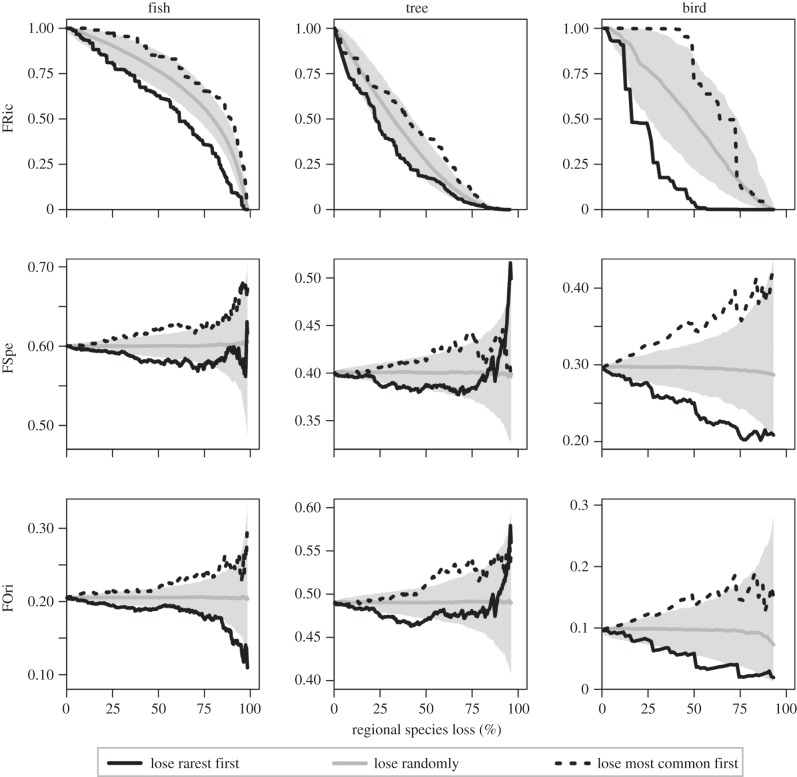
Impact of regional species extinction on the functional structure (functional richness, FRic; specialization, FSpe; and originality, FOri) of three tropical assemblages: stream fish from the Brazilian Amazon, rainforest trees from French Guiana, and birds from the Australian Wet Tropics. Rarest species sequential loss (black solid line) is compared with the opposite scenario where most common species are lost first (black dashed line) and with a null scenario simulating a random sequential extinction (grey line indicates the median of this scenario among 1 000 replicates and the 95% confidence interval is represented as the shaded area). Due to computation constraints the maximum species removals from the regional pools of fish, trees, and birds were, respectively, 99%, 96%, and 93%.
Figure 3.
Figure 3.
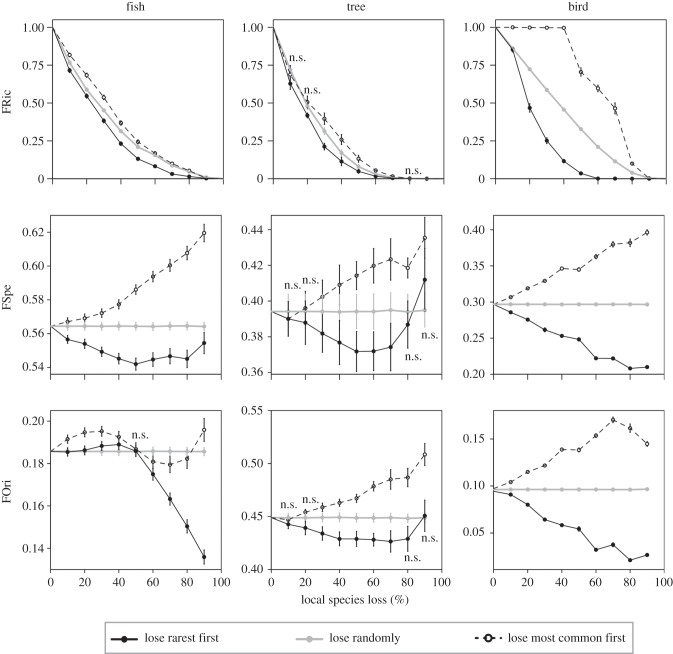
Impact of local species extinction on the functional structure (functional richness, FRic; specialization, FSpe; and originality, FOri) of local assemblages of stream fish from the Brazilian Amazon, rainforest trees from French Guiana, and birds from the Australian Wet Tropics. For computations of functional indices, 10–90% of the species of each local assemblage were removed according to three different scenarios: lose the rarest species first (black solid line); lose the most common species first (black dashed line); and lose species randomly (grey solid line). Dots and vertical bars represent mean values and standard error at the species-removal level among all local assemblages. ‘n.s.' indicates no significant difference (p > 0.05) when comparing scenarios for a given level of species removal (see detailed results of Friedman paired test and sample sizes in the electronic supplementary material, table S2).
Figure 4.
Figure 4.
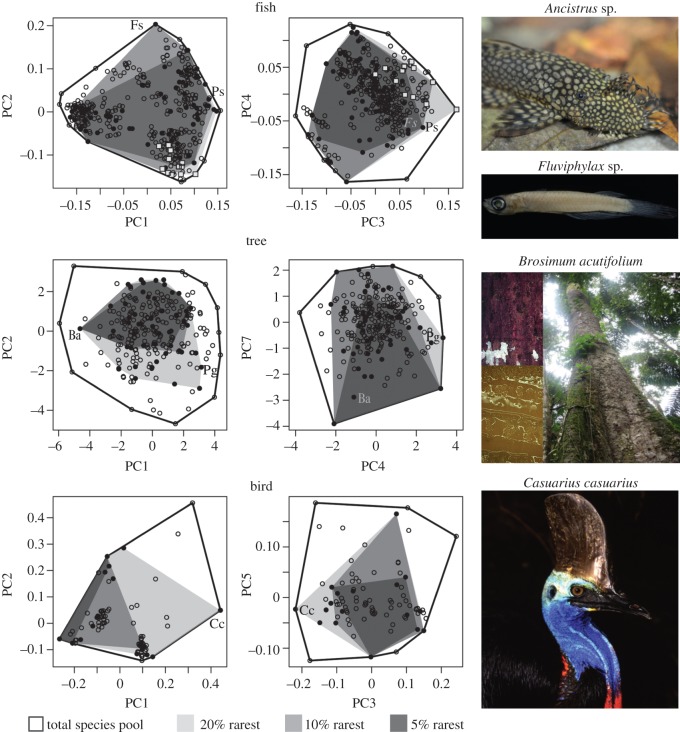
Multidimensional functional spaces built with the species pool of three tropical assemblages: stream fish from the Brazilian Amazon (395 species), rainforest trees from French Guiana (262), and birds from the Australian Wet Tropics (86). Each panel represents two axes (PC) of the functional space where species are plotted according to their respective trait values (see biplots for all PC combinations in the electronic supplementary material, figures S4–S6). Convex hull volumes filled by the 5%, 10%, and 20% rarest species are illustrated as the nested grey areas. Circles filled with black are the 20% rarest species. Grey squares on top panels are periphyton-grazing fishes (illustrated by the loricariid Ancistrus sp.). Ps, Paravandellia sp.; Fs, Fluviphylax simplex; Ba, Brosimum acutifolium; Pg, Protium giganteum; and Cc, Casuarius casuarius. (Online version in colour.)

References

    1. Vitousek PM, Mooney HA, Lubchneco J, Melillo JM. 1997. Human domination of Earth's ecosystems. Science 277, 494–499. (10.1126/science.277.5325.494) - DOI
    1. Barnosky AD, et al. 2011. Has the Earth's sixth mass extinction already arrived? Nature 471, 51–57. (10.1038/nature09678) - DOI - PubMed
    1. Purvis A, Agapow PM, Gittleman JC, Mace GM. 2000. Non-random extinction and the loss of evolutionary history. Science 288, 328–330. (10.1126/science.288.5464.328) - DOI - PubMed
    1. Rabinowitz D. 1981. Seven forms of rarity. In Biological aspects of rare plant conservation (ed. Synge H.), pp. 205–217. Chichester, UK: John Wiley.
    1. Harnik PG, Simpson C, Payne L. 2012. Long-term differences in extinction risk among the seven forms of rarity. Proc. R. Soc. B 279, 4969–4976. (10.1098/rspb.2012.1902) - DOI - PMC - PubMed

Publication types