


Limited artemisinin resistance-associated polymorphisms in Plasmodium falciparum K13-propeller and PfATPase6 gene isolated from Bioko Island, Equatorial Guinea
- PMID: 27054064
- PMCID: PMC4805774
- DOI: 10.1016/j.ijpddr.2015.11.002
Limited artemisinin resistance-associated polymorphisms in Plasmodium falciparum K13-propeller and PfATPase6 gene isolated from Bioko Island, Equatorial Guinea
Abstract
Objective: With emergence and geographically expanding of antimalarial resistance worldwide, molecular markers are essential tool for surveillance of resistant Plasmodium parasites. Recently, single-nucleotide polymorphisms (SNPs) in the PF3D7_1343700 kelch propeller (K13-propeller) domain are shown to be associated with artemisinin (ART) resistance in vivo and in vitro. This study aims to investigate the ART resistance-associated polymorphisms of K13-propeller and PfATPase6 genes in Plasmodium falciparum isolates from Bioko Island, Equatorial Guinea (EG).
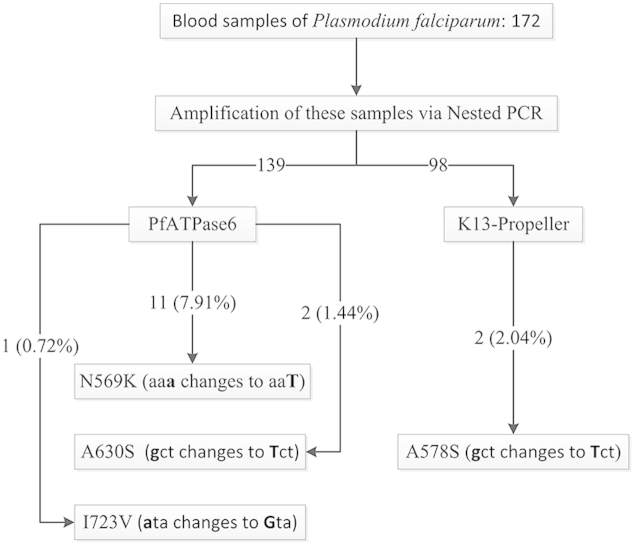
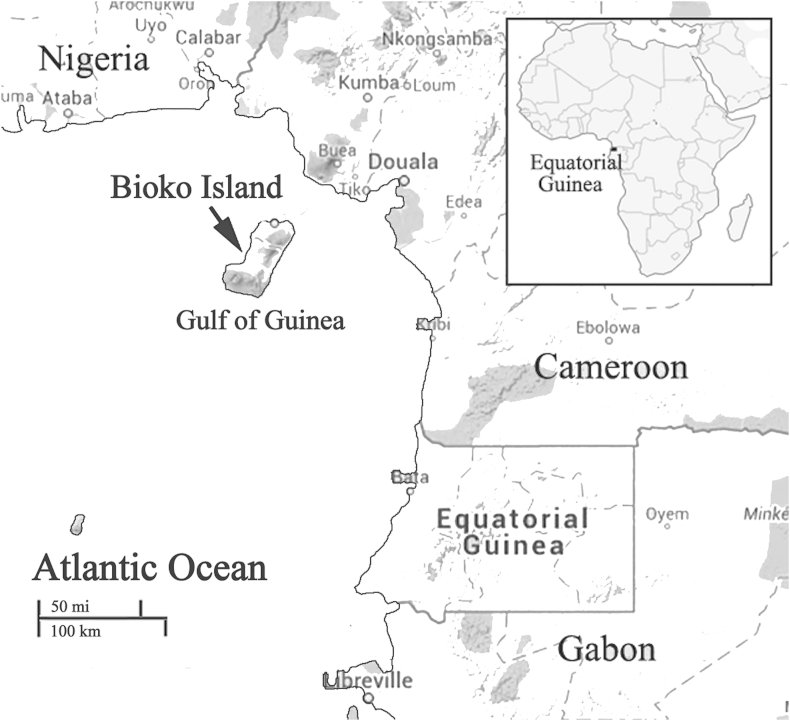
Methods: A total of 172 samples were collected from falciparum malaria patients on Bioko Island between 2013 and 2014. The polymorphisms of K13-propeller and PfATPase6 genes were analyzed by Nest-PCR and sequencing.
Results: Sequences of K13-propeller and PfATPase6 were obtained from 90.74% (98/108) and 91.45% (139/152) samples, respectively. The 2.04% (2/98) cases had non-synonymous K13-propeller A578S mutation but no found the mutations associated with ART resistance in Southeast Asia. For PfATPase6, the mutations were found at positions N569K and A630S with the mutation prevalence of 7.91% (11/139) and 1.44% (2/139), respectively. In addition, a sample with the mixed type at position I723V was discovered (0.72%, 1/139).
Conclusions: This study initially offers an insight of K13-propeller and PfATPase6 polymorphisms on Bioko Island, EG. It suggests no widespread ART resistance or tolerance in the region, and might be helpful for developing and updating guidance for the use of ART-based combination therapies (ACTs).
Keywords: Artemisinin resistance; K13-propeller; Plasmodium falciparum; Polymorphism.
Figures
References
-
- Afonso A., Hunt P., Cheesman S., Alves A.C., Cunha C.V., do Rosario V., Cravo P. Malaria parasites can develop stable resistance to artemisinin but lack mutations in candidate genes atp6 (encoding the sarcoplasmic and endoplasmic reticulum Ca2+ ATPase), tctp, mdr1, and cg10. Antimicrob. Agents Chemother. 2006;50:480–489. - PMC - PubMed
-
- Amaratunga C., Sreng S., Suon S., Phelps E.S., Stepniewska K., Lim P., Zhou C., Mao S., Anderson J.M., Lindegardh N., Jiang H., Song J., Su X.Z., White N.J., Dondorp A.M., Anderson T.J., Fay M.P., Mu J., Duong S., Fairhurst R.M. Artemisinin-resistant Plasmodium falciparum in Pursat province, western Cambodia: a parasite clearance rate study. Lancet. Infect. Dis. 2012;12:851–858. - PMC - PubMed
-
- Ariey F., Witkowski B., Amaratunga C., Beghain J., Langlois A.C., Khim N., Kim S., Duru V., Bouchier C., Ma L., Lim P., Leang R., Duong S., Sreng S., Suon S., Chuor C.M., Bout D.M., Menard S., Rogers W.O., Genton B., Fandeur T., Miotto O., Ringwald P., Le Bras J., Berry A., Barale J.C., Fairhurst R.M., Benoit-Vical F., Mercereau-Puijalon O., Menard D. A molecular marker of artemisinin-resistant Plasmodium falciparum malaria. Nature. 2014;505:50–55. - PMC - PubMed
Publication types
MeSH terms
Substances
LinkOut - more resources
Full Text Sources
Other Literature Sources
Research Materials
