


Prevalence of Intracranial Atherosclerotic Stenosis Using High-Resolution Magnetic Resonance Angiography in the General Population: The Atherosclerosis Risk in Communities Study
- PMID: 27056984
- PMCID: PMC5319392
- DOI: 10.1161/STROKEAHA.115.011292
Prevalence of Intracranial Atherosclerotic Stenosis Using High-Resolution Magnetic Resonance Angiography in the General Population: The Atherosclerosis Risk in Communities Study
Abstract
Background and purpose: Intracranial atherosclerotic stenosis (ICAS) is a common cause of stroke, but little is known about its epidemiology. We studied the prevalence of ICAS and its association with vascular risk factors using high-resolution magnetic resonance angiography in a US cardiovascular cohort.
Methods: The Atherosclerosis Risk in Communities (ARIC) study recruited participants from 4 US communities from 1987 to 1989. Using stratified sampling, we selected 1980 participants from visit 5 (2011-2013) for high-resolution 3T-magnetic resonance angiography. All images were analyzed in a centralized laboratory, and ICAS was graded as: no stenosis, <50% stenosis, 50% to 69% stenosis, 70% to 99% stenosis, and complete occlusion. We calculated per-vessel and per-person prevalence of ICAS (weighted for n=6538 visit 5 participants) and also estimated the US prevalence. We used multivariable logistic regression to identify variables independently associated with ICAS.
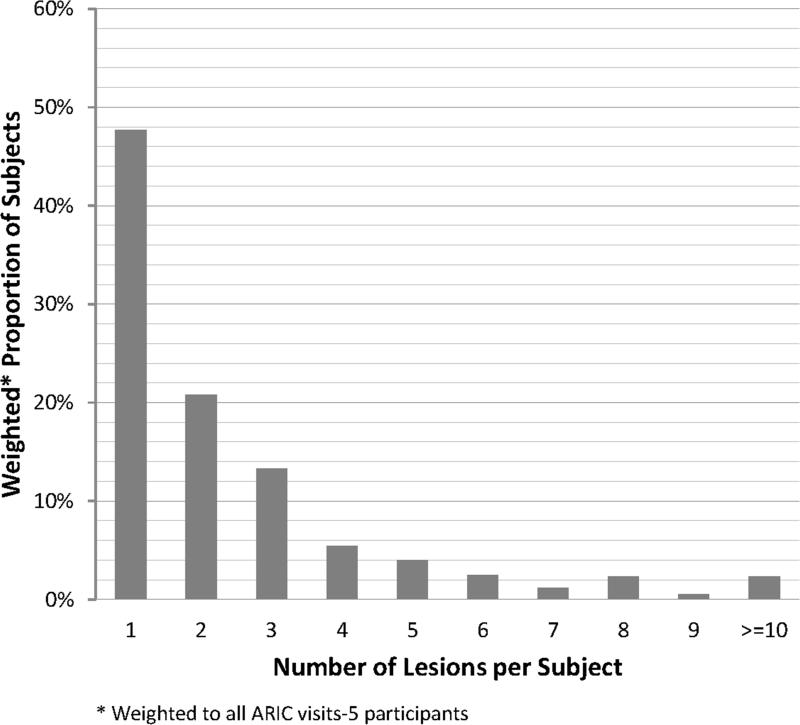
Results: Subjects who had an adequate magnetic resonance angiography (n=1765) were aged 67 to 90 years, 41% were men, 70% were white, and 29% were black. ICAS was prevalent in 31% of participants and 9% had ICAS ≥50%. Estimated US prevalence of ICAS ≥50% for 65 to 90 years old was 8% for whites and 12% for blacks. Older age, black race, higher systolic blood pressure, and higher low-density lipoprotein cholesterol levels were associated with increased odds of ICAS, whereas higher levels of high-density lipoprotein cholesterol and use of cholesterol-lowering medications were associated with decreased odds of ICAS. Body mass index and smoking were not associated with ICAS.
Conclusions: The prevalence of ICAS in older adults is high, and it could be a target for primary prevention of stroke and dementia in this population.
Keywords: intracranial atherosclerosis stenosis; intracranial stenosis; magnetic resonance angiography; prevalence.
© 2016 American Heart Association, Inc.
Figures
References
-
- Sacco RL, Kargman DE, Gu Q, Zamanillo MC. Race-ethnicity and determinants of intracranial atherosclerotic cerebral infarction. The Northern Manhattan Stroke Study. Stroke. 1995;26:14–20. - PubMed
-
- Qureshi AI, Caplan LR. Intracranial atherosclerosis. Lancet. 2014;383:984–998. - PubMed
-
- Feldmann E, Daneault N, Kwan E, Ho KJ, Pessin MS, Langenberg P, et al. Chinese-white differences in the distribution of occlusive cerebrovascular disease. Neurology. 1990;40:1541–1545. - PubMed
Publication types
MeSH terms
Grants and funding
- HHSN268201100012C/HL/NHLBI NIH HHS/United States
- HHSN268201100009I/HL/NHLBI NIH HHS/United States
- U01 HL096812/HL/NHLBI NIH HHS/United States
- HHSN268201100010C/HL/NHLBI NIH HHS/United States
- HHSN268201100008C/HL/NHLBI NIH HHS/United States
- HHSN268201100007C/HL/NHLBI NIH HHS/United States
- HHSN268201100011I/HL/NHLBI NIH HHS/United States
- HHSN268201100011C/HL/NHLBI NIH HHS/United States
- U01 HL096902/HL/NHLBI NIH HHS/United States
- R01 HL105626/HL/NHLBI NIH HHS/United States
- HHSN268201100006C/HL/NHLBI NIH HHS/United States
- HHSN268201100005I/HL/NHLBI NIH HHS/United States
- U01 HL096814/HL/NHLBI NIH HHS/United States
- R01 HL105930/HL/NHLBI NIH HHS/United States
- HHSN268201100005G/HL/NHLBI NIH HHS/United States
- U01 HL096917/HL/NHLBI NIH HHS/United States
- HHSN268201100008I/HL/NHLBI NIH HHS/United States
- HHSN268201100009C/HL/NHLBI NIH HHS/United States
- R01 HL070825/HL/NHLBI NIH HHS/United States
- HHSN268201100005C/HL/NHLBI NIH HHS/United States
- U01 HL096899/HL/NHLBI NIH HHS/United States
- HHSN268201100007I/HL/NHLBI NIH HHS/United States
LinkOut - more resources
Full Text Sources
Other Literature Sources
Medical
