. 2016 Aug;10(8):2010-9.
doi: 10.1038/ismej.2015.250. Epub 2016 Apr 8.

Long-distance electron transfer by cable bacteria in aquifer sediments

Affiliations

Long-distance electron transfer by cable bacteria in aquifer sediments

Hubert Müller et al. ISME J. 2016 Aug.

Abstract

The biodegradation of organic pollutants in aquifers is often restricted to the fringes of contaminant plumes where steep countergradients of electron donors and acceptors are separated by limited dispersive mixing. However, long-distance electron transfer (LDET) by filamentous 'cable bacteria' has recently been discovered in marine sediments to couple spatially separated redox half reactions over centimeter scales. Here we provide primary evidence that such sulfur-oxidizing cable bacteria can also be found at oxic-anoxic interfaces in aquifer sediments, where they provide a means for the direct recycling of sulfate by electron transfer over 1-2-cm distance. Sediments were taken from a hydrocarbon-contaminated aquifer, amended with iron sulfide and saturated with water, leaving the sediment surface exposed to air. Steep geochemical gradients developed in the upper 3 cm, showing a spatial separation of oxygen and sulfide by 9 mm together with a pH profile characteristic for sulfur oxidation by LDET. Bacterial filaments, which were highly abundant in the suboxic zone, were identified by sequencing of 16S rRNA genes and fluorescence in situ hybridization (FISH) as cable bacteria belonging to the Desulfobulbaceae. The detection of similar Desulfobulbaceae at the oxic-anoxic interface of fresh sediment cores taken at a contaminated aquifer suggests that LDET may indeed be active at the capillary fringe in situ.


Figures
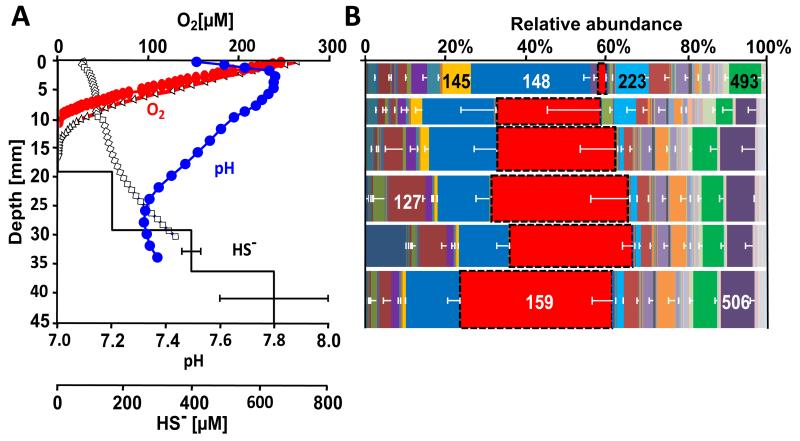
Figure 1
Figure 1
Geochemical gradients and microbial community analysis from a representative incubation of sediments taken from the Flingern aquifer. A) Porewater profiles of O2, pH, and HS of homogenized sediment amended with 2 μmol g−1 sediment after 70 days of incubation in the dark. One typical replicate out of four is shown. Error bars for sulfide concentrations in different slices of the cut sediment represent standard deviations of 3 technical replicates. Open symbols show porewater profiles of O2 (triangles) and pH (squares) of one typical abiotic control column out of two. B) Corresponding depth-resolved relative abundance of T-RF 159 (dashed frame) representing members of the Desulfobulbaceae as mean values of three independent DNA extractions. Error bars show standard deviations of relative abundances determined from triplicate DNA extractions of one typical replicate out of two.
Figure 2
Figure 2
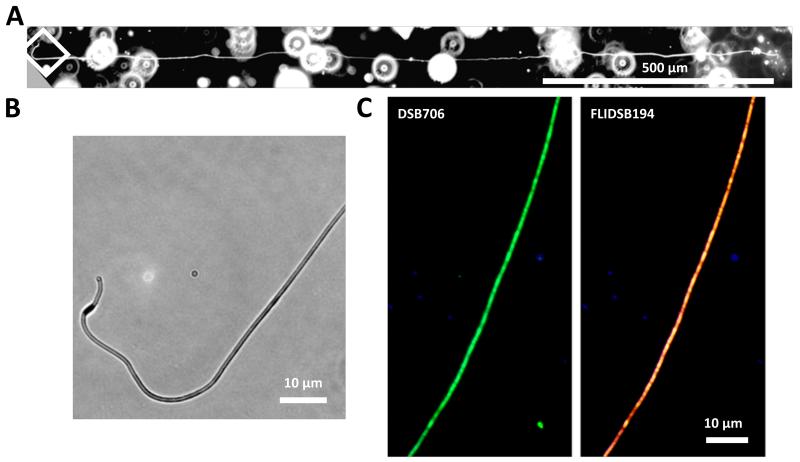
A) Microscopic image of a filament fragment of approximately 1.7 mm length. Three pictures were merged to cover the full length of the fragment. The white square indicates the part of the filament shown in higher magnification in B). C) Micrographs of filaments stained with FISH probes specific for the family Desulfobulbaceae (DSB706; 6-FAM labeled) and D) for groundwater cable bacteria (FLIDSB194, Cy3 labeled). Each image is presented as overlay of two pictures taken with filters for specific probe fluorescence and DAPI for counterstaining.
Figure 3
Figure 3
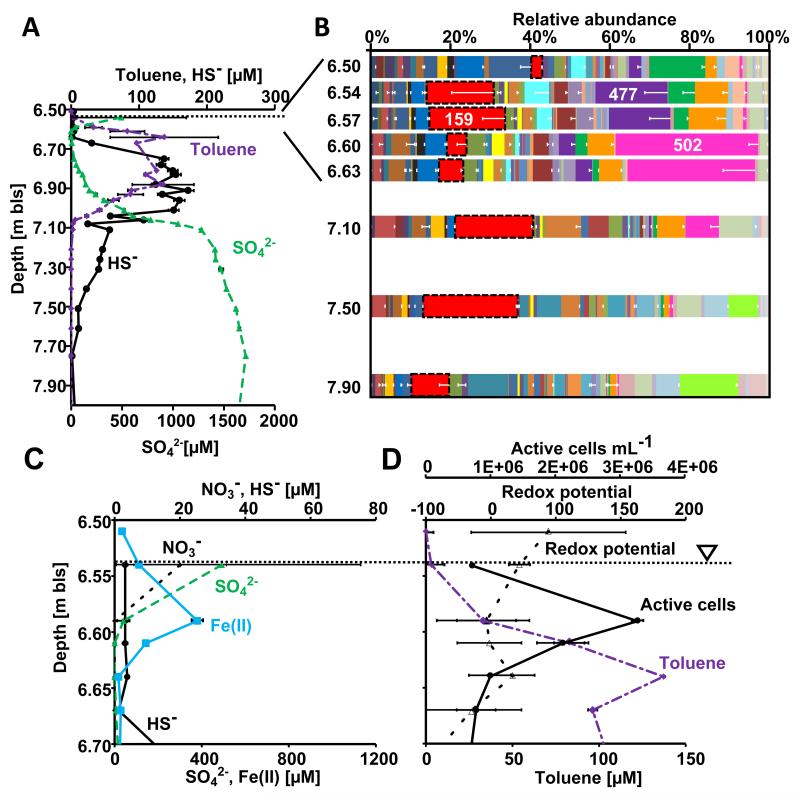
Depth profiles of geochemistry of water samples from a high-resolution monitoring well installed in Flingern and of microbial community compositions from a sediment core drilled at 1 m distance. A) Groundwater chemistry of duplicate measurements showing the zone of toluene contamination as well as the sulfide- and sulfate concentrations. B) T-RFLP microbial community fingerprints obtained from triplicate DNA extractions of different sediment layers. T-RF 159 (dashed frame) is representing members of the Desulfobulbaceae. Data show the mean values and standard deviations of three independent DNA extractions. C), D) Geochemistry and active cell densities estimated from intracellular ATP concentrations of groundwater at the upper plume fringe. Bls, below land surface. The dashed horizontal lines indicate the groundwater table.
Figure 4
Figure 4
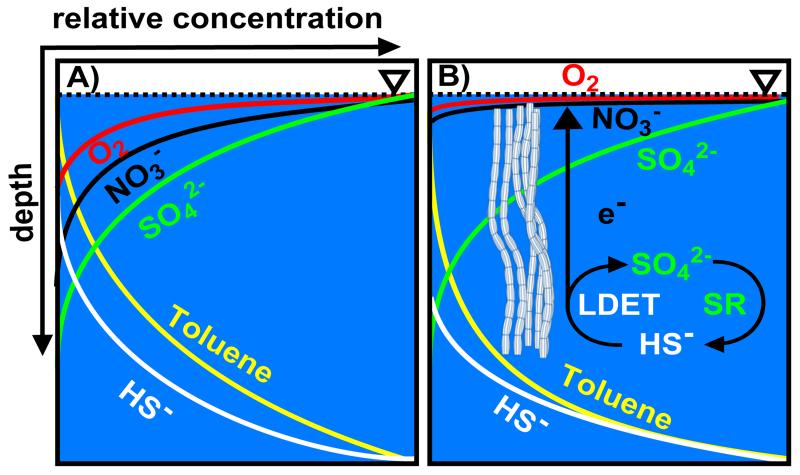
Conceptual model of the impact of LDET by cable bacteria on sulfur cycling and contaminant degradation at the plume fringe. A) Redox zonation at a toluene plume fringe only controlled by dispersive/diffusive mixing in the absence of cable bacteria. B) A plume fringe scenario including sulfide re-oxidation by cable bacteria leads to higher availability of sulfate for toluene degradation by sulfate reduction (SR) and a broader zone of biodegradation at the plume fringes. Steeper gradients indicate higher fluxes of solutes.

References

    1. Anneser B, Einsiedl F, Meckenstock RU, Richters L, Wisotzky F, Griebler C. High-resolution monitoring of biogeochemical gradients in a tar oil-contaminated aquifer. Applied Geochemistry. 2008;23:1715–1730.
    1. Anneser B, Pilloni G, Bayer A, Lueders T, Griebler C, Einsiedl F, et al. High Resolution Analysis of Contaminated Aquifer Sediments and Groundwater—What Can be Learned in Terms of Natural Attenuation? Geomicrobiology Journal. 2010;27:130–142.
    1. Atekwana EA, Slater LD. Biogeophysics: A new frontier in Earth science research. Reviews of Geophysics. 2009:47.
    1. Awwa A. Standard methods for the examination of water and wastewater. Standard Methods for the Examination of Water and Wastewater; Washington, DC: 1998. p. 20.
    1. Bauer RD, Maloszewski P, Zhang Y, Meckenstock RU, Griebler C. Mixing-controlled biodegradation in a toluene plume -results from two-dimensional laboratory experiments. Journal of Contaminant Hydrology. 2008;96:150–68. - PubMed

MeSH terms