


The Intestinal Microbiota in Metabolic Disease
- PMID: 27058556
- PMCID: PMC4848671
- DOI: 10.3390/nu8040202
The Intestinal Microbiota in Metabolic Disease
Abstract
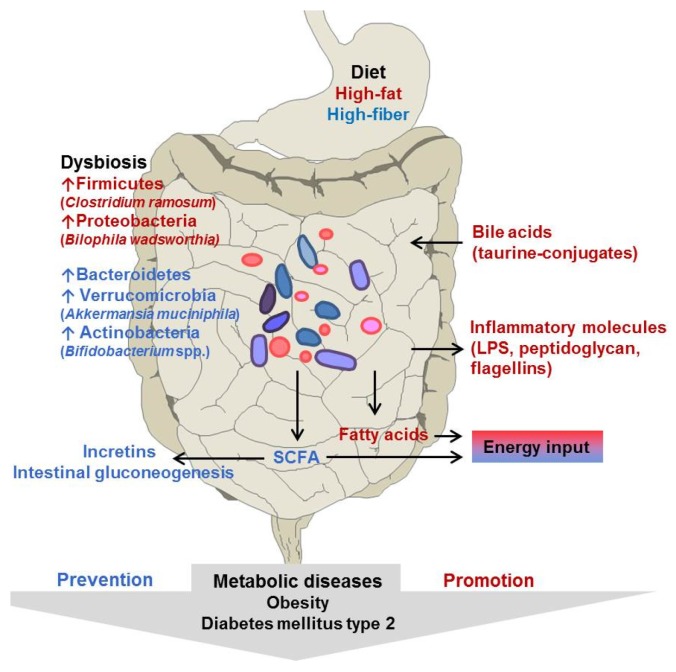
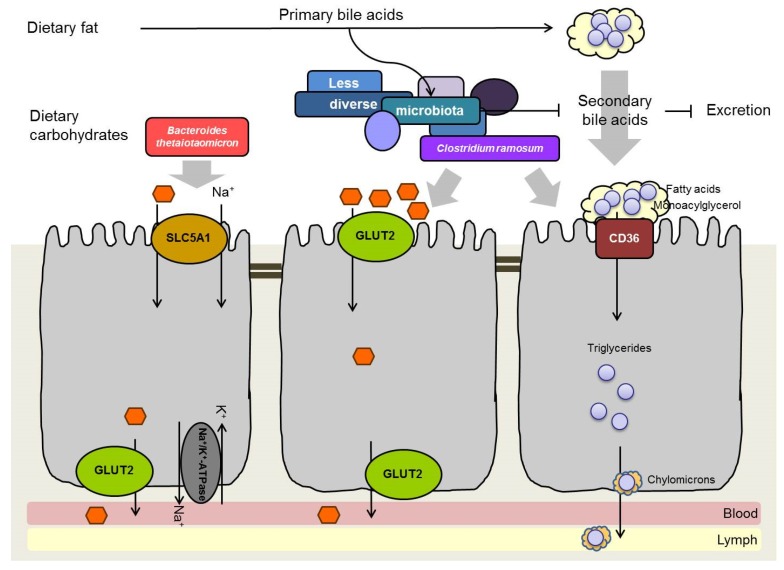
Gut bacteria exert beneficial and harmful effects in metabolic diseases as deduced from the comparison of germfree and conventional mice and from fecal transplantation studies. Compositional microbial changes in diseased subjects have been linked to adiposity, type 2 diabetes and dyslipidemia. Promotion of an increased expression of intestinal nutrient transporters or a modified lipid and bile acid metabolism by the intestinal microbiota could result in an increased nutrient absorption by the host. The degradation of dietary fiber and the subsequent fermentation of monosaccharides to short-chain fatty acids (SCFA) is one of the most controversially discussed mechanisms of how gut bacteria impact host physiology. Fibers reduce the energy density of the diet, and the resulting SCFA promote intestinal gluconeogenesis, incretin formation and subsequently satiety. However, SCFA also deliver energy to the host and support liponeogenesis. Thus far, there is little knowledge on bacterial species that promote or prevent metabolic disease. Clostridium ramosum and Enterococcus cloacae were demonstrated to promote obesity in gnotobiotic mouse models, whereas bifidobacteria and Akkermansia muciniphila were associated with favorable phenotypes in conventional mice, especially when oligofructose was fed. How diet modulates the gut microbiota towards a beneficial or harmful composition needs further research. Gnotobiotic animals are a valuable tool to elucidate mechanisms underlying diet-host-microbe interactions.
Keywords: SCFA; absorption; bile acids; diabetes; diet; energy harvest; intestinal microbiota; low-grade inflammation; metabolic syndrome; obesity.
Figures
References
-
- Hildebrandt M.A., Hoffmann C., Sherrill-Mix S.A., Keilbaugh S.A., Hamady M., Chen Y.Y., Knight R., Ahima R.S., Bushman F., Wu G.D. High-fat diet determines the composition of the murine gut microbiome independently of obesity. Gastroenterology. 2009;137 doi: 10.1053/j.gastro.2009.08.042. - DOI - PMC - PubMed
-
- Murphy E.F., Cotter P.D., Healy S., Marques T.M., O’Sullivan O., Fouhy F., Clarke S.F., O’Toole P.W., Quigley E.M., Stanton C., et al. Composition and energy harvesting capacity of the gut microbiota: Relationship to diet, obesity and time in mouse models. Gut. 2010;59:1635–1642. doi: 10.1136/gut.2010.215665. - DOI - PubMed
Publication types
MeSH terms
Substances
LinkOut - more resources
Full Text Sources
Other Literature Sources
Medical
