


Biophotons Contribute to Retinal Dark Noise
- PMID: 27059222
- PMCID: PMC5563773
- DOI: 10.1007/s12264-016-0029-6
Biophotons Contribute to Retinal Dark Noise
Abstract
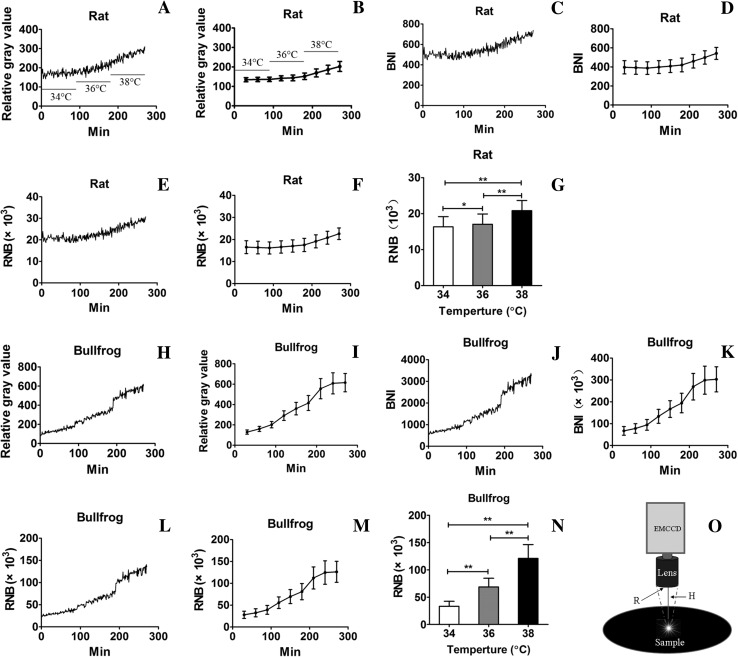
The discovery of dark noise in retinal photoreceptors resulted in a long-lasting controversy over its origin and the underlying mechanisms. Here, we used a novel ultra-weak biophoton imaging system (UBIS) to detect biophotonic activity (emission) under dark conditions in rat and bullfrog (Rana catesbeiana) retinas in vitro. We found a significant temperature-dependent increase in biophotonic activity that was completely blocked either by removing intracellular and extracellular Ca(2+) together or inhibiting phosphodiesterase 6. These findings suggest that the photon-like component of discrete dark noise may not be caused by a direct contribution of the thermal activation of rhodopsin, but rather by an indirect thermal induction of biophotonic activity, which then activates the retinal chromophore of rhodopsin. Therefore, this study suggests a possible solution regarding the thermal activation energy barrier for discrete dark noise, which has been debated for almost half a century.
Keywords: Biophoton; Biophoton imaging; Ca2+; Phosphodiesterase 6; Rat and bullfrog retinas; Retinal dark noise.
Figures


References
-
- Liu J, Liu MY, Nguyen JB, Bhagat A, Mooney V, Yan EC. Thermal decay of rhodopsin: role of hydrogen bonds in thermal isomerization of 11-cis retinal in the binding site and hydrolysis of protonated Schiff base. Journal of the American Chemical Society. 2009;131:8750–8751. doi: 10.1021/ja903154u. - DOI - PMC - PubMed
MeSH terms
Substances
LinkOut - more resources
Full Text Sources
Other Literature Sources
Miscellaneous
