Case Reports
. 2016 Apr 8:15:37.
doi: 10.1186/s12937-016-0156-y.

Case report: pericardial effusion with constrictive physiology in a patient with wet beriberi

Affiliations
Case Reports

Case report: pericardial effusion with constrictive physiology in a patient with wet beriberi

Minako Yamamura et al. Nutr J. .

Abstract

Wet beriberi-induced pericardial effusion has rarely been previously described. Little is known about the effect of beriberi-induced pericardial effusion on hemodynamics. Here we present a case of wet beriberi with pericardial effusion that exhibited constrictive physiology, which was dramatically improved after treatment. A 61-year-old male patient was admitted to our hospital for progressive leg edema, dyspnea on exertion, and lower-extremity muscle weakness. Echocardiography showed a hyperkinetic left ventricle and a moderate amount of pericardial effusion. Hemodynamic measurements, including simultaneous measurement of left and right ventricular pressures, revealed high output heart failure and constrictive physiology. Blood test showed lactic acidosis, and low level of serum thiamine levels; consistent with a diagnosis of wet beriberi. After thiamine replacement therapy, the patient's hemodynamic state rapidly improved. Additionally, pericardial effusion decreased and constrictive physiology was successfully resolved. No other possible causes of pericardial effusion could be identified, with the exception of thiamine deficiency. This case illustrates the importance of considering wet beriberi as a possible cause of pericardial effusion with constrictive physiology.

Keywords: Beriberi; Constrictive physiology; Heart failure; Pericarditis.


Figures
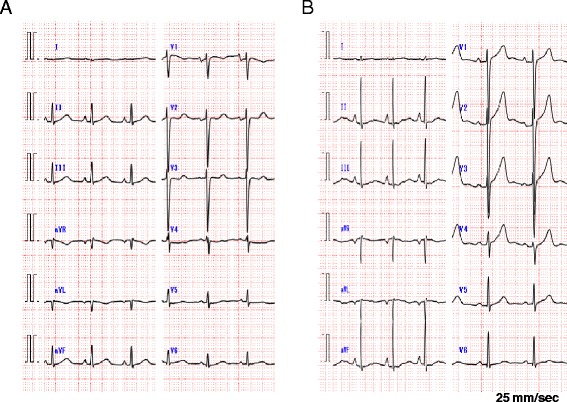
Fig. 1
Fig. 1
Electrocardiogram on admission showed slightly low voltage, poor progression R wave and ST segment depression in leads V4-5 (a). With the exception of the poor progression R wave, all changes were no longer observed by day 27 (b)
Fig. 2
Fig. 2
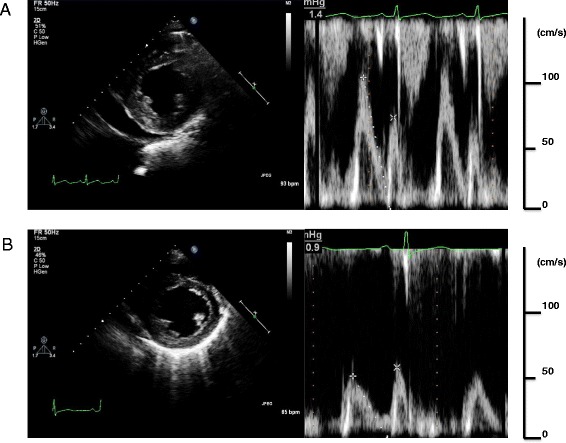
A transthoracic echocardiogram showed a moderate amount of pericardial effusion. A pseudonormal pattern of transmitral flow was observed on administration of thiamine (a). Two days after thiamine administration, pericardial effusion decreased and the mitral Doppler findings showed that constrictive physiology was resolved after thiamine replacement therapy (b)
Fig. 3
Fig. 3
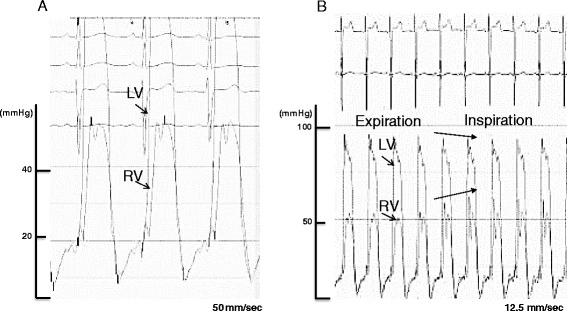
Simultaneous right and left ventricular measurements showed elevated and approximately equal end-diastolic pressures with dip and plateau pattern (a). Paradoxical pulsation was not observer during respiratory change, but respiratory ventricular discordance was seen; Arrows shows increased RV pressure occurred concomitantly with decreased LV pressure decreased during inspiratory phase (b)

References

    1. Attas M, Hanley HG, Stultz D, Jones MR, McAllister RG. Fluminant beriberi heart disease with lactic acidosis: presentation of a case with evaluation of left ventricular function and review of pathophysiologic mechanisms. Circulation. 1978;58:566–72. doi: 10.1161/01.CIR.58.3.566. - DOI - PubMed
    1. Dabar G, Harmouche C, Habr B, Riachi M, Jaber B. Shoshin beriberi in critically-ill patients: case series. Nutr J. 2015;14:51. doi: 10.1186/s12937-015-0039-7. - DOI - PMC - PubMed
    1. Kuno T, Nakamura H, Endo Y, Saito K, Yamazaki H, Motoda H, et al. Clinical history and colliquative myocytolysis are keys to the diagnosis of shoshin beriberi. Case Rep Pathol. 2014;2014:506072. - PMC - PubMed
    1. Hurrell DG, Nishimura RA, Higano ST, Appleton CP, Danielson GK, Holmes DR, Jr, et al. Value of dynamic respiratory changes in left and right ventricular pressures for the diagnosis of constrictive pericarditis. Circulation. 1996;93:2007–13. doi: 10.1161/01.CIR.93.11.2007. - DOI - PubMed
    1. Abelmann WH, Lorell BH. The challenge of cardiomyopathy. J Am Coll Cardiol. 1989;13:1219–39. doi: 10.1016/0735-1097(89)90293-3. - DOI - PubMed

Publication types