


Sustained Effectiveness of Rotavirus Vaccine Against Very Severe Rotavirus Disease Through the Second Year of Life, Bolivia 2013-2014
- PMID: 27059344
- PMCID: PMC9234969
- DOI: 10.1093/cid/civ1026
Sustained Effectiveness of Rotavirus Vaccine Against Very Severe Rotavirus Disease Through the Second Year of Life, Bolivia 2013-2014
Abstract
Background: In Bolivia, monovalent rotavirus vaccine was introduced in 2008 and a previous evaluation reported a vaccine effectiveness (VE) of 77% with 2 doses of vaccine in children aged <3 years. This evaluation sought to determine if rotavirus vaccine provided protection through the second year of life against circulating genotypes.
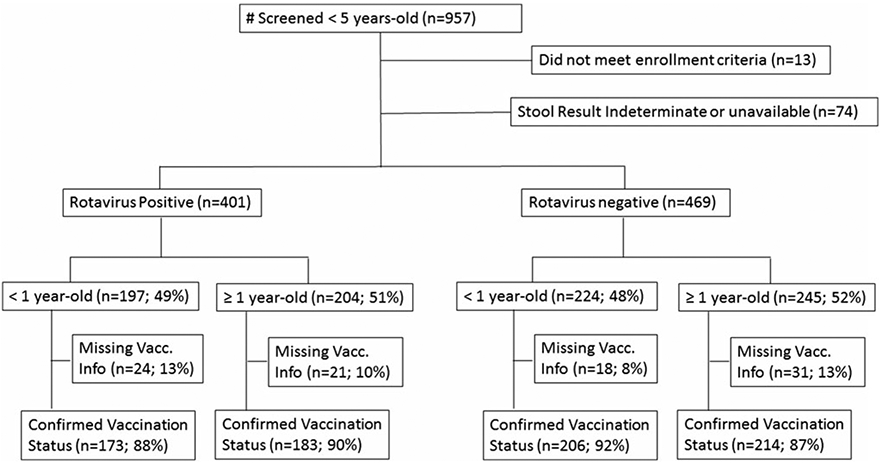
Methods: A case-control study was performed in 5 hospitals from April 2013 to March 2014. Among enrolled participants who met study criteria and had rotavirus stool testing performed and vaccine status confirmed, we calculated VE using a logistic regression model. Subgroup analyses were performed among children aged <1 year and those aged ≥1 year, among children with severe diarrhea (Vesikari score ≥11) and very severe diarrhea (Vesikari score ≥15), and among G and P strains with at least 40 specimens.
Results: A total of 776 children were enrolled. For children <1 year and ≥1 year of age with severe diarrhea, VE for 2 doses was 75% (95% confidence interval [CI], 46%-88%) and 53% (95% CI, 9%-76%), respectively. For children <1 year and ≥1 year of age with very severe diarrhea, VE for 2 doses was 80% (95% CI, 44%-93%) and 74% (95% CI, 35%-90%), respectively. Genotype-specific analysis demonstrated similar VE for the 4 most common G and P types (G3, G9, P[6] and P[8]).
Conclusions: A monovalent rotavirus vaccine remains effective against a broad range of circulating strains as part of a routine immunization program >5 years after its introduction in Bolivia. Although VE appears to wane in children aged ≥1 year, it still provides significant protection, and does not wane against severe disease.
Keywords: childhood mortality; diarrhea; gastroenteritis; middle-income country; rotavirus.
Published by Oxford University Press for the Infectious Diseases Society of America 2016. This work is written by (a) US Government employee(s) and is in the public domain in the US.
Conflict of interest statement
Figures
References
-
- World Health Organization. Immunization, vaccines and biologicals. Available at: http://www.who.int/immunization/diseases/rotavirus/en/. Accessed 29 April 2015.
-
- Patel M, Pedreira C, De Oliveira LH, et al. Association between pentavalent rotavirus vaccine and severe rotavirus diarrhea among children in Nicaragua. JAMA 2009; 301:2243–51. - PubMed
Publication types
MeSH terms
Substances
Grants and funding
LinkOut - more resources
Full Text Sources
Other Literature Sources
Medical
Miscellaneous
