


Geriatric Syndromes in Hospitalized Older Adults Discharged to Skilled Nursing Facilities
- PMID: 27059831
- PMCID: PMC4840035
- DOI: 10.1111/jgs.14035
Geriatric Syndromes in Hospitalized Older Adults Discharged to Skilled Nursing Facilities
Abstract
Objectives: To determine the prevalence, recognition, co-occurrence, and recent onset of geriatric syndromes in individuals transferred from the hospital to a skilled nursing facility (SNF).
Design: Quality improvement project.
Setting: Acute care academic medical center and 23 regional partner SNFs.
Participants: Medicare beneficiaries hospitalized between January 2013 and April 2014 and referred to SNFs (N = 686).
Measurements: Project staff measured nine geriatric syndromes: weight loss, lack of appetite, incontinence, and pain (standardized interview); depression (Geriatric Depression Scale); delirium (Brief Confusion Assessment Method); cognitive impairment (Brief Interview for Mental Status); and falls and pressure ulcers (hospital medical record using hospital-implemented screening tools). Estimated prevalence, new-onset prevalence, and common coexisting clusters were determined. The extent to which treating physicians commonly recognized syndromes and communicated them to SNFs in hospital discharge documentation was evaluated.
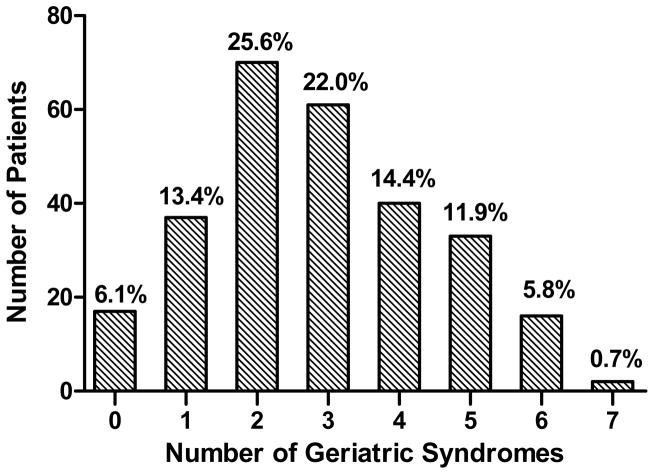
Results: Geriatric syndromes were prevalent in more than 90% of hospitalized adults referred to SNFs; 55% met criteria for three or more coexisting syndromes. The most-prevalent syndromes were falls (39%), incontinence (39%), loss of appetite (37%), and weight loss (33%). In individuals who met criteria for three or more syndromes, the most common triad clusters were nutritional syndromes (weight loss, loss of appetite), incontinence, and depression. Treating hospital physicians commonly did not recognize and document geriatric syndromes in discharge summaries, missing 33% to 95% of syndromes present according to research personnel.
Conclusion: Geriatric syndromes in hospitalized older adults transferred to SNFs are prevalent and commonly coexist, with the most frequent clusters including nutritional syndromes, depression, and incontinence. Despite the high prevalence, this clinical information is rarely communicated to SNFs on discharge.
Keywords: care transitions; geriatric syndromes; older adults; skilled nursing facility.
© 2016, Copyright the Authors Journal compilation © 2016, The American Geriatrics Society.
Conflict of interest statement
Figures
Comment in
-
Re: Geriatric Syndromes in Hospitalized Older Adults Discharged to Skilled Nursing Facilities.J Urol. 2017 Sep;198(3):462. doi: 10.1016/j.juro.2017.06.059. Epub 2017 Jun 20. J Urol. 2017. PMID: 28817876 No abstract available.
References
-
- Tinetti ME, Inouye SK, Gill TM, et al. Shared risk factors for falls, incontinence, and functional dependence. Unifying the approach to geriatric syndromes. JAMA. 1995;273:1348–1353. - PubMed
-
- Anpalahan M, Gibson SJ. Geriatric syndromes as predictors of adverse outcomes of hospitalization. Intern Med J. 2008;38:16–23. - PubMed
-
- Lee PG, Cigolle C, Blaum C. The co-occurrence of chronic diseases and geriatric syndromes: The health and retirement study. J Am Geriatr Soc. 2009;57:511–516. - PubMed
Publication types
MeSH terms
Grants and funding
LinkOut - more resources
Full Text Sources
Other Literature Sources
Miscellaneous
