Clinical workload in UK primary care: a retrospective analysis of 100 million consultations in England, 2007-14
- PMID: 27059888
- PMCID: PMC4899422
- DOI: 10.1016/S0140-6736(16)00620-6
Clinical workload in UK primary care: a retrospective analysis of 100 million consultations in England, 2007-14
Erratum in
-
Department of Error.Lancet. 2016 Jun 4;387(10035):2292. doi: 10.1016/S0140-6736(16)30692-4. Lancet. 2016. PMID: 27302268 Free PMC article. No abstract available.
Abstract
Background: Primary care is the main source of health care in many health systems, including the UK National Health Service (NHS), but few objective data exist for the volume and nature of primary care activity. With rising concerns that NHS primary care workload has increased substantially, we aimed to assess the direct clinical workload of general practitioners (GPs) and practice nurses in primary care in the UK.
Methods: We did a retrospective analysis of GP and nurse consultations of non-temporary patients registered at 398 English general practices between April, 2007, and March, 2014. We used data from electronic health records routinely entered in the Clinical Practice Research Datalink, and linked CPRD data to national datasets. Trends in age-standardised and sex-standardised consultation rates were modelled with joinpoint regression analysis.
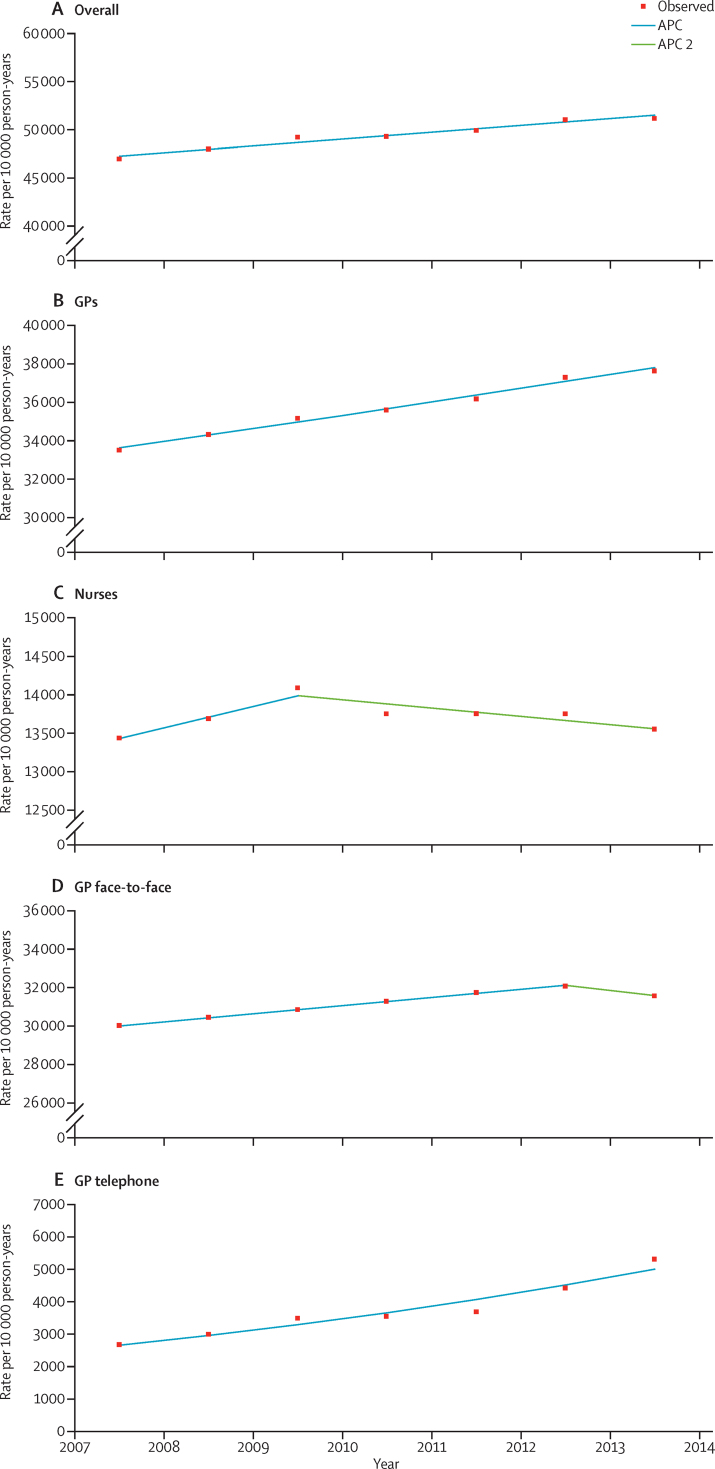
Findings: The dataset comprised 101,818,352 consultations and 20,626,297 person-years of observation. The crude annual consultation rate per person increased by 10·51%, from 4·67 in 2007-08, to 5·16 in 2013-14. Consultation rates were highest in infants (age 0-4 years) and elderly people (≥85 years), and were higher for female patients than for male patients of all ages. The greatest increases in age-standardised and sex-standardised rates were in GPs, with a rise of 12·36% per 10,000 person-years, compared with 0·9% for practice nurses. GP telephone consultation rates doubled, compared with a 5·20% rise in surgery consultations, which accounted for 90% of all consultations. The mean duration of GP surgery consultations increased by 6·7%, from 8·65 min (95% CI 8·64-8·65) to 9·22 min (9·22-9·23), and overall workload increased by 16%.
Interpretation: Our findings show a substantial increase in practice consultation rates, average consultation duration, and total patient-facing clinical workload in English general practice. These results suggest that English primary care as currently delivered could be reaching saturation point. Notably, our data only explore direct clinical workload and not indirect activities and professional duties, which have probably also increased. This and additional research questions, including the outcomes of workload changes on other sectors of health care, need urgent answers for primary care provision internationally.
Funding: Department of Health Policy Research Programme.
Copyright © 2016 Hobbs et al. Open Access article distributed under the terms of CC BY. Published by Elsevier Ltd.. All rights reserved.
Figures
Comment in
-
Increases in general practice workload in England.Lancet. 2016 Jun 4;387(10035):2270-2272. doi: 10.1016/S0140-6736(16)00743-1. Epub 2016 Apr 5. Lancet. 2016. PMID: 27059885 No abstract available.
References
-
- McCormick A, Fleming D, Charlton J. Morbidity statistics from general practice: fourth national study 1991–1992. HMSO; London: 1995.
-
- Hippisley-Cox J, Vinogradova Y. Trends in consultation rates in general practice 1995/1996 to 2008/2009: analysis of the QResearch® database. Sept, 2009. http://www.hscic.gov.uk/catalogue/PUB01077/tren-cons-rate-gene-prac-95-0... (accessed Sept 4, 2015).
-
- Office for National Statistics . General household survey 2007. Office for National statistics; Newport: 2009.
-
- Gibson J, Checkland K, Coleman A. Eighth national GP worklife survey report. http://www.population-health.manchester.ac.uk/healtheconomics/research/R... (accessed Feb 11, 2016).
Publication types
MeSH terms
Grants and funding
LinkOut - more resources
Full Text Sources
Other Literature Sources
Miscellaneous